
$1 Billion Hits the Streets to Fund Canadian Modular Rapid Housing Initiative
For the past two years, MBI and our members have been working with the Canadian Mortgage Housing Corporation (CMHC) to open up opportunities for modular social housing projects in Canada. The challenge, according to CMHC, is that “modular does not fit our traditional underwriting and financing profile.”
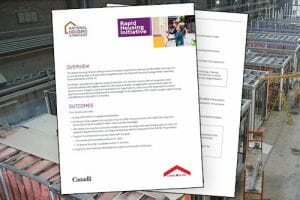
MBI has been able to work with CMHC to develop new underwriting guidelines specific to modular projects. Based on a late-October call with CMHC, those guidelines are expected to be available and in force by the end of 2020. But the bigger news for the industry is the recent announcement by CMHC about their “Rapid Housing Initiative (RHI).”
The Government of Canada, through CMHC, has launched the RHI as a $1 billion program utilizing only modular construction to help address urgent housing needs of vulnerable Canadians, especially in the context of COVID-19, through the rapid construction of affordable housing. The initiative provides capital contributions (upon signing a funding agreement with CMHC) under two streams to expedite the delivery of affordable housing.
The RHI will:
- Support the creation of up to 3,000 new permanent affordable housing units.
- Cover the construction of modular housing, as well as the acquisition of land, and the conversion/rehabilitation of existing buildings to affordable housing.
- Aim to commit all funds before March 31, 2021, and ensure housing is available within 12 months of agreements.
Applications for projects must be submitted by cities in partnership with a developer/builder by December 31, 2020.
RHI will deliver funding under two streams, each containing $500 million in available funds. Under the first stream, RHI will expedite funds to pre-identified municipalities with the highest level of renters in severe housing need and people experiencing homelessness. For the second stream, an application portal will be open to municipalities, provinces and territories, Indigenous governing bodies and organizations, and non-profit organizations where applications will be prioritized based on the strength of the application.
MBI has put together a directory of Canadian manufacturers for the express purpose of helping decision-makers locate qualified modular companies with whom to partner.
MBI is also reaching out directly to the pre-identified municipalities to offer resources and assistance to help ensure these modular projects are successful. If you are interested in participating in this housing initiative, please visit this page for more details: https://www.cmhc-schl.gc.ca/en/nhs/rapid-housing-initiative
MBI has identified the multifamily, social/affordable housing sector as one of the greatest growth opportunities for the industry. This work with CMHC dovetails with the recently completed work MBI did with Fannie Mae in the development of their Multifamily Modular Construction Toolkit.
Special thanks to MBI member Joseph Kiss of Horizon North for his assistance on this effort.
More from Modular Advantage
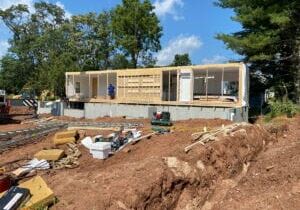
AoRa Development Aims for New York’s First Triple Net Zero Building Using Modular Methods
More cities are providing funding for newer infrastructure projects as long as they meet sustainability requirements. This is how modular can fit the bill, thanks to its lower waste production.
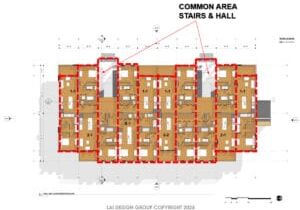
Developers and Designers: Lessons Learned with Modular Design
Modular construction is attractive to many developers because sitework and module construction can occur simultaneously, shortening the schedule and reducing additional costs.
UTILE: Putting Modular Building on a Fast Track
In Quebec, UTILE is taking the lead in creating affordable modular buildings to help decrease the student housing shortage. During the process, the company discovered what it takes to make the transition to modular building a success.

Sobha Modular Teaches Developers How to Think Like Manufacturers
With its 2.7 million square foot factory in UAE, Sobha Modular is bringing both its high-end bathroom pods to high-end residences to Dubai while developing modular projects for the U.S. and Australia.
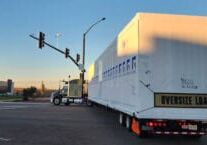
RoadMasters: Why Early Transport Planning is Make-or-Break in Modular Construction
In modular construction, transportation is often called the “missing link.” While it rarely stops a project outright, poor planning can trigger costly delays, rerouting, and budget overruns.
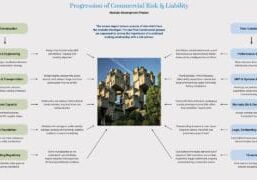
Navigating Risk in Commercial Real Estate and Modular Construction: Insights from a 44-Year Industry Veteran
Modular projects involve manufacturing, transportation, and on-site assembly. Developers must understand exactly what they are responsible for versus what they subcontract. Risk advisors should research the developer’s contractors, subcontractors, and design-build consultants—especially the modular manufacturer.
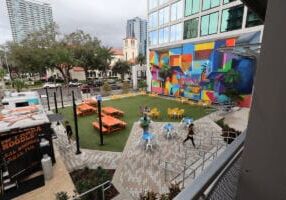
Art²Park – A Creative Application of Modular and Conventional Construction
Art²Park is more than a park building—it’s a demonstration of what modular construction can achieve when thoughtfully integrated with traditional materials. The use of shipping containers provided not only speed and sustainability benefits but also a powerful structural core that simplified and strengthened the rest of the building.
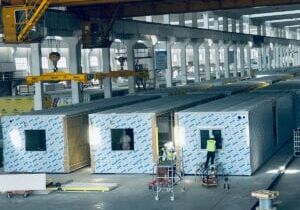
Building Smarter: A New Standard in Modular Construction Efficiency
Rising material prices, labour shortages, expensive financing and tightening environmental rules have made conventional construction slower, costlier, and more unpredictable. To keep projects on schedule and within budget, builders are increasingly turning to smarter industrialized methods.
Resia: Breaking All the Rules
Resia Manufacturing, a division of U.S.-based Resia, is now offering prefabricated bathroom and kitchen components to industry partners. Its hybrid fabrication facility produces more precise bathroom and kitchen components (modules) faster and at lower cost than traditional construction. Here’s how Resia Manufacturing does it.
How LINQ Modular Innovates to Bring Modular To The Market in the UAE and Beyond
LINQ Modular, with an office and three manufacturing facilities in Dubai, is a modular firm based in United Arab Emirates. The company is on a mission: to break open the housing and construction markets in the Gulf Cooperation Council (GCC) area with modular.