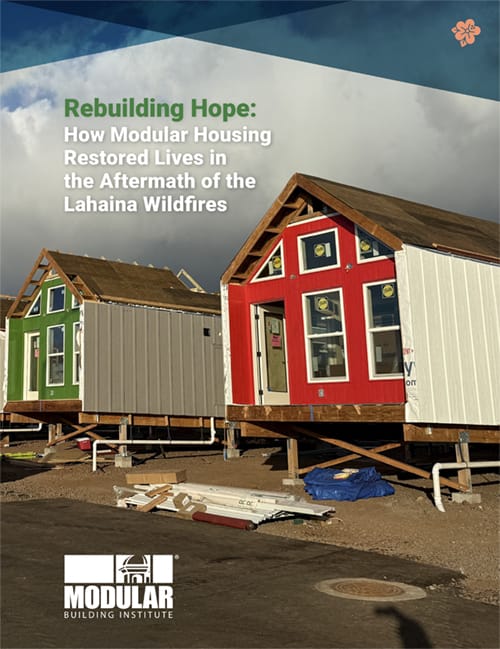
Rebuilding Hope: How Modular Housing Restored Lives in the Aftermath of the Lahaina Wildfires
In the early hours of August 8, 2023, a brush fire near Lahaina, Hawaii, sparked under the dry, volatile conditions of Hawaii’s peak fire season.
Fueled by severe drought and high winds from Hurricane Dora’s distant passage, the fire rapidly spread across Maui, catching residents off guard. Within hours, Lahaina—a historic coastal town home to over 12,000 people—was overwhelmed.
Downed power lines severed communications, road closures blocked escape routes, and depleted water systems left firefighters with insufficient resources to battle the blaze. By the next day, much of Lahaina had been reduced to ashes. Nearly 12,000 residents were displaced, 102 lives were lost, and more than 2,200 homes were destroyed, compounding the island’s existing housing challenges. Amidst the devastation stood the charred but resilient 150-year-old Banyan Tree, a poignant symbol of hope for the community.
In response to this unprecedented disaster—one of the deadliest fires in modern U.S. history—state and federal governments launched a coordinated recovery effort. Part of that effort involved a coalition of MBI members who worked together with the state of Hawaii to create over 100 permanent modular houses for displaced residents of Lahaina. Remarkably, these modular homes were built, barged to Maui, and set within weeks of the project kickoff, again proving the speed and efficiency of modular construction.
Learn how modular construction benefitted the residents of Lahaina—and how the industry can help respond to future disasters—in this detailed case study.
WITH SPECIAL THANKS TO


“They didn’t understand modular construction," said Jon Hannah-Spacagna, MBI's Director of Government Affairs, "so I began working with them to provide the basics—explaining that modular construction is built to the same building codes as site-built structures, its capabilities, and how to write a modular-specific Request for Proposal.”
Understanding the Stafford Act
The Robert T. Stafford Disaster Relief and Emergency Assistance Act, which was enacted in 1988 to provide federal assistance for disasters. The act enables financial and physical assistance, coordinates government-wide relief efforts, and allows federal agencies to provide disaster aid. However, the Stafford Act also includes a clause that enables states like Hawaii to decline traditional HUD trailers in favor of alternative housing solutions.
“The Hawaiian people not only wanted housing that was long-lasting, but they also wanted housing that looks like it belongs on the island and fits the environment," said Hannah-Spacagna. "These homes will be fixtures on the island for years to come, unlike in the continental U.S., where temporary housing can be easily removed after serving its purpose.”
From Factory to Maui: A Modular Housing Solution
Fading West and Guerdon were two of three contractors to build modular homes for Lahaina’s recovery. Together, they built over 100 units. These included one-bedroom, two-bedroom, and three-bedroom homes, ranging from 490 to 980 square feet, all built on temporary foundations for future relocation.
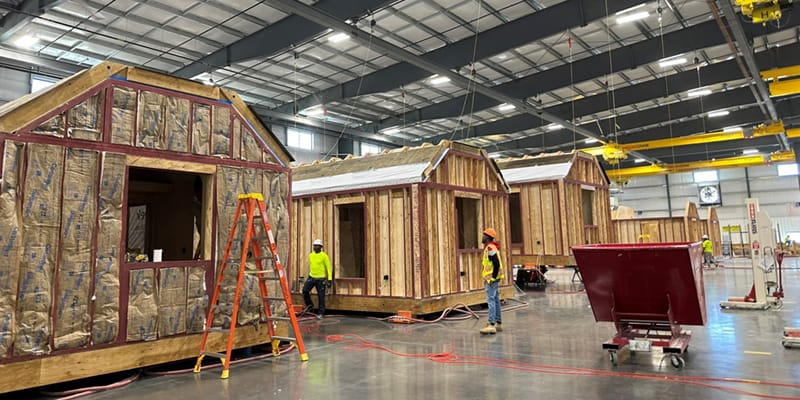
“Our factory is 110,000 square feet, set up like a Toyota lean car factory with two workstations,” explained Eric Schaefer, Chief Business Development Officer of Fading West. “Twenty houses are in the factory at any given time at different levels of completion, moving to a new station every four hours. It takes about seven or eight days to finish a house.”
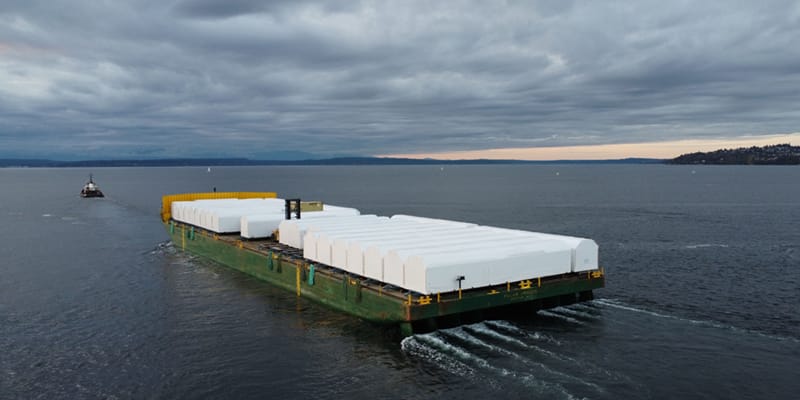
“Materials arrived at the factory, and within 14 calendar days, we had units on a barge headed to Maui,” said Tommy Rakes, CEO of Guerdon.“It was an incredible pace.”
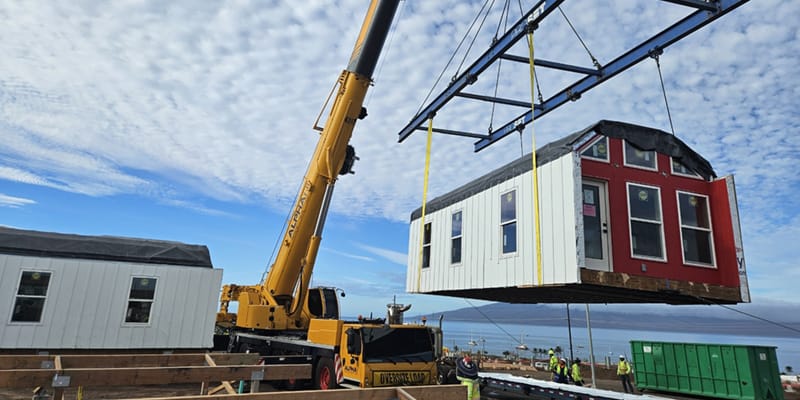
“In a lot of ways, this project is a great example of the extreme benefits of modular construction because of the pre-existing conditions before the fires,” . explained Scott Bridger, Principal at ProSet Modular.“The nature of the acute [housing needs] in Lahaina was just begging for modular in a lot of ways.”
The Case for Modular as a Long-Term Housing Solution
Hawaii’s unique geographic challenges as an island underscore the need for innovative solutions, but the larger question remains: Why not apply this approach everywhere? Hannah-Spacagna elaborates, “If a modular home could be built for the same cost or less than a HUD trailer—$180,000—you could have a structure built to the regular building codes of the area. That makes it suitable for long-term use, addressing both the affordable housing crisis and homelessness. Maui is the perfect example to show that this is possible.”
Schaefer echoed this, urging decision-makers to consider the financial and functional advantages of modular housing over traditional disaster relief options. “If a project like this costs $200 million, but the purchased housing is only going to last for three years before they’re thrown out—you do the math, right?” he said. “But, if the housing is well-built and to an international code with the same level of quality as a stick-built home, it could be repurposed and even sold after it has filled a community’s need post-disaster, allowing [the government] to make its money back.”
“If FEMA had a library of pre-approved modular plans, we could start production within 7 to 10 days of a natural disaster,” said Rakes. “These homes could be shipped anywhere in the continental U.S. in 3 to 5 days, installed, and occupied within a day. In under three weeks, displaced victims could have permanent homes.”
By embracing modular construction as both a short-term and long-term solution, Lahaina’s recovery provides a transformative blueprint for disaster relief and housing innovation. It’s a model that not only responds to crises but also proactively addresses the larger issue of housing affordability—a challenge that communities across the country and around the world continue to face.
Download the Complete Disaster Recovery & Rebuilding Case Study
Overall, this project proved that when innovation, efficiency, and empathy come together, the impossible becomes achievable. Lahaina’s recovery serves as a beacon for how modular housing can redefine what it means to rebuild—not just with speed, but with purpose.
To learn more about this project, the roles and contributions of its stakeholders, and the possibilities of modular construction to help with future disaster recovery and rebuilding efforts, download the complete case study below.
Explore More Modular Building Case Studies
Vertical Integration: Stacking Cleanroom Performance and Storage
The challenge: build a high-performing ISO 8 cleanroom without sacrificing the square footage needed for daily tools, storage, and maintenance operations.
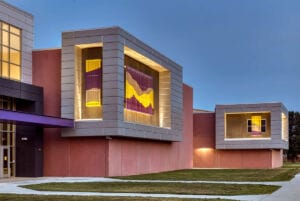
Painted, Perforated Panels Provide School with Pulled-Together Polish
The Williamsville-Sherman Community Unit School District No. 15 serves students from its namesake villages on the outskirts of Springfield, IL. To bring life to two school buildings, bright school colors were applied2,200 sq. ft. of PAC-CLAD 7.2 Perforated Corrugated panels.
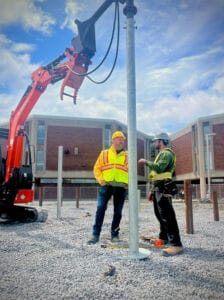
Du Moulin School
When the Lanaudière school board approved a new modular expansion for Du Moulin School, the expectations were clear: The project needed a foundation system that could match the pace of modular construction while delivering absolute confidence in weak ground.
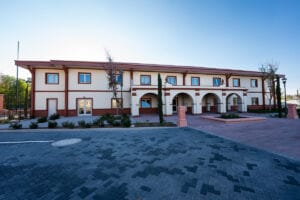
Housing Without Borders: Go Global with Haskell Modular Solutions
With the capacity to service over 15 diverse markets across multiple continents, Haskell is the reliable choice for our 80% repeat client base no matter how their needs evolve. So, when a longstanding client—typically known for their large-scale, institutional buildings—engaged Haskell with a very different need—multinational
housing projects—Haskell knew exactly what approach to take.
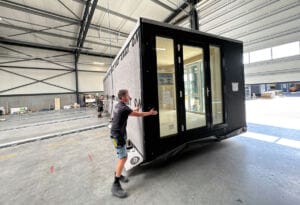
Flexible Air Caster Solution Boosts Output in a Growing Modular Factory
With Aerofilm Systems’ flexible internal transport system, Maat Feeling Home increased production capacity from 300–400 modules per year to 500–600 modules per year, without expanding the factory footprint.
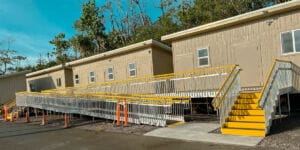
Reimagining Temporary Infrastructure: Hilo Wastewater Treatment Plant Project
Nan Inc. required an access system that mirrored the benefits of the modular buildings themselves: pre-engineered, scalable, and rapidly deployable. The chosen solution was RightWay Pro, a modular walkway, stair, and ramp system engineered for rapid deployment and long-term durability.
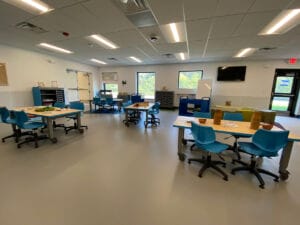
Modular Childcare for One Client in Two Locations
Despite their differences, both facilities share a common program and design intent. Each includes classrooms, a Movement Matters studio, a STEAM-focused learning lab, and a fully electric commercial kitchen.
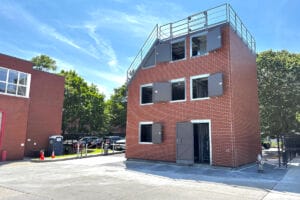
Cambridge Fire Department
The new facility provides firefighters with a durable and realistic training environment while showcasing how modular construction can deliver innovative solutions in urban settings.
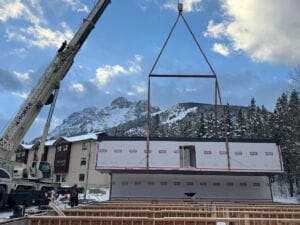
Pomeroy Employee Housing
The Pomeroy Lodging Employee Housing complex in Kananaskis, AB, is a 24,194 sq. ft., three-story structure with 57 studio units and a communal main-level area, designed for full-time employees and comprised of 36 prefabricated modules.