AoRa Development Aims for New York's First Triple Net Zero Building Using Modular Methods
It started with a few brownstones in Brooklyn for Aundre Oldacre, before it quickly turned into a burgeoning and future-facing real estate business.
Aundre Oldacre, now the founder and CEO of AoRa Development in New York City, went to Cornell and Columbia to build his understanding of “real estate development, digging into property management, asset management, underwriting, quantity takeoffs” and more.
While taking these classes, Aundre continued networking to expand his business outside, leading him to his current efforts running AoRa Development.
After attending a series of real estate events—including a series of events hosted by MBI—he met his current partner Robert Allen, a 65-year-old Cornell engineer with 25 years of construction experience. Robert was working on renovations across all of New York City from the ground up.
“He did all these shopping centers, renovations, synagogues,” said Aundre. “He’s done everything from single family homes all the way to a billion dollar hospital.”
With a keen eye in bringing the developer point of view to construction, Aundre was asked to join the Off-Site Construction Council. He eventually became chair, heading the organization from 2021 to 2023.
It was during this time that he was convinced of the flexibility and power of modular construction.
“I saw that modular is a great opportunity, especially in high price markets like New York City for construction change to happen,” he said.
Know When to Use Modular Construction
Aundre cites three main reasons for AoRa Development’s embrace of modular: labor prices, sustainability initiatives, and holding costs.
In the Big Apple, one of the main considerations is labor, both in terms of cost and time.
“Labor costs are through the roof and there’s labor shortages going on throughout the country, but you see it more here than you see it in other places,” Aundre said. “The great thing about modular is it’s exempt from prevailing wage if you build it off-site, and that’s a huge advantage because prevailing wage adds a 20 percent cost to your labor costs, which is already sky high.”
When factoring in off-site fabrication, labor costs for modular become far lower because of time spent, says Aundre. Stick-built construction by nature is not 100 percent productive, which can result in time and money wasted on-site.
“If you look at the people who have done waste studies on how much they’re actually working versus not in traditional construction, it’s pretty low,” he said.
And the numbers reflect this.
According to a study presented at the Annual Conference for International Group for Lean Construction in 2021, workers are spending only about 43.6 percent directly working. In dollars, this equals to about $30 to $40 billion lost annually across the construction industry in the U.S., according to a 2023 labor productivity study from FMI.
By contrast, Aundre says that “modular is very efficient. It’s an assembly line product, just like car manufacturing.”
And if you go an hour outside of New York City, the labor rates might be half or a third in Pennsylvania, and then overseas it could be a fifth of the cost.”
Meeting a City’s Sustainability Needs with Modular
Secondly, more cities are providing funding for newer infrastructure projects as long as they meet sustainability requirements. This is how modular can fit the bill, thanks to its lower waste production.
With modular factories producing “less than five percent waste, you’re actually spending less on materials,” said Aundre. A UK university study states that modular construction can emit up to 45 percent less carbon than traditional construction, which can yield dividends in the long run.
“You are more ESG friendly, you’re going to have a tighter building in the long run, lower operating expenditures, and lower operating costs because [you’re] building to net zero.”
And in practical terms, Aundre looks at net zero to bet against inflation, especially during a time when energy costs are rising across the city.
“Your building envelope is tighter, the insulation is better, your operation expenses are going to be much lower, with a modular building versus a traditional building that’s built on-site,” he said. “You can get to LEED and Passive House much easier. They can do third party inspections in the factory and get you your certifications quicker. So controlling your environment allows you to build tighter building envelopes and more sustainable projects inherently.”
Lastly, the holding costs associated with stick-built construction can mean a delay in return on investment, which is a critical metric of success for developers.
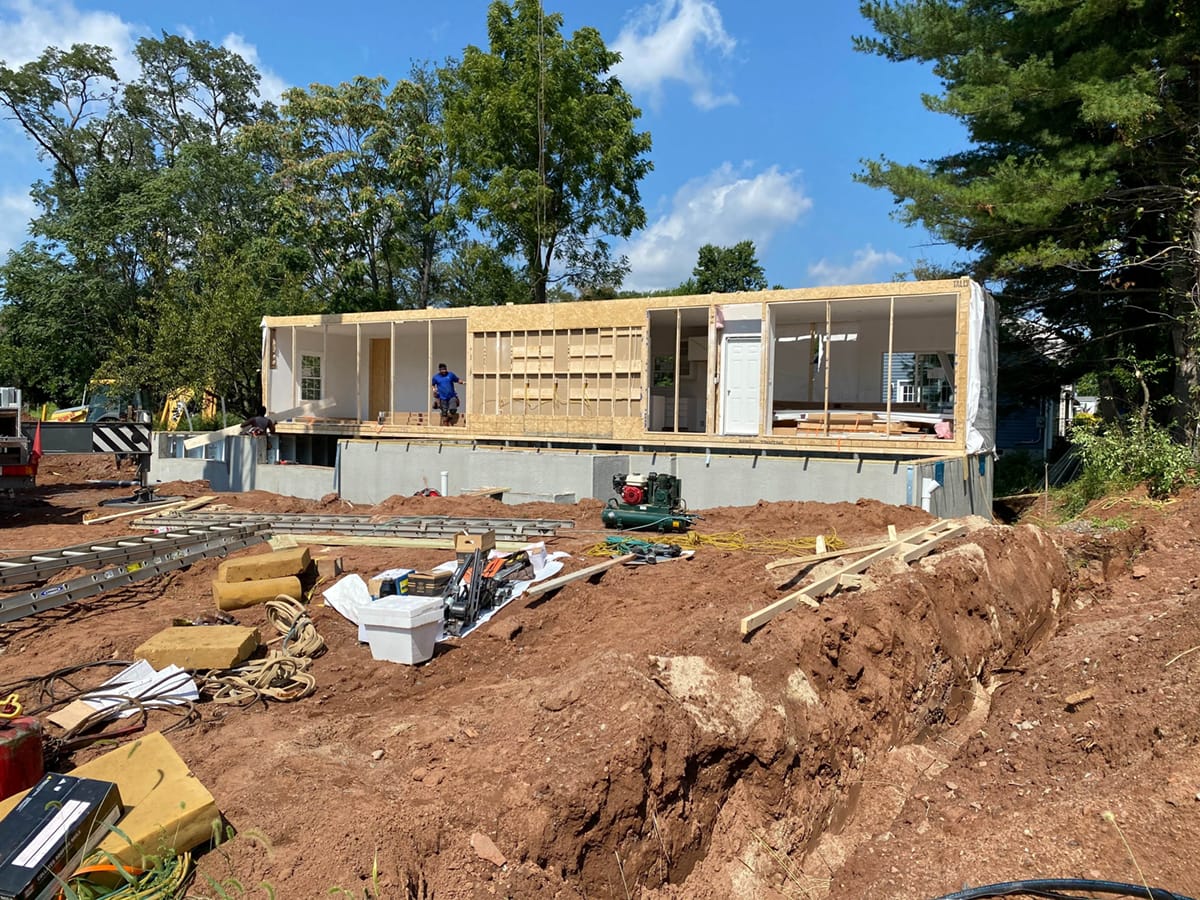
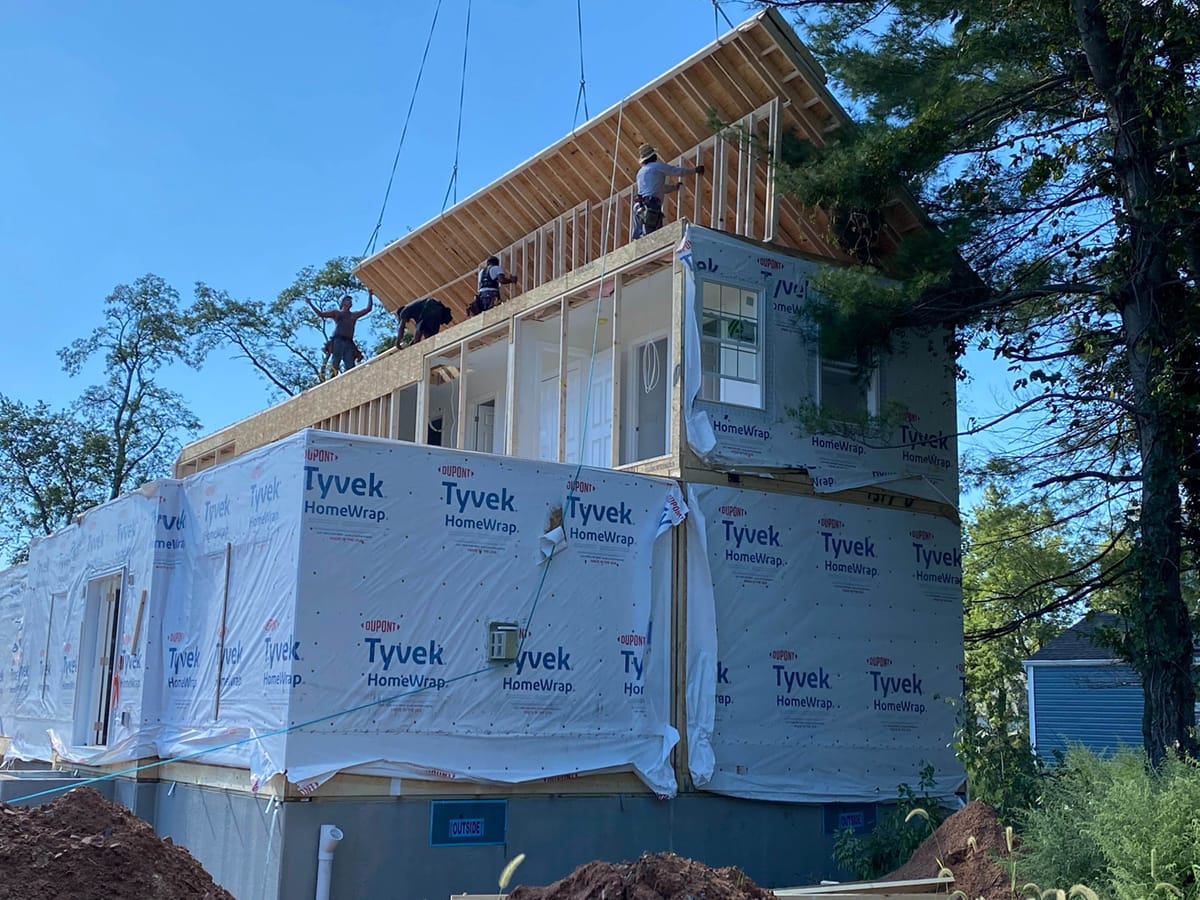
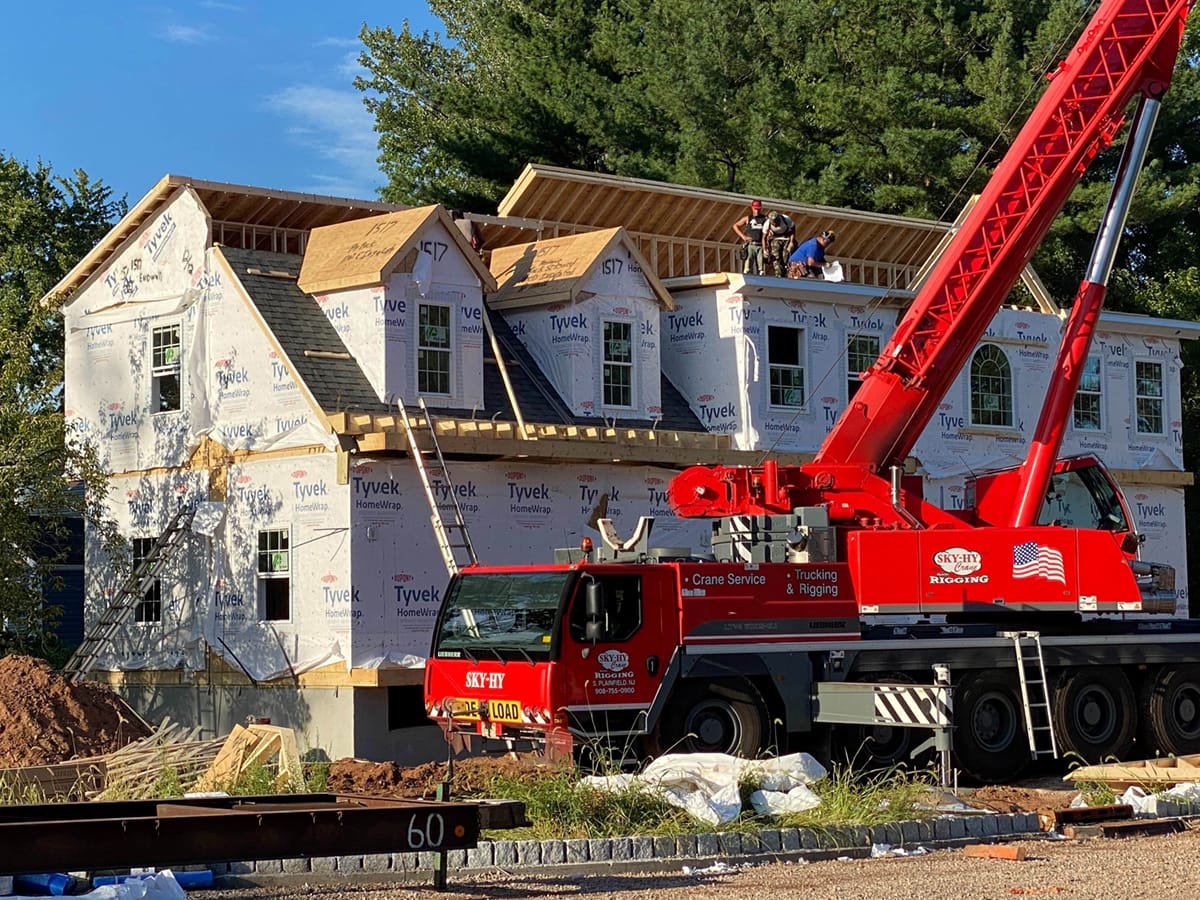
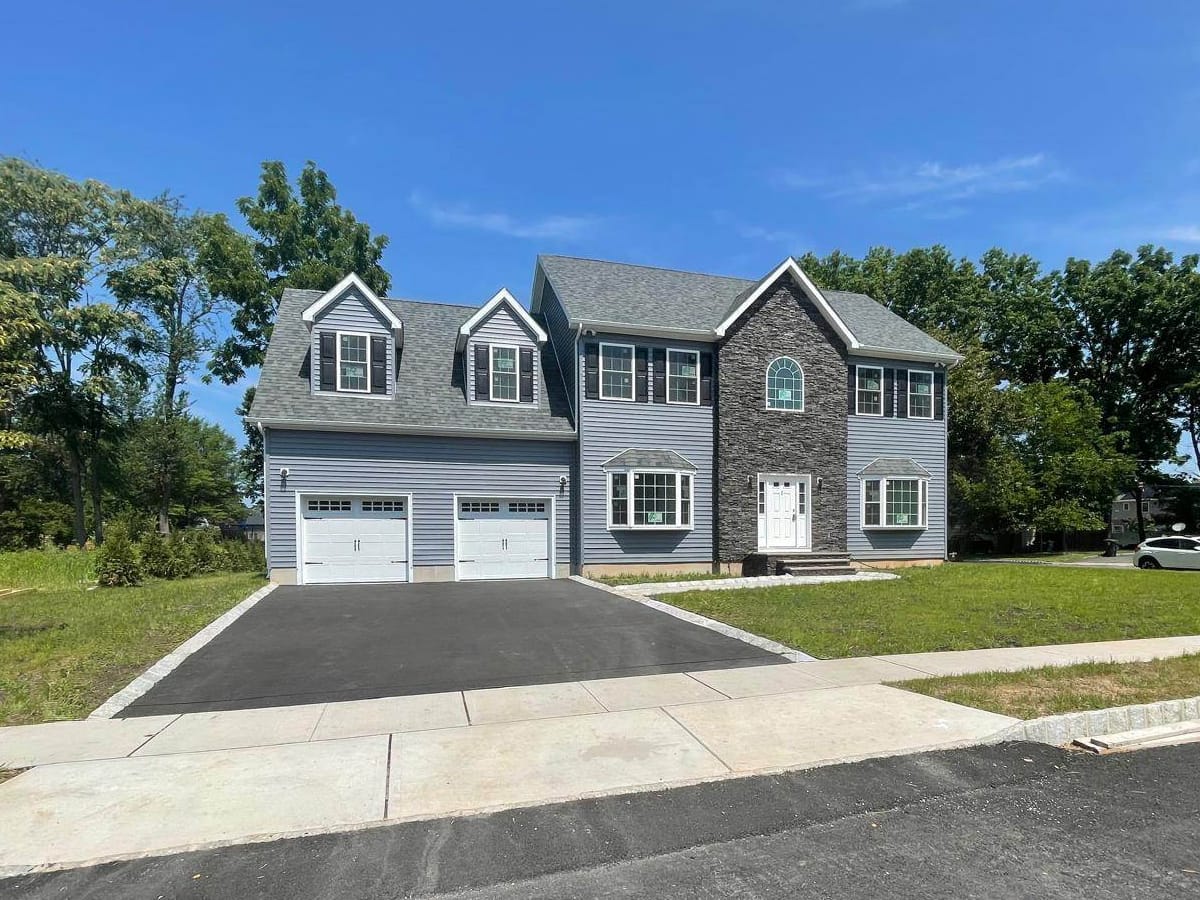
One of AoRa Development’s residential projects. Neighbors were in awe seeing the house delivered and set in five hours.
“Holding cost is a big thing, especially when you have a construction loan and bridge loan,” he said. “That could be a variable if you can get to stabilization quicker, meaning either if it is for sale like the houses were. If you can get to stabilization quicker, one, you have less holding costs and interest that you’re paying out but two, you’re collecting rent quicker.”
For Aundre and his company AoRa Development, this was made plainly clear when they started their first modular project.
AoRa’s Foray Into Modular
AoRa’s first modular development involved building four single family homes in South Plainfield, New Jersey. Though they had some delays due to COVID, the time spent was far less than initially expected.
“We built it with a Pennsylvania modular company and used Superior Walls, which [provided] 2D panelization of foundation walls,” he said. “And then we used MSI [for the] modular steel building systems [to construct] the modular units. And it was amazing to actually see buildings go up in four hours stacking four different boxes for a two-story building. Neighbors were amazed that one minute they had a foundation and then in less than a day, they had a fully erect structure with a rooftop.”
The First Triple Net Zero Project for NY
Currently, AoRa Development is in the midst of creating a mixed-use building center in Mount Vernon, just on the border of the Bronx in New York City. The project is located in a TOD, or transit development zone, with Metro-North trains providing service to Manhattan and beyond. What started off as a smaller development has evolved into a 15-floor building and includes more than what was originally planned.
Originally starting off in 2019, Aundre was already impressed with the potential for the TOD zone.
“They were putting together an assemblage of parcels that you could go and build 189 units. At that point, I was looking at knocking my building down in Brooklyn and doing 24 units. I had never heard of a developer doing so many looking at such a large project in a development.”
After meeting with Robert, they decided to collaborate on the Mount Vernon project.
“We started working on this project and it was 1.2 million square feet [with] 747 units and 220,000 square feet of retail,” said Aundre. “We found a much bigger project than he even had.”
AoRa Development aims to use a mix of 2D panelization and 3D volumetric modular design alongside a kit of parts to both renovate and build new projects.
“We’re going to price out both for our Mount Vernon project, [as] we’re looking to build the first triple net zero building in the world, meaning zero water, zero waste, zero energy,” he said.
AoRa’s full embrace of sustainability led Aundre to a nomination for an Energy New York Award (ENYA) in 2025 from the New York Energy Consumer Council.
Using AI, Automation, and BIM to Bring Modular Up To Speed
As the development firm looks to modular to pave a path toward the future, there are still plenty of opportunities for developers and modular factories to improve, says Aundre.
“The fact still remains that modular is in the third inning of where it could be,” he said. “I say that because there’s so many advancements that we could be leaning on from the car industry and advanced robotics...A lot of the companies now are using BIM technology, but they’re not using the full extent of it. They could be using AI and automation more. We’re still in the early stages.”
There is also the issue of modular companies staying in business. Aundre says external factors like market and financial rate changes can determine whether or not a project can be finished, as modular companies can be stuck scheduling the fabrication of said projects while waiting for finances to clear.
“It only takes one or two failed projects that they weren’t able to reschedule another project in its place and then the modular factory goes belly up,” he said. “We need more well-capitalized modular companies with direct deals with cities. If we can figure out the scheduling problem [then] modular can take off, because the scheduling kills when factories go dormant.”
About the Author: Karen P. Rivera is a freelance writer and editor with a passion for storytelling. She is a former United Nations-based reporter, with experience covering international breaking news, venture capital, emerging healthcare tech, and the video game industry.
More from Modular Advantage
MBI Town Halls 2026: Reflections from Boston
By the end of 2026 MBI’s Government Affairs team will have traveled over 6,000 air miles to bring Town Hall events to five different cities in two countries.
Mind the Gap: The Interface Between Onsite and Offsite Construction
Every design for manufacture and assembly (DfMA) project — modular, mass timber, or panelized — is really two projects joined at a seam. One is built in a controlled factory to millimeter tolerances; the other in the field, in weather, to the looser tolerances of poured concrete and human hands. Between them sits an interface: where the factory’s precision meets the site’s reality.
Rules, Rails & Repeatability: Applying DfMA to Modular Healthcare
DfMA offers several advantages for healthcare projects, with faster delivery among the most valuable. Schedule matters when building new facilities, expanding campuses, renovating existing space or bringing care closer to communities that need it.
Precision and Possibility: Demands of DfMA and What Modular Mass Timber Makes Possible
Mass timber does not automatically create an efficient modular building. Its precision makes early coordination more important: fabricated components will accurately reproduce both the team’s solutions and its mistakes. The material’s advantages are realized only when supported by an equally precise design and delivery process.
Catch It in the Factory, Not in the Field: Smarter Testing for Modular Builds
Integrating watertightness and airtightness testing into factory workflows transforms quality assurance from a reactive process into a proactive commissioning strategy. It ensures that every module shipped is field ready and resilient for transportation while also supporting the ability of the modular construction industry to make buildings better.
Modular Construction Contracts: Key Considerations for Successful Canadian Projects
Starting a modular project with a well-developed contract protects both the owner and the contractor. It will help keep the project on track and on budget, and it will improve quality from the factory floor to final installation on-site.
Modular by Design: Turning Architecture into a Manufacturing System
Modular construction is often presented as a faster way to build. Speed, however, is only one part of its value. The larger opportunity is to create a coordinated design and production system that improves quality, reduces uncertainty, and allows a building to move efficiently from concept design through manufacturing, transportation, installation, and completion.
Repeatability Begins with Trust: What Alora at Dry Creek Reveals About Scaling Modular Housing
Alora at Dry Creek, a 329-unit, multifamily community comprising five four-story buildings in Centennial, Colorado, demonstrates how repeatable design, standardized manufacturing and early collaboration can work together to create a model that is not only faster to deliver, but easier to replicate across future projects.

T.R. Arnold: The Art of Third-Party Inspections
T.R. Arnold (TRA), a third-party inspection company in Elkhart, Indiana, contracts with modular manufacturers across the US. Manufacturers register with each state to which they intend to send their modules and may be required to hire a third-party inspection company.
Creating an ‘Ecosystem for Innovation:’ 50+ Years of Modular Construction Oversight in Virginia
Virginia’s modular building program began in 1973, with the implementation of the Virginia Industrialized Building Unit and Mobile Home Safety Regulations. Now it’s leading the country in modular code adoption.