Developers and Designers: Lessons Learned with Modular Design
The tagline for Colorado design firm LAI Design Group is “Designers that think like developers.” It’s ideally suited to founder Ken Puncerelli’s background. “I'm not just a designer,” he said. “I see projects through the lens of a developer, if they could design.”
With over 30 years of experience in construction and design, Puncerelli has worked in the field and holds four degrees in architecture, landscape architecture, finance, and business. He started LAI in 1996, and his first foray into modular design came in 2003, when Guerdon founder Lad Dawson approached him with a workforce housing project in the mountains of Colorado.
After completing site planning for the residential development, he began to wonder why more homebuilders weren’t using modular for their projects. “It seemed like an efficient way to do repetitive production design while still achieving meaningful architecture for people to live in,” he said.
Now with over two decades of modular design experience under his belt and his business and finance background, he offers sage advice for developers and design teams, whether they’re just starting or have decades of experience.
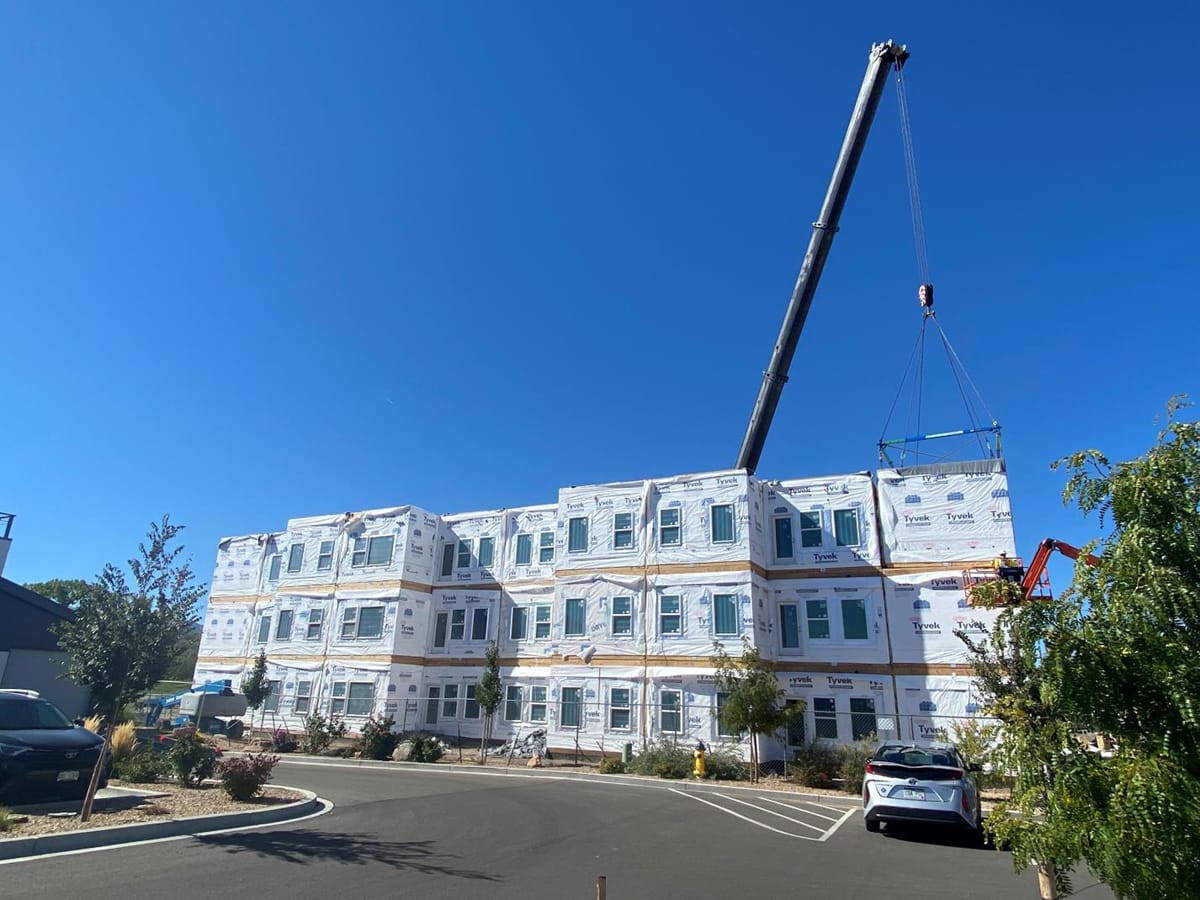
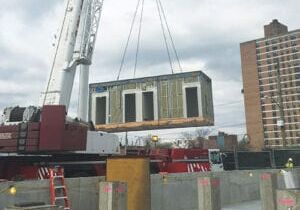
Onsite crane placement of volumetric modules in progress. Each module arrives nearly complete—windows, drywall, fixtures, and finishes installed—allowing rapid assembly and reducing weather exposure and onsite labor.
Know When to Use Modular Construction
Not every project is suitable for modular construction, according to Puncerelli. He believes three circumstances make modular financially attractive: a remote site, a limited labor pool, and a limited construction season. When all three are present, modular pricing is often less expensive than traditional construction.
In Colorado, projects in the mountains are better suited to modular construction due to their remoteness, limited labor availability, and harsh winters. Conversely, projects in larger cities are often best served by traditional site-built construction methods. Knowing when to use each method will help developers keep costs down.
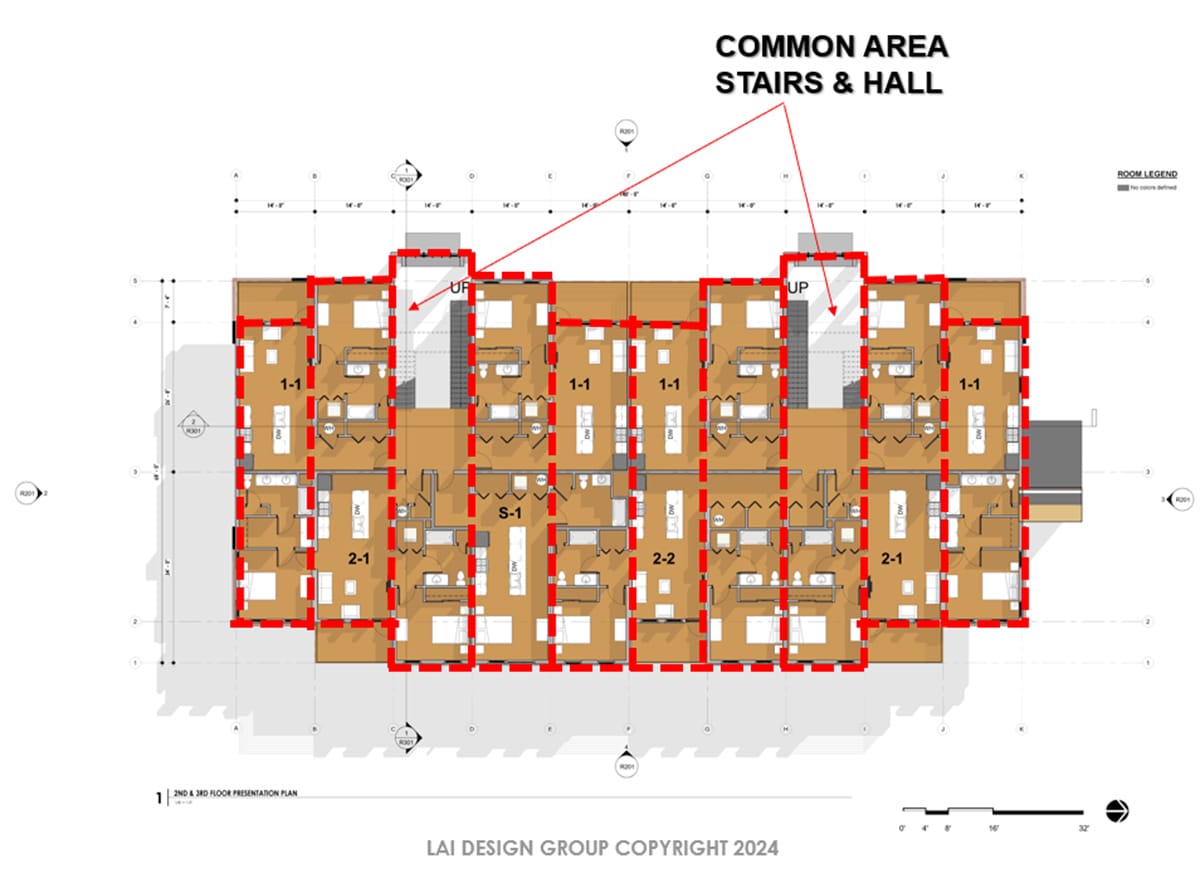
Annotated floor plans identify each modular unit and its connection points. These diagrams establish how modules stack vertically and connect horizontally around the central corridor and stair core, supporting efficient assembly and simplified MEP tie-ins once onsite.
Understand the Project Goals
All members of the project team need to understand the developer’s project goals, including operational objectives. He also recommends designing for maintenance access. For instance, locating electrical panels and plumbing shutoff valves in the hallway of a multi-family development or hotel so that maintenance personnel can more easily shut utilities off without having to enter the apartment or room.
Another key is understanding the possible financial consequences of schedule delays. In most cases, the developer will have to pay additional fees and interest on their loan if the project is delayed. Modular construction is attractive to many developers because sitework and module construction can occur simultaneously, shortening the schedule and reducing additional costs. Designers should be aware that developers may ask them to expedite the process, depending on the magnitude of the savings.
Use a General Contractor Who’s Familiar with Modular Construction
Choosing a general contractor who’s familiar with modular construction can make a big difference in outcomes and costs. GCs that haven’t worked with modular construction before may not know exactly what to expect and, consequently, may overestimate costs.
Puncerelli recommends selecting a contractor that understands which portions of the project's risk shift to the factory, where the units are built in a controlled environment. He also suggests choosing a contractor that you can work with and that communicates well.
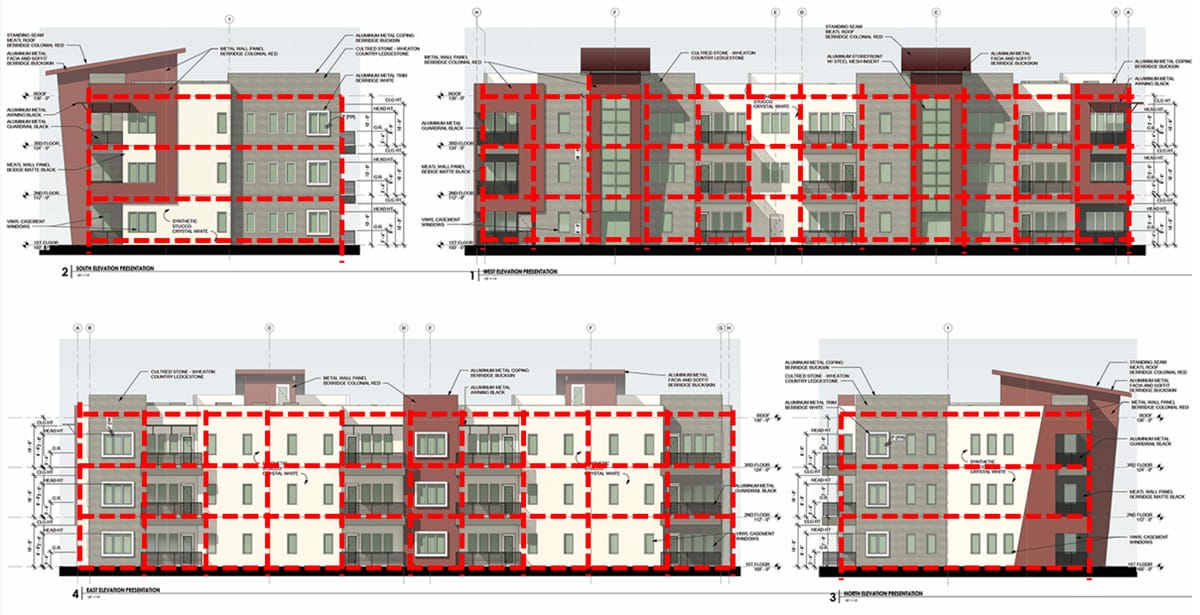
Elevation studies illustrating the modular grid that underpins the building’s structural and façade rhythm. The grid clarifies stacking logic, window alignment, and material transitions, ensuring each factory-built module integrates seamlessly into the architectural expression.
Understand the Logistics Required
Transporting modules isn’t as easy as just driving from A to B. There are many considerations when picking up, routing, and delivering modular units. Weight and height restrictions, winter weather, summer road construction, and oversize load curfews can significantly increase the cost and time required to deliver the modules from the factory to the job site. “If you don’t design with these realities in mind, the project can fail before it even leaves the drawing board.”
Puncerelli says teams must carefully select unit width, considering transportation constraints, project size, and module count. Surprisingly, smaller isn’t necessarily better. Puncerelli said most of the manufacturers he works with prefer a minimum width of 11 to 11.5 feet.
Choose the Right Manufacturer
When selecting the module manufacturer, consider their experience with the project’s building type. For example, for an apartment complex, you’ll want a manufacturer that has completed several multi-family housing projects.
When a manufacturer has experience with a particular building type, they are usually more cost-effective, Puncerelli said. A manufacturer taking on a new building type may overestimate costs to cover unknowns.
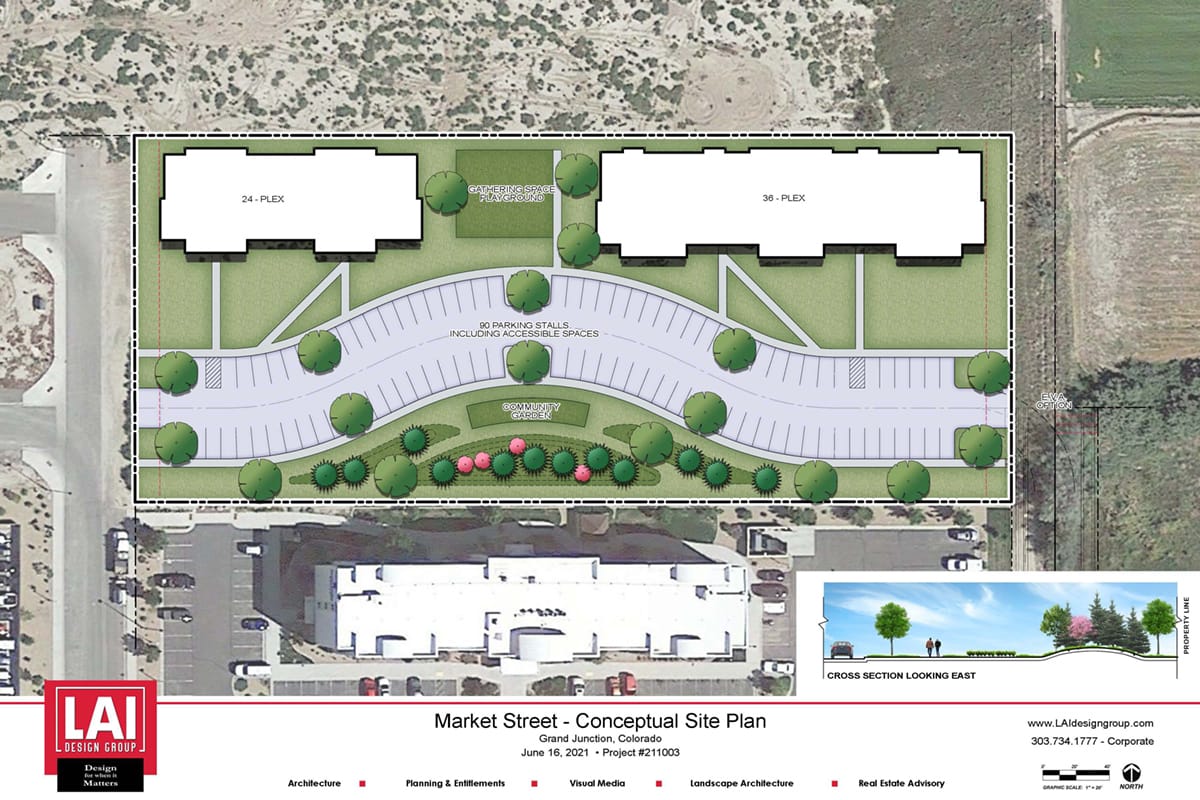
The conceptual site plan illustrates global project organization, including building footprints, circulation routes, parking, and community spaces. Early site planning accounted for modular delivery routes, crane staging, and efficient site access to support streamlined installation.
Keep the Design Team Fully Engaged throughout the Project
On a recent project in Grand Junction, Colorado, LAI was brought in to quickly adapt a site-built project to a modular approach. They completed the design but were only contacted during construction when a conflict arose. “Had we had regular meetings every two weeks or even once a month, a lot of drama would have been avoided or resolved.”
“The biggest factor for success is keeping the architect involved through construction. When we've been kept at arm's length during the build process, issues arise, regardless of whether it's modular or site-built.”
Have Regular Meetings with the Entire Project Team
Puncerelli recommends holding recurring coordination meetings to review team members' progress. “Each party brings unique knowledge to the table, whether it’s the manufacturer, architect, contractor, or engineer.”
The team must collaborate to understand what works with modular construction and what doesn’t. He recalls a project in California where his team was asked to convert two multi-family buildings from site-built to modular construction, and the design featured mirror-image floor plans for neighboring units. “While that sounds simple for a stick-built building, in a factory, that’s a whole other setup on the production line. Essentially, it’s a new floor plan. Consistency and repetition are essential for modular design.”
When asked about the future of the designer-developer relationship, Puncerelli highlighted the role of artificial intelligence. While designers are already using AI to estimate material requirements from computer models, he expects its use to grow exponentially. “I think eventually you’ll be able to tell a computer what kind of building you want, and it will create the concept and construction drawings for you. I know that sounds space age, but I don’t think we’re far from it.”
He firmly believes that developers considering modular construction should thoroughly research it and tour modular projects to ensure it aligns with their expectations. Puncerelli said it won’t work for every project, so the more they know in advance, the better their decision.
About the Author: Dawn Killough is a freelance construction writer with over 25 years of experience working with construction companies, subcontractors and general contractors. Her published work can be found at dkilloughwriter.com.
More from Modular Advantage
MBI Town Halls 2026: Reflections from Boston
By the end of 2026 MBI’s Government Affairs team will have traveled over 6,000 air miles to bring Town Hall events to five different cities in two countries.
Mind the Gap: The Interface Between Onsite and Offsite Construction
Every design for manufacture and assembly (DfMA) project — modular, mass timber, or panelized — is really two projects joined at a seam. One is built in a controlled factory to millimeter tolerances; the other in the field, in weather, to the looser tolerances of poured concrete and human hands. Between them sits an interface: where the factory’s precision meets the site’s reality.
Rules, Rails & Repeatability: Applying DfMA to Modular Healthcare
DfMA offers several advantages for healthcare projects, with faster delivery among the most valuable. Schedule matters when building new facilities, expanding campuses, renovating existing space or bringing care closer to communities that need it.
Precision and Possibility: Demands of DfMA and What Modular Mass Timber Makes Possible
Mass timber does not automatically create an efficient modular building. Its precision makes early coordination more important: fabricated components will accurately reproduce both the team’s solutions and its mistakes. The material’s advantages are realized only when supported by an equally precise design and delivery process.
Catch It in the Factory, Not in the Field: Smarter Testing for Modular Builds
Integrating watertightness and airtightness testing into factory workflows transforms quality assurance from a reactive process into a proactive commissioning strategy. It ensures that every module shipped is field ready and resilient for transportation while also supporting the ability of the modular construction industry to make buildings better.
Modular Construction Contracts: Key Considerations for Successful Canadian Projects
Starting a modular project with a well-developed contract protects both the owner and the contractor. It will help keep the project on track and on budget, and it will improve quality from the factory floor to final installation on-site.
Modular by Design: Turning Architecture into a Manufacturing System
Modular construction is often presented as a faster way to build. Speed, however, is only one part of its value. The larger opportunity is to create a coordinated design and production system that improves quality, reduces uncertainty, and allows a building to move efficiently from concept design through manufacturing, transportation, installation, and completion.
Repeatability Begins with Trust: What Alora at Dry Creek Reveals About Scaling Modular Housing
Alora at Dry Creek, a 329-unit, multifamily community comprising five four-story buildings in Centennial, Colorado, demonstrates how repeatable design, standardized manufacturing and early collaboration can work together to create a model that is not only faster to deliver, but easier to replicate across future projects.

T.R. Arnold: The Art of Third-Party Inspections
T.R. Arnold (TRA), a third-party inspection company in Elkhart, Indiana, contracts with modular manufacturers across the US. Manufacturers register with each state to which they intend to send their modules and may be required to hire a third-party inspection company.
Creating an ‘Ecosystem for Innovation:’ 50+ Years of Modular Construction Oversight in Virginia
Virginia’s modular building program began in 1973, with the implementation of the Virginia Industrialized Building Unit and Mobile Home Safety Regulations. Now it’s leading the country in modular code adoption.