Five Factors to Consider When Evaluating a Modular Data Center

Kent Anderson is the Business Development Manager at Wesco.
The demand for modular data centers is on the rise as companies seek out more computing power to handle the advancements of artificial intelligence (AI), edge computing and increased security demands. But what factors need to be taken into consideration as you evaluate the next steps? Here are five elements to consider:

1. This is a Product, Not a Project
The beauty of a modular data center is that it can be delivered to your site and operational in mere days. That’s a big difference than building a datacenter from scratch as it eliminates customizations and complexities, reduces construction costs, simplifies the process, and perhaps most importantly saves valuable time. Traditional data centers take 12 to 24 months – or more – to build from design to construction to operation. Modular data centers on the other hand can be delivered 2 or 3 times faster, ready to plug and play. We can typically deliver a new building 3 or 4 months after an order is placed. If you want to enhance your processing power, you can simply order another modular data center and grow your system as you need it, without a capital expenditure prior to that demand.
2. When the Cloud Won’t Cut It
Given the rapid evolution of AI and edge computing, demand for computing power is high, but how quickly that computing power can impact critical business applications matters most. Data latency and data privacy are major concerns so the cloud may not be the best solution. For example, leveraging robotics in an auto manufacturing facility requires multiple complex computations to occur in quick succession. Any data latency will hinder the operation of the robot. Modular datacenters are built to handle the demands of innovations such as AI and provide much needed processing power onsite.
3. Managing Physical Space Limitations
Consider a hospital where margins are thin, and every square inch of space within the four walls of the building need to be revenue generating. Instead of giving up patient rooms to make space for a data center, an exterior modular data center can provide the computing power needed without having to sacrifice opportunity for revenue. This flexibility is helpful in an expansion phase as well. If the facility is growing, the modular data center can grow along with it. No need to shut down or move the datacenter but rather this model ensures continuous operation as the space where the processing occurs can continue uninterrupted.
4. The Need for Speed
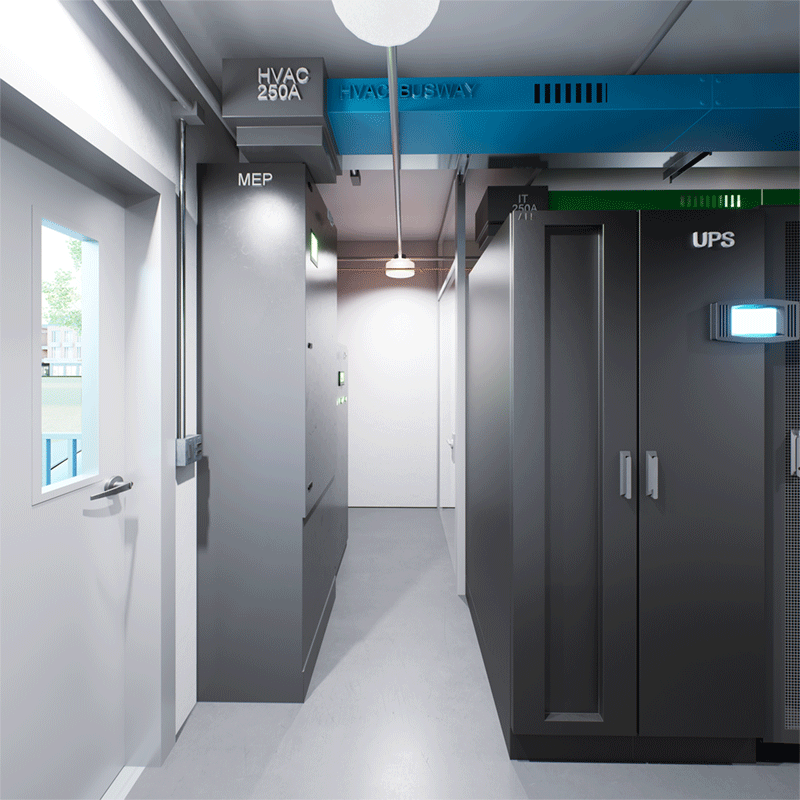
Most organizations that are considering building capacity for a bigger and better datacenter need to get it done as quickly as possible. Waiting for customized datacenters with impossibly long lead times does not need to be the norm. With modular data centers, businesses can simplify the decision process and operationalize quickly. But trading up on timeliness doesn’t mean sacrificing quality. Rather, modular data centers are built with resiliency and redundancy in mind, including backup generators to avoid downtime.
This is also critical in remote areas where skilled labor can be a concern. Skilled labor that is familiar with setting up data centers is typically limited to larger cities. By completing the majority of the work in a factory, the skilled labor does not need to travel to various job sites. This flexibility improves schedules, reduces costs and creates a more consistent product.

5. Built for Today and Tomorrow
There is a dated misconception that modular isn’t as sturdy as onsite construction, but nothing could be further from the truth. Could your data center structure handle heading down the highway at 60mph? Modular data centers are built to the same code specifications as traditional construction process. Inspections are done at the factory, eliminating often complicated (and time consuming) onsite inspections. Plus, if plans change, the modular data center can be moved to another site or relocated back to headquarters if needed. Wherever you need computing power, you can have it. Flexibility is inherent in a modular data center.
Also, when you realize that the units are relocatable, you also can appreciate that unlike traditional construction, these units can have multiple lives in multiple locations. Traditional buildings need to be demolished when their useful life comes to an end. A modular building can be relocated or sold. By extending the lifespan of your modular data center, you are creating less waste. They even have much less waste when the units are built.
Leaning on a Trusted Partner
As the demand for data center capacity continues to grow, businesses may need to find innovative ways to meet those needs. Budget, space constraints and other considerations may make modular data centers a great option, but if you’re not familiar with them, incorporating one could seem like a daunting task.
Your distribution partner can provide the valuable expertise needed to weigh your options and determine whether a modular data center is a good fit. They can also connect you with top-tier manufacturers who can ensure you have the computing power you need, while still working within your physical limitations.
More from Modular Advantage
MBI Town Halls 2026: Reflections from Boston
By the end of 2026 MBI’s Government Affairs team will have traveled over 6,000 air miles to bring Town Hall events to five different cities in two countries.
Mind the Gap: The Interface Between Onsite and Offsite Construction
Every design for manufacture and assembly (DfMA) project — modular, mass timber, or panelized — is really two projects joined at a seam. One is built in a controlled factory to millimeter tolerances; the other in the field, in weather, to the looser tolerances of poured concrete and human hands. Between them sits an interface: where the factory’s precision meets the site’s reality.
Rules, Rails & Repeatability: Applying DfMA to Modular Healthcare
DfMA offers several advantages for healthcare projects, with faster delivery among the most valuable. Schedule matters when building new facilities, expanding campuses, renovating existing space or bringing care closer to communities that need it.
Precision and Possibility: Demands of DfMA and What Modular Mass Timber Makes Possible
Mass timber does not automatically create an efficient modular building. Its precision makes early coordination more important: fabricated components will accurately reproduce both the team’s solutions and its mistakes. The material’s advantages are realized only when supported by an equally precise design and delivery process.

Catch It in the Factory, Not in the Field: Smarter Testing for Modular Builds
Integrating watertightness and airtightness testing into factory workflows transforms quality assurance from a reactive process into a proactive commissioning strategy. It ensures that every module shipped is field ready and resilient for transportation while also supporting the ability of the modular construction industry to make buildings better.
Modular Construction Contracts: Key Considerations for Successful Canadian Projects
Starting a modular project with a well-developed contract protects both the owner and the contractor. It will help keep the project on track and on budget, and it will improve quality from the factory floor to final installation on-site.
Modular by Design: Turning Architecture into a Manufacturing System
Modular construction is often presented as a faster way to build. Speed, however, is only one part of its value. The larger opportunity is to create a coordinated design and production system that improves quality, reduces uncertainty, and allows a building to move efficiently from concept design through manufacturing, transportation, installation, and completion.
Repeatability Begins with Trust: What Alora at Dry Creek Reveals About Scaling Modular Housing
Alora at Dry Creek, a 329-unit, multifamily community comprising five four-story buildings in Centennial, Colorado, demonstrates how repeatable design, standardized manufacturing and early collaboration can work together to create a model that is not only faster to deliver, but easier to replicate across future projects.

T.R. Arnold: The Art of Third-Party Inspections
T.R. Arnold (TRA), a third-party inspection company in Elkhart, Indiana, contracts with modular manufacturers across the US. Manufacturers register with each state to which they intend to send their modules and may be required to hire a third-party inspection company.

Creating an ‘Ecosystem for Innovation:’ 50+ Years of Modular Construction Oversight in Virginia
Virginia’s modular building program began in 1973, with the implementation of the Virginia Industrialized Building Unit and Mobile Home Safety Regulations. Now it’s leading the country in modular code adoption.