
New Off-Site Construction Course Reflects Growing Interest in Modular Construction in Brazil
Ralph Tavares has over 35 years of experience in the modular construction industry. He’s been a member of MBI since 2002 and was instrumental in the creation of the MBI South American Advisory Council. He’s is a trustee of MBI’s educational foundation, and also served on its board. In 2013, Tavares received MBI’s Outstanding Achievement Award. Tavares founded R & S Tavares Associates in 2002, a design and engineering company based in San Diego, California.
A few weeks ago, he taught the inaugural class of the post-graduate Off-Site Construction course offered by the Institute of Technology and Buildings Industrialization at the University Candido Mendes in Sao Paulo, Brazil.
“Professors from the university will teach some of the material,” says Tavares, “but most of the content about modular construction will be taught by professionals who work in the industry.”
The course is taught live via Zoom and about 80 students with bachelor’s degrees in architecture or engineering have enrolled, from all over Brazil. In total, there will be 420 hours of instruction over 21 months, with classes every other Saturday. Although the course has been designed to be online, the university hopes that once the world is post-COVID, there will be opportunities for students and instructors to meet in person.
Tavares and the other course developers are excited that the interest in learning about modular construction has been so high. Tavares explained that in Brazil, “most prefabrication is concrete. Panelized wall systems and prefabricated trusses are also popular, but there is much less 3D modular than there is in the United States. This course will help increase the awareness of modular construction in Brazil.”
Course Content 

Tavares taught the first lecture in the course. Furio Barzon and Franco Vietti, members of the MBI European Advisory Council and Bruna Rafaela, Chair of the MBI South American Advisory Council, were also participating instructors in the inaugural 3.5-hour lecture. (Barzon is the CEO and Vietti is the Business Development Officer at Green Prefab. Rafaela is the International Business Manager at Lafaete Leasing.)
The course curriculum is divided into three sections: Knowing, Understanding, and Applying.
The Knowing series of classes is taught by professionals with extensive experience in the industry. In the Understanding series, students will come to have a greater understanding of the industry and the market as a whole. Several companies are developing content especially for this section of the course. In the Applying section, students will be able to develop their practical skills in various hands-on workshops.
The course covers diverse topics including:
• Modern Methods of Construction
• Introduction to Modular Buildings
• Prefabricated Architecture
• Design for Manufacturing and Assembly
• MEP Connections
• Fire Safety
• Lean Manufacturing
• Supply Chain Logistics
• Contracts
• Taxation
• Property Financing
Course Goals
Once students have finished the course, the goal is for them to be ready to “be employed by off-site manufacturers, or to start their own modular companies,” Tavares says.
Tavares says that while modular construction is a little over 4% of the commercial construction market in the United States, in Brazil, it has a market share of only 1% to 2%. “And a lot of the modular construction in Brazil is work camps,” Tavares says. “It would be good to see more sophisticated modules being built there.”
The growing interest in modular construction in Brazil is driven by the same factors as in the United States.
“The interest is high because prefabricated modular products are high quality, require less labor, and the costs are more certain than with on-site construction.”
About the Author: Zena Ryder is a freelance writer, specializing in writing about construction and for construction companies. You can find her at Zena, Freelance Writer or on LinkedIn.
More from Modular Advantage
MBI Town Halls 2026: Reflections from Boston
By the end of 2026 MBI’s Government Affairs team will have traveled over 6,000 air miles to bring Town Hall events to five different cities in two countries.
Mind the Gap: The Interface Between Onsite and Offsite Construction
Every design for manufacture and assembly (DfMA) project — modular, mass timber, or panelized — is really two projects joined at a seam. One is built in a controlled factory to millimeter tolerances; the other in the field, in weather, to the looser tolerances of poured concrete and human hands. Between them sits an interface: where the factory’s precision meets the site’s reality.
Rules, Rails & Repeatability: Applying DfMA to Modular Healthcare
DfMA offers several advantages for healthcare projects, with faster delivery among the most valuable. Schedule matters when building new facilities, expanding campuses, renovating existing space or bringing care closer to communities that need it.
Precision and Possibility: Demands of DfMA and What Modular Mass Timber Makes Possible
Mass timber does not automatically create an efficient modular building. Its precision makes early coordination more important: fabricated components will accurately reproduce both the team’s solutions and its mistakes. The material’s advantages are realized only when supported by an equally precise design and delivery process.
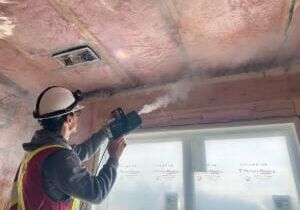
Catch It in the Factory, Not in the Field: Smarter Testing for Modular Builds
Integrating watertightness and airtightness testing into factory workflows transforms quality assurance from a reactive process into a proactive commissioning strategy. It ensures that every module shipped is field ready and resilient for transportation while also supporting the ability of the modular construction industry to make buildings better.
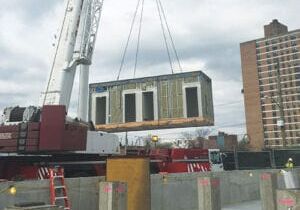
Modular Construction Contracts: Key Considerations for Successful Canadian Projects
Starting a modular project with a well-developed contract protects both the owner and the contractor. It will help keep the project on track and on budget, and it will improve quality from the factory floor to final installation on-site.
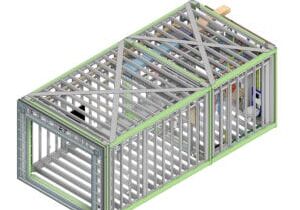
Modular by Design: Turning Architecture into a Manufacturing System
Modular construction is often presented as a faster way to build. Speed, however, is only one part of its value. The larger opportunity is to create a coordinated design and production system that improves quality, reduces uncertainty, and allows a building to move efficiently from concept design through manufacturing, transportation, installation, and completion.
Repeatability Begins with Trust: What Alora at Dry Creek Reveals About Scaling Modular Housing
Alora at Dry Creek, a 329-unit, multifamily community comprising five four-story buildings in Centennial, Colorado, demonstrates how repeatable design, standardized manufacturing and early collaboration can work together to create a model that is not only faster to deliver, but easier to replicate across future projects.

T.R. Arnold: The Art of Third-Party Inspections
T.R. Arnold (TRA), a third-party inspection company in Elkhart, Indiana, contracts with modular manufacturers across the US. Manufacturers register with each state to which they intend to send their modules and may be required to hire a third-party inspection company.
Creating an ‘Ecosystem for Innovation:’ 50+ Years of Modular Construction Oversight in Virginia
Virginia’s modular building program began in 1973, with the implementation of the Virginia Industrialized Building Unit and Mobile Home Safety Regulations. Now it’s leading the country in modular code adoption.