
State of Modular in 2025: Facing Reality

Jennifer Castenson is a VP of Public Relations at BUILDXACT.
It is time for the U.S. modular industry to face some harsh realities and embrace some positive momentum.
Advocates for modular have been talking about cost savings, time savings, higher quality, and sustainability. While all of those are true on different projects and at different scales, it’s not consistent enough to be real.
Reality One: Laboring Over Labor
Many modular projects have documented time savings from a labor perspective, whether from a reduced number of required workers or from the time of labor or both, which could result in cost savings. However, the reality is that onsite construction relies on a different and unique workforce that has fewer requirements and regulations than an offsite workforce.
Sean Dobson, CEO at Amherst, recently presented at the Industrialized Housing Summit, giving his perspective from a company that has both site-built homes and offsite built homes. The volumetric modular arm of his business, StudioBuilt by Amherst, operates out of a 360,000-square-foot facility in Texas. He humbly discussed the discovery process comparing operations of both side by side, the failures and the wins.
“It’s pure fiction that you can build cheaper in a factory than on site,” he said. “All people who work in the factory get benefits, but the competition doesn’t have to offer any of that. Modular has a huge cost disadvantage in labor. You cannot run a factory with OSHA and all the things required for a business and compete with the traditional construction labor pool that doesn’t collect benefits.”
Despite the higher cost of labor, Dobson admits that he would take an offsite build over onsite any day because the lack of quality control on an onsite project. With the higher quality, the insurance costs and risk of issues are lowered with offsite.
“Homes built on site show glitz and glamour but a lot of bad design choices,” he said.
Since offsite boosts the quality and the design, Rommel Sulit, principal and founder at Forge Craft, has found a great application for it with subsidized affordable housing projects that are very process oriented.
“There are already synergies because offsite and affordable housing are both very process oriented,” he said. “You have to qualify for all the funding, build for resiliency, and then you can aggregate that value into the modular boxes. From the labor side, the prevailing wage mandate goes away.”

Reality Two: Localization is Key
Another stark reality for the industry is that federal funding for innovative housing solutions is disappearing. Bobby Vance, who is an assistant professor at the Virginia Tech School of Architecture and also serves as the co-director of the Housing Innovation Challenge, said that this trend is driving more partnerships between the industry and research institutions.
“From a trend perspective, we are looking at smaller homes and working to understand how to use offsite for a speed advantage to create what the starter home looks like,” Vance said. “It doesn’t have to be a rental property or an apartment but how do we scale down for someone to purchase in their 20s.”
Another aspect of the strength of localization is a trend toward micro factories that get the production of homes closer to population centers. Brian Gaudio is the CEO at Pittsburgh-based Module, and is developing design, construction, and manufacturing assets to grow an ecosystem of last-mile facilities with a low capex start that create local jobs and that can produce 50 homes per year.
Module is offering turnkey services for developers to increase its revenue per housing unit, another aspect that makes the localization appealing to developers – they want to keep the economic boost local.
Alex Horowitz serves as the director of the Housing Policy Initiative at The Pew Charitable Trusts and sees local code improvements that are making a big distance. For example, Colorado developed a program to lure modular manufacturers to the state because transportation costs from outside the state were too high factoring in the commute through the Rocky Mountains.
Overall, Colorado’s and other local codes have helped move modular a couple steps forward. Horowitz notes that there are other states and localities that have created legislative packages to change zoning and land use laws to make housing developments faster and easier, while removing rules that discourage density and residential development.
He also notes the value of states opening up inspections to third party reviewers to help expedite the process. Some states are creating pre-approved plans that allow consistency and predictability rather than all new being custom, which is another generous step forward.
While there has been local progress, Dobson from Amherst is continually surprised by how much push back volumetric gets from the local markets it is serving, where cities and counties refuse permits.
Reality Three: More Intangibles
We spend about $901 billion annually on private residential construction in the U.S. according to the U.S. Census Bureau, and workforce management platform Rhumbix calculates that we add 10 to 25% to the total contract values with change orders.
Sean Shields is the director of marketing at the Structural Building Components Association and says that reducing change orders is just one of many hidden benefits of doing modular construction.
In doing work with national homebuilder Taylor Morrison, he was able to show how opportunity costs and costs associated with precision and quality, were able to translate to the builder.
During the Industrialized Housing Summit, he shared that Taylor Morrison started producing a floorplan offsite that it had stick built 500 times and was able to save time in framing and MEP installation. The delays that typically occurred onsite didn’t occur in the factory because the house was to built to specification, and because it was built to specification, was able to pass inspection the first time.

“They were able to get at a 16% increase moving to offsite on first glance,” Shields said. “Looking at the back end it was a more cost-efficient solution—the downstream benefits spoke to them to change processes.”
So, this reality is that everything needs to be tracked because sometimes the improvements and the savings aren’t the things that are obvious.
“Now’s the time for the industry to say we can do this and not rely on the government and make better decisions on our own,” he said.
“We are trying to say we can take this on and give it as a template to production builders, and it doesn’t have to be the federal government to come in so that the home can remain safe and operational. It is the industry’s time to shine, and regardless of who is in power, the government is not being helpful, so we can take matters into our own hands.”
As a step further from federal support, his work on the Housing Innovation Challenge is focusing on creating designs for completely grid-independent homes that can separate from an instable grid so the home can remain functional even with the current increase in storm activity.
Reality Four: On Site is Under Threat
Japanese building companies have been moving to the U.S. to acquire homebuilders and convert them to a more efficient offsite building process. Ken Pinto, a supply chain consultant at Kenzai USA, said that the current reality for onsite builders is that they should feel threatened by offsite.
“The Japanese are continuing with acquisitions, they have the money and the experience and are already in the top five builders in the U.S.,” he said. “The Japanese are successful because they are using vertical integration, and they own the lumber supply chain. Plus, they have been doing offsite for more than 40 years. They changed scheduling increments from days to hours and brought precision and technique.”
These formulas are key to the future of home building in the U.S. as labor and supply challenges persist and will be the only way to survive financially.
Robin Bartram Brown brought his modular business, MMY US, to Louisville, Kentucky, from the U.K. He targeted the area as an intermodal hub as a strong location to design, manufacture and deliver smarter, more affordable homes using cold-formed steel frames.
He’s also presenting a threat to the local onsite builders by providing a faster, stronger building system that can meet the needs of affordable and infill housing at a much more competitive price point and helping local leaders navigate codes and regulation to continue to improve the process.
Wrapping It Up & Moving Modular Forward
The critical and urgent reality is that the modular industry needs to open the doors to collaboration across all sectors, across all dynamics, and embrace new ideas to be successful in offsite in the United States.
“No one wants to share secrets, but they complain that there is no way to standardize the process,” said Forge Craft’s Sulit. “There are growing pains, and some realize they aren’t being consistent in their thinking. Everyone deserves a fair crack at succeeding in this business. Don’t assume you can’t go down a road because no none has been successful here in the past, because maybe you are the one.”
The sooner we stare down these challenges, the sooner we can welcome a new reality where modular is the dominant way to deliver housing for better performance, quality and all at a lower cost.
More from Modular Advantage
MBI Town Halls 2026: Reflections from Boston
By the end of 2026 MBI’s Government Affairs team will have traveled over 6,000 air miles to bring Town Hall events to five different cities in two countries.

Mind the Gap: The Interface Between Onsite and Offsite Construction
Every design for manufacture and assembly (DfMA) project — modular, mass timber, or panelized — is really two projects joined at a seam. One is built in a controlled factory to millimeter tolerances; the other in the field, in weather, to the looser tolerances of poured concrete and human hands. Between them sits an interface: where the factory’s precision meets the site’s reality.
Rules, Rails & Repeatability: Applying DfMA to Modular Healthcare
DfMA offers several advantages for healthcare projects, with faster delivery among the most valuable. Schedule matters when building new facilities, expanding campuses, renovating existing space or bringing care closer to communities that need it.
Precision and Possibility: Demands of DfMA and What Modular Mass Timber Makes Possible
Mass timber does not automatically create an efficient modular building. Its precision makes early coordination more important: fabricated components will accurately reproduce both the team’s solutions and its mistakes. The material’s advantages are realized only when supported by an equally precise design and delivery process.
Catch It in the Factory, Not in the Field: Smarter Testing for Modular Builds
Integrating watertightness and airtightness testing into factory workflows transforms quality assurance from a reactive process into a proactive commissioning strategy. It ensures that every module shipped is field ready and resilient for transportation while also supporting the ability of the modular construction industry to make buildings better.
Modular Construction Contracts: Key Considerations for Successful Canadian Projects
Starting a modular project with a well-developed contract protects both the owner and the contractor. It will help keep the project on track and on budget, and it will improve quality from the factory floor to final installation on-site.
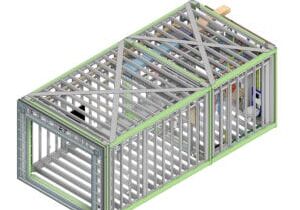
Modular by Design: Turning Architecture into a Manufacturing System
Modular construction is often presented as a faster way to build. Speed, however, is only one part of its value. The larger opportunity is to create a coordinated design and production system that improves quality, reduces uncertainty, and allows a building to move efficiently from concept design through manufacturing, transportation, installation, and completion.
Repeatability Begins with Trust: What Alora at Dry Creek Reveals About Scaling Modular Housing
Alora at Dry Creek, a 329-unit, multifamily community comprising five four-story buildings in Centennial, Colorado, demonstrates how repeatable design, standardized manufacturing and early collaboration can work together to create a model that is not only faster to deliver, but easier to replicate across future projects.

T.R. Arnold: The Art of Third-Party Inspections
T.R. Arnold (TRA), a third-party inspection company in Elkhart, Indiana, contracts with modular manufacturers across the US. Manufacturers register with each state to which they intend to send their modules and may be required to hire a third-party inspection company.
Creating an ‘Ecosystem for Innovation:’ 50+ Years of Modular Construction Oversight in Virginia
Virginia’s modular building program began in 1973, with the implementation of the Virginia Industrialized Building Unit and Mobile Home Safety Regulations. Now it’s leading the country in modular code adoption.