
Spotlight on the Future: MBI Hosts Tremco's Rising Stars at 2025 World of Modular
The Modular Building Institute (MBI) proudly welcomed 70 students from Tremco’s Rising Stars program to its 2025 World of Modular conference and tradeshow, continuing a growing tradition of connecting young talent with the modular construction industry. This partnership, which has been steadily evolving over the past few years, exemplifies MBI’s commitment to education, innovation, and the future of the built environment.
A Bridge Between Education and Industry
Held annually, the World of Modular is the modular construction industry’s most comprehensive event, attracting professionals, exhibitors, and thought leaders from across the globe. For the students, who this year hailed from East Career & Technical Academy and Southeast Career Technical Academy, the event offered a chance to interact directly with industry leaders from around the world.
Launched by Tremco Construction Products Group, the Rising Stars program introduces promising high school students to the building industry through immersive, hands-on experiences. The initiative aims to spark early interest in the trades and provide valuable exposure to real-world construction environments. MBI’s World of Modular offers the perfect stage for this mission, providing access to cutting-edge technologies, expert panels, and vibrant networking opportunities.
Introducing Students to Modular Construction
David Hutchinson, founder and executive director of the Rising Stars program, emphasized the importance of active participation during the event. “Once the students arrive the directive is to be curious and engaged,” he said. “We want them to break out of their shell and be inquisitive for the entire day. The takeaway should be two-fold. They will undoubtedly learn something they never have but also affirm their passions and how they may be applied in the future.”
To ensure this level of engagement, the Rising Stars’ day at the World of Modular is packed with high-energy activities tailored to encourage interaction, exploration, and creativity. “As it is such a compressed schedule we must move quickly through a lot of activities. The pace is what really makes it an exciting day,” Hutchinson explained.
The agenda begins with warm-up activities like a construction-themed jeopardy game and “construction bingo,” designed to break the ice and promote camaraderie. Students then dive into a scavenger hunt across the expansive tradeshow floor, a unique activity that not only enhances their understanding of the modular construction world but also facilitates conversations with industry professionals in a light-hearted setting.
“We finish the day with a LEGO® design build challenge,” Hutchinson said. “The goal of each activity is for them to learn about the industry in a very fun and interactive way.”

David Hutchinson (center) observes Rising Stars students during a LEGO® build challenge.

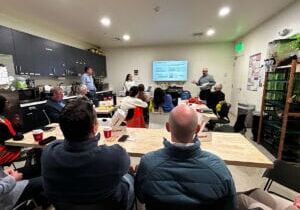
Tom Hardiman (center left), MBI's executive director, poses with students in the World of MOdular exhibit hall.

Students from East Career Techincal Academy and Southeast Career Technical Academy collaborated throughout the day.
A Learning Experience That Sticks
The response from students has been overwhelmingly enthusiastic. “The scavenger hunt and opportunity to interact and learn from people in the industry is a huge positive each year for the participants,” Hutchinson noted. “The only complaint we get is the students wish the event was longer and,” he added with a laugh, “that I ‘never’ pick the right LEGO® build champion.”
This hands-on exposure not only reinforces classroom learning but allows students to see their future careers in action. Through direct engagement with modular construction technologies and conversations with seasoned professionals, the students leave with a broader perspective on the opportunities available to them in the industry.
For many, this one-day immersion marks a turning point in their career planning. Whether discovering a new interest or deepening an existing passion, the experience at World of Modular provides direction and inspiration.
Fostering the Next Generation of Industry Leaders
Beyond the structured activities, the World of Modular offers Rising Stars participants a chance to absorb the industry’s vibrant energy and innovative spirit. The conference is a dynamic microcosm of modular construction’s present and future — the ideal learning environment for aspiring builders and designers.
“Our industry, not unlike the overall construction industry, is suffering from a worker shortage, not only in trades but also in white collar roles,” said Heather Packard, MBI’s professional and workforce development director. “We need to inspire the next generation of talent for our members and industry at large to ultimately solve this long tail problem. Planting seeds as early as possible can help encourage youth to consider learning more about our industry and pursuing a career within it."
"It has been so great seeing this program develop and grow over the years through the leadership of David Hutchinson,” said Heather Wallace, communications director at Momentum Innovation Group. “The students were engaged and had great questions. A few of the young ladies at my table were interested in architecture so I introduced them to Sara Ann Logan from Volumetric Building Companies and I believe she helped at least one or two of them secure internships this summer. The networking practice the students are receiving at this event will be invaluable to them in the future."
MBI’s collaboration with Tremco’s Rising Stars program is more than a partnership — it’s an investment in the future of the modular building industry. By opening its doors to the next generation, the Institute reinforces its role as a leader not only in innovation and sustainability but also in workforce development and education.
“Next year,” added Packard, “we plan on doubling the number of participants we can host and ways we can continue to increase the impact. As we develop relationships with participating vocational-technology high schools, I’m hopeful that we’ll also begin to see some new talent flowing into our industry.”
As the industry continues to evolve, programs like Rising Stars will be essential in shaping the next wave of talent. And with the support of organizations like MBI, students will continue to have unique opportunities to learn, connect, and ultimately lead.
About the Author: John McMullen, PCM, is the marketing director for the Modular Building Institute. You can reach him directly at mcmullen@modular.org or on LinkedIn.
More From Modular Advantage
MBI Town Halls 2026: Reflections from Boston
By the end of 2026 MBI’s Government Affairs team will have traveled over 6,000 air miles to bring Town Hall events to five different cities in two countries.

Mind the Gap: The Interface Between Onsite and Offsite Construction
Every design for manufacture and assembly (DfMA) project — modular, mass timber, or panelized — is really two projects joined at a seam. One is built in a controlled factory to millimeter tolerances; the other in the field, in weather, to the looser tolerances of poured concrete and human hands. Between them sits an interface: where the factory’s precision meets the site’s reality.
Rules, Rails & Repeatability: Applying DfMA to Modular Healthcare
DfMA offers several advantages for healthcare projects, with faster delivery among the most valuable. Schedule matters when building new facilities, expanding campuses, renovating existing space or bringing care closer to communities that need it.
Precision and Possibility: Demands of DfMA and What Modular Mass Timber Makes Possible
Mass timber does not automatically create an efficient modular building. Its precision makes early coordination more important: fabricated components will accurately reproduce both the team’s solutions and its mistakes. The material’s advantages are realized only when supported by an equally precise design and delivery process.
Catch It in the Factory, Not in the Field: Smarter Testing for Modular Builds
Integrating watertightness and airtightness testing into factory workflows transforms quality assurance from a reactive process into a proactive commissioning strategy. It ensures that every module shipped is field ready and resilient for transportation while also supporting the ability of the modular construction industry to make buildings better.
Modular Construction Contracts: Key Considerations for Successful Canadian Projects
Starting a modular project with a well-developed contract protects both the owner and the contractor. It will help keep the project on track and on budget, and it will improve quality from the factory floor to final installation on-site.
Modular by Design: Turning Architecture into a Manufacturing System
Modular construction is often presented as a faster way to build. Speed, however, is only one part of its value. The larger opportunity is to create a coordinated design and production system that improves quality, reduces uncertainty, and allows a building to move efficiently from concept design through manufacturing, transportation, installation, and completion.

Repeatability Begins with Trust: What Alora at Dry Creek Reveals About Scaling Modular Housing
Alora at Dry Creek, a 329-unit, multifamily community comprising five four-story buildings in Centennial, Colorado, demonstrates how repeatable design, standardized manufacturing and early collaboration can work together to create a model that is not only faster to deliver, but easier to replicate across future projects.

T.R. Arnold: The Art of Third-Party Inspections
T.R. Arnold (TRA), a third-party inspection company in Elkhart, Indiana, contracts with modular manufacturers across the US. Manufacturers register with each state to which they intend to send their modules and may be required to hire a third-party inspection company.

Creating an ‘Ecosystem for Innovation:’ 50+ Years of Modular Construction Oversight in Virginia
Virginia’s modular building program began in 1973, with the implementation of the Virginia Industrialized Building Unit and Mobile Home Safety Regulations. Now it’s leading the country in modular code adoption.