
Career Lessons Learned: Interviews with Modular Construction Industry Professionals

Heather Packard is the professional and workforce development director for the Modular Building Institute.
What lessons have mid-career and veteran industry professionals learned over the course of their careers? How has the commercial modular construction industry changed over time, what needs to happen to keep the industry growing, and what keeps them invested?
MBI’s Professional & Workforce Development Director, Heather Packard, caught up with several industry professionals to explore these questions.
How Has the Modular Construction Industry Grown/Changed Since You Entered It?
“Well, the numbers don’t lie. I entered the modular industry in 2011, when the market share was under 2%. Fast forward to 2023, and the market share has more than doubled to 6.64%. At a base level, the most apparent change is the growth. Within that growth, I have seen the industry change or adapt to meet the needs of our society. At the beginning of my career, the modular industry was relatively niche and wasn’t utilized as a problem-solving technique. I have witnessed modular meet homeless and affordable housing needs, healthcare, the workforce, and even temporary housing demands through the industry’s ability to produce accelerated construction times and non-permanent solutions. The biggest change I have seen is the jump from a niche market to a mainstream building technique.”
- Richard Chiavetta, Director of Architecture & Engineering, R&S Tavares Associates
“Utilizing prefabricated or modular components 10 years ago was something that we had to play down or otherwise describe differently to clients and prospective clients. Since that time, I’ve seen a drastic change in perceptions around the benefits of modular, to the point where design and development of projects that incorporate these elements are now a prominent sales feature.”
- Sara-Ann Logan, Vice President of Design, Volumetric Building Companies
“I have a unique take on how the industry has changed as I work within the technology side of this space. Specifically, automated production. I have seen a lot of new players enter the fray, along with some significant strides in innovation. As is the case with utilization, there is a lot of growth and development to come still but the progress to date is promising.”
- Cooper Lane, Vice President of Sales, Reko International Group Inc.
“When we founded ProSet nearly a decade ago, modular construction was prevalent in the single-family home market, but extremely limited in terms of its utilization for large scale multi-family and hospitality buildings. There were just a few modular manufacturers building large multi-story, permanent buildings. As this segment of the construction industry struggled with expanding budgets and longer durations, many developers turned to the modular solution, resulting in dozens of new factories coming online to serve this new demand.”
- Scott Bridger, Vice President, ProSet, Inc.
“When I entered the industry in 1983, it was comprised of local and regionalized dealers. There really weren’t any national, let alone, international companies. The industry was primarily that of a rental fleet comprised of construction trailers. Each decade has brought tremendous change, some good, some not so good, to the industry. But where we sit today – I wouldn’t want to be anywhere else. It is ready to explode for those that want to take the time to really learn and educate themselves. If the right partners are brought together with the same goals and motivation, amazing things can and will be done.”
- John Buongiorno, Vice President, Modular Division, Axis Construction Corp.
What Needs to Happen to Keep the Industry Growing?
“Further investment in automation and more modern means of manufacturing will continue to move the industry to the standards you see in other, more industrialized, spaces. With better means of manufacturing, we can continue to make the utilization percentage grow. With proper manufacturing processes and means of production, the industry will become more efficient, drive down the cost of production, reduce the reliance on skilled labor, and continue to move the needle towards the preference for this means of construction.”
- Cooper Lane, Vice President of Sales, Reko International Group Inc.
Want to learn more?
Watch these videos to glean more insights on professional roles within the industry and ways to inspire the next generation of industry talent to take up the mantle.
“I think a collaborative effort of all involved to produce successful projects. Nothing will slow the growth more than not producing. The industry needs to work together to ensure we are backing up the claims that modular is a better way to build. We can accomplish this by educating newcomers to the industry, both young and old. We need to create opportunities for youth to enter the workforce educated and engaged in modular and invested in its success. We also need to create opportunities for individuals to enter from other industries because we offer better and different ways to build. If we help educate these newcomers and keep them engaged, our industry will continue to grow through successfully delivering projects.”
- Richard Chiavetta, Director of Architecture & Engineering, R&S Tavares Associates
“We need a concerted marketing campaign that describes to the consumer and client market how we want them to interact with us to be successful. This includes defining terminology that we can adopt universally to minimize any confusion or differing expectations from the market. We also need a large-scale workforce development effort to support both the traditional and new skills that have been created by the advancements over that last couple of decades in design, manufacturing, and construction.”
- Sara-Ann Logan, Vice President of Design, Volumetric Building Companies
“More manufacturing capacity will be needed to continue this shift from conventional construction to modular building. One key metric required for the manufacturing industry to grow is standardization. The more efficient a factory can produce product, the more cost effective it can be. There are two keys to achieving efficiency. First, the development and design community need to allow for standardization, meaning refrain from demanding customization. And second, the building codes need to be standardized so each project is not subject to differing codes across the nation.”
- Scott Bridger, Vice President, ProSet, Inc.
“Education of all parties and prospective parties is paramount and will help continue to drive industry growth.”
- John Buongiorno, Vice President, Modular Division, Axis Construction Corp.
What Keeps You Going Personally?
“There are so many problems to solve, including inefficiency and inherent lack of affordability and appropriate access to housing. New ideas, methods, and processes to solve this global crisis keep me excited to come to work every day.”
- Sara-Ann Logan, Vice President of Design, Volumetric Building Companies
“On a larger scale, the idea of being part of an industry that is truly growing and investing in its success keeps me engaged. Every day is different. Every project is different. Having the opportunity to create and problem solve together with my team keeps me going.”
- Richard Chiavetta, Director of Architecture & Engineering, R&S Tavares Associates
“Working in the automation space has me recommitted to my career. I feel that the work that we are doing at Reko Automation is making a change in this world. We are finding better ways to build housing and improve construction. We are addressing things like the labor crisis, the housing shortage, and trying to make housing more attainable.”
- Cooper Lane, Vice President of Sales, Reko International Group Inc.
“Trying to find the next project that no one else wants or thinks can be done keeps me engaged. I once dreamed of doing a $1 million dollar project, and now I award multi-million-dollar subcontracts.”
- John Buongiorno, Vice President, Modular Division, Axis Construction Corp.
“I spent the first few decades of my career in conventional construction. In 2014, risking burnout, I was fortunate to have been introduced to the modular world by Matt Mitchell. He saw the future of the large scale commercial modular industry, and by joining him to found ProSet, my energy for construction was rejuvenated. A decade later, I’m genuinely excited every day to be part of what can only be referred to as a construction revolution.”
- Scott Bridger, Vice President, ProSet, Inc.
What Lessons Have You Learned Over the Course of Your Career?
“Make connections. Grow your network. Help others make connections, but also build long-lasting relationships with those connections, in and around the industry. I have found the more relationships I build and the more I am able to connect with people (and connect people), the more successful my career becomes.”
- Richard Chiavetta, Director of Architecture & Engineering, R&S Tavares Associates
“Be patient. Be persistent. Be willing to change your mind. Nothing happens when you want it, in the exact manner that you want it and without compromise. Knowing when to bend and compromise has served me well in my career.”
- Sara-Ann Logan, Vice President of Design, Volumetric Building Companies
“First and foremost, meet and get to know as many like-minded people as possible. Relationships are paramount for success. Be humble, show empathy, and be real. Focus on doing the right thing and be relentless. If it feels easy…you are probably doing it wrong. Nothing comes without hard work.”
- Cooper Lane, Vice President of Sales, Reko International Group Inc.
“Something I did not understand earlier in my career is that to be an innovator in a shifting industry, it’s not only important to think creatively and “outside the box” but to also be a keen listener. Too often we focus too much on what we each see as the keys to meeting our own specific goals, but if we step back and look at the broader picture of what will make the overall industry succeed, our piece of the puzzle will necessarily benefit. All boats rise with the tide, as they say.”
- Scott Bridger, Vice President, ProSet, Inc.
“The biggest lesson I’ve learned is that there are no limits to what we can do in this industry. While there are certain challenges within the actual constructability of certain building use types, if a team is motivated to solve a challenge, a solution can always be found.”
- John Buongiorno, Vice President, Modular Division, Axis Construction Corp.
More from Modular Advantage
MBI Town Halls 2026: Reflections from Boston
By the end of 2026 MBI’s Government Affairs team will have traveled over 6,000 air miles to bring Town Hall events to five different cities in two countries.

Mind the Gap: The Interface Between Onsite and Offsite Construction
Every design for manufacture and assembly (DfMA) project — modular, mass timber, or panelized — is really two projects joined at a seam. One is built in a controlled factory to millimeter tolerances; the other in the field, in weather, to the looser tolerances of poured concrete and human hands. Between them sits an interface: where the factory’s precision meets the site’s reality.
Rules, Rails & Repeatability: Applying DfMA to Modular Healthcare
DfMA offers several advantages for healthcare projects, with faster delivery among the most valuable. Schedule matters when building new facilities, expanding campuses, renovating existing space or bringing care closer to communities that need it.
Precision and Possibility: Demands of DfMA and What Modular Mass Timber Makes Possible
Mass timber does not automatically create an efficient modular building. Its precision makes early coordination more important: fabricated components will accurately reproduce both the team’s solutions and its mistakes. The material’s advantages are realized only when supported by an equally precise design and delivery process.
Catch It in the Factory, Not in the Field: Smarter Testing for Modular Builds
Integrating watertightness and airtightness testing into factory workflows transforms quality assurance from a reactive process into a proactive commissioning strategy. It ensures that every module shipped is field ready and resilient for transportation while also supporting the ability of the modular construction industry to make buildings better.
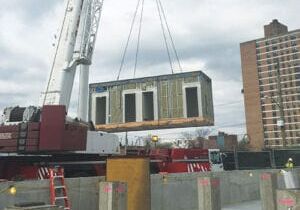
Modular Construction Contracts: Key Considerations for Successful Canadian Projects
Starting a modular project with a well-developed contract protects both the owner and the contractor. It will help keep the project on track and on budget, and it will improve quality from the factory floor to final installation on-site.
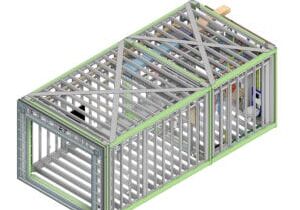
Modular by Design: Turning Architecture into a Manufacturing System
Modular construction is often presented as a faster way to build. Speed, however, is only one part of its value. The larger opportunity is to create a coordinated design and production system that improves quality, reduces uncertainty, and allows a building to move efficiently from concept design through manufacturing, transportation, installation, and completion.

Repeatability Begins with Trust: What Alora at Dry Creek Reveals About Scaling Modular Housing
Alora at Dry Creek, a 329-unit, multifamily community comprising five four-story buildings in Centennial, Colorado, demonstrates how repeatable design, standardized manufacturing and early collaboration can work together to create a model that is not only faster to deliver, but easier to replicate across future projects.

T.R. Arnold: The Art of Third-Party Inspections
T.R. Arnold (TRA), a third-party inspection company in Elkhart, Indiana, contracts with modular manufacturers across the US. Manufacturers register with each state to which they intend to send their modules and may be required to hire a third-party inspection company.
Creating an ‘Ecosystem for Innovation:’ 50+ Years of Modular Construction Oversight in Virginia
Virginia’s modular building program began in 1973, with the implementation of the Virginia Industrialized Building Unit and Mobile Home Safety Regulations. Now it’s leading the country in modular code adoption.