
Greg DeLeon: Military Engineering to Modular Design
Greg DeLeon, a structural engineer at ISE Structural Engineers in Temecula, California, can tell you not only how large a beam needs to be to support a house, but also how much explosives you’ll need to take it down, thanks to his unique combination of professional and military experience.
After taking classes at Cal State for four years and being close to graduating with a degree in music composition, DeLeon realized that he needed an education that would lead to a career with a living wage. “You have to be really phenomenal to get a good job in music composition, and I was just slightly above average. I knew where I stood in the crowd. I figured I could be slightly average in engineering and still get a decent job.”
He has worked at ISE as a structural design engineer for the past eight years. He teases that his coworkers say he’s only been there for five years, as he has taken significant time away from the office on military service deployments with the Army National Guard. In response to a job ad posted by ISE, he contacted them during an emergency activation where his Army unit was called up to help fight a wildfire in 2016 known as the Soberanes Fire. Despite spotty cell reception and the inability to send his resume, he got the job.
DeLeon is a commissioned officer in the Army National Guard and has been in the service for twelve years. After completing college, he was assigned as a route clearance platoon leader that looks for IEDs. His military training and education was primarily in combat engineering and horizontal construction earth moving. He sees his military experience as “another side of engineering, where I know how to calculate the amount of demolition needed to blow certain things up.”
Today he focuses on designing custom homes and multi-family buildings. While ISE works mainly in California, DeLeon has done some design work outside the state. He has also worked on a couple of public school projects, which necessitate working with the California Division of the State Architect (DSA). DSA provides oversight for K–12 schools, community colleges, and various other state-owned and leased facilities. These projects often require more calculations and back-up documentation than private projects.
‘Modular was a Foreign Concept’

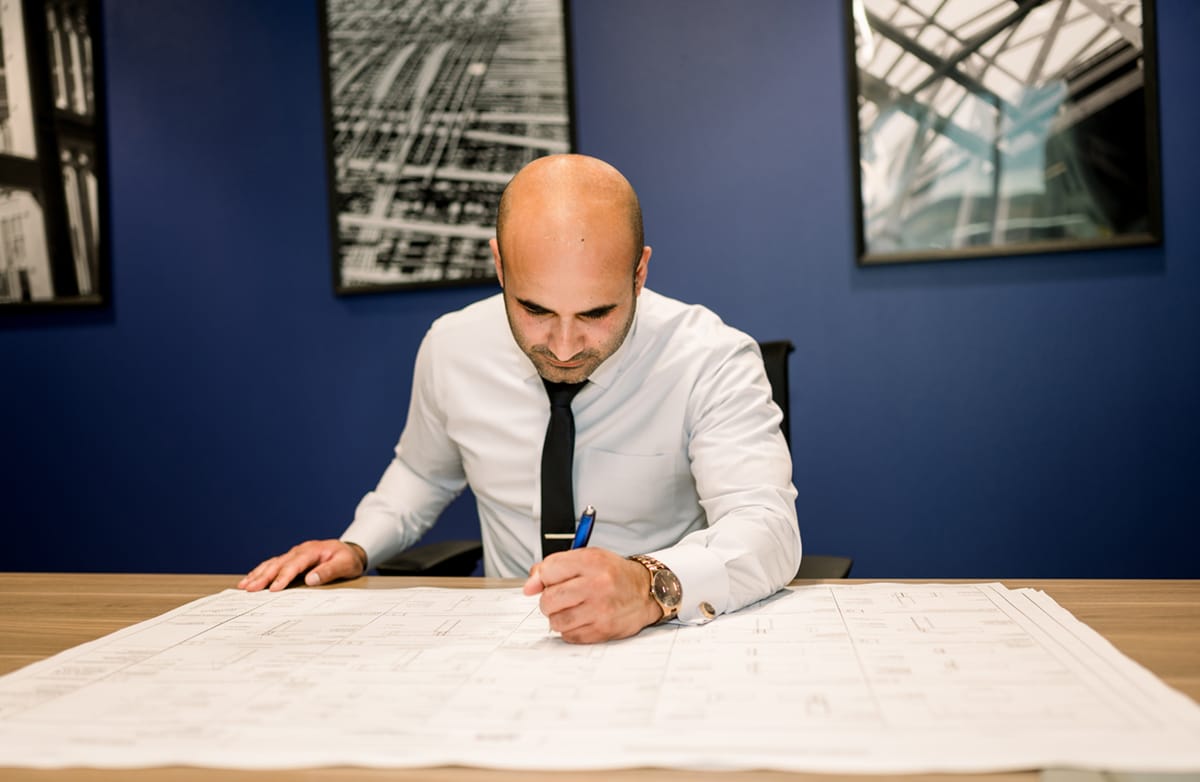
Greg DeLeon, structural engineer at ISE Structural Engineers in Temecula, CA.
A long-term partnership with architect Toby Long in Oakland has resulted in several custom modular home projects, but DeLeon hasn’t always been a fan of modular construction. “I didn’t like modular at first because it was a foreign concept to me. When I first came to ISE I didn’t understand the assemblies.” After being assigned as part of the design team for several of these projects, he is now a fan. “Our team is really good at custom modular houses.”
But they’re still learning, he says. “There’s always stuff to learn. Different factories have their own methods, and as an engineer it behooves me to accommodate those factories. You don’t want to say, ‘I want to do it my way or not at all.’ We try to design it in such a way that it doesn’t affect their process as much. Even though they’re custom houses, we try to do things pretty efficiently in the factory and our team is very sensitive to that.”
The team’s goal is to provide as much coordination up front as possible. “When you have coordination up front, it helps at the end. We do a lot of modular and site-built houses together, like 60% will be modular and 40% site-built.
It gets a bit tricky to connect those pieces sometimes. If you wait to coordinate at the end, you end up doing a lot of fixes, and that takes longer. You spend more hours on a project, and you go over budget.”
In recent years, DeLeon has learned a lot about framing with cold-formed steel, also called light-gauge steel or metal stud framing. “I wasn’t that familiar with it, but I’ve worked on several projects now and want them because that’s a weak muscle of mine.” He’s also expanding his knowledge about post-tension concrete podium construction. “We have engineers in the office that are pretty well versed in building with concrete podiums. I’ve done a couple, but I typically refer back to them for guidance. But it’s something that I’ve gotten better at.”

Internal Drive
DeLeon contributes his success, both in the military and in his profession, to his internal drive to be the best he can be. “I strive to be the best at everything I do. And that’s why I joined the Army too, because I took it as a challenge. I’m competitive, but I try to keep a low profile sometimes.
“You need to have an internal drive just so you can stay competitive and set yourself apart from everyone else. Everyone comes into the engineering field with a degree and an internship, but you need to bring something else to the field, a drive.” His secret to getting ahead is to work longer than anyone else. “If you only work 40 hours a week, you’ll never get anywhere beyond everyone else.”
He also advises newer engineers to read as much as possible, even if it’s not about engineering. “Read something that makes you learn.”
DeLeon has definitely taken his advice to heart, and it shows in his continued success.
About the Author: Dawn Killough is a freelance construction writer with over 25 years of experience working with construction companies, subcontractors and general contractors. Her published work can be found at dkilloughwriter.com.
More from Modular Advantage

Mind the Gap: The Interface Between Onsite and Offsite Construction
Every design for manufacture and assembly (DfMA) project — modular, mass timber, or panelized — is really two projects joined at a seam. One is built in a controlled factory to millimeter tolerances; the other in the field, in weather, to the looser tolerances of poured concrete and human hands. Between them sits an interface: where the factory’s precision meets the site’s reality.
Rules, Rails & Repeatability: Applying DfMA to Modular Healthcare
DfMA offers several advantages for healthcare projects, with faster delivery among the most valuable. Schedule matters when building new facilities, expanding campuses, renovating existing space or bringing care closer to communities that need it.
Precision and Possibility: Demands of DfMA and What Modular Mass Timber Makes Possible
Mass timber does not automatically create an efficient modular building. Its precision makes early coordination more important: fabricated components will accurately reproduce both the team’s solutions and its mistakes. The material’s advantages are realized only when supported by an equally precise design and delivery process.
Catch It in the Factory, Not in the Field: Smarter Testing for Modular Builds
Integrating watertightness and airtightness testing into factory workflows transforms quality assurance from a reactive process into a proactive commissioning strategy. It ensures that every module shipped is field ready and resilient for transportation while also supporting the ability of the modular construction industry to make buildings better.
Modular Construction Contracts: Key Considerations for Successful Canadian Projects
Starting a modular project with a well-developed contract protects both the owner and the contractor. It will help keep the project on track and on budget, and it will improve quality from the factory floor to final installation on-site.
Modular by Design: Turning Architecture into a Manufacturing System
Modular construction is often presented as a faster way to build. Speed, however, is only one part of its value. The larger opportunity is to create a coordinated design and production system that improves quality, reduces uncertainty, and allows a building to move efficiently from concept design through manufacturing, transportation, installation, and completion.
Repeatability Begins with Trust: What Alora at Dry Creek Reveals About Scaling Modular Housing
Alora at Dry Creek, a 329-unit, multifamily community comprising five four-story buildings in Centennial, Colorado, demonstrates how repeatable design, standardized manufacturing and early collaboration can work together to create a model that is not only faster to deliver, but easier to replicate across future projects.

T.R. Arnold: The Art of Third-Party Inspections
T.R. Arnold (TRA), a third-party inspection company in Elkhart, Indiana, contracts with modular manufacturers across the US. Manufacturers register with each state to which they intend to send their modules and may be required to hire a third-party inspection company.
Creating an ‘Ecosystem for Innovation:’ 50+ Years of Modular Construction Oversight in Virginia
Virginia’s modular building program began in 1973, with the implementation of the Virginia Industrialized Building Unit and Mobile Home Safety Regulations. Now it’s leading the country in modular code adoption.
Understanding Thermal Barriers Compliance Methods & Emerging NFPA-275 Foam Plastic Technologies
New fire barrier technologies are improving total costs and margins in major areas of construction, such as commercial, government, union and prevailing wage projects. These benefits translate into other large fringe areas, such as agriculture, commercial cold storage facilities, grow houses, outbuildings, military and aviation hangars.