Laurie Robert: An Industry Pioneer

Laurie Robert has had a distinguished career in the modular construction industry. She served as vice president of NRB (now NRB Modular Solutions) and was the first Canadian and the first woman to be president of the Modular Building Institute. Laurie is now retired but continues to serve the industry in several advisory roles.
Laurie Robert is proud of many accomplishments in her distinguished career in modular construction, not the least of which is being the first Canadian and the first woman to be president of the Modular Building Institute (MBI). Considering that her start in the industry was more by chance than any intention on her part, that accomplishment is even more important.
A Start in Sales
Robert’s journey started when she accepted a job as a sales administrator with Design Space Rentals in the 1980s. The US-based company was expanding into Canada, and Robert quickly moved into a sales position, and on to branch sales manager. Then she met Bob McNeil Sr., the owner of leading modular building manufacturer, NRB (now NRB Modular Solutions). Realizing she was more interested in the manufacturing and construction side of the business than the leasing side, she accepted a position as their new Sales Manager, continuing her career there until her retirement in 2021.
NRB’s focus, like many modular manufacturers at that time, had been on relocatable structures, such as temporary offices and portable classrooms. They wanted to expand their offerings, including looking at permanent modular construction, and her job was to build a sales and marketing department from the ground up. So, she explored new business opportunities, developed marketing partners, and created a sales and estimating team to support NRB’s strategic growth initiatives.
Robert became a director of NRB in 1992, and helped the company expand into the US and served as vice president of sales and marketing for both the Canadian and US companies until 2021.
On a Mission
Her journey with MBI started in the 80s as well, when it was known as the Mobile Modular Office Association (MMOA). NRB was a member but didn’t feel like it was a good fit due to their location in Canada. But later in the 90s, when they were looking to expand their product offerings into permanent modular construction, they took another look at the organization, now called the Modular Building Institute.
Robert attended a couple of conventions as a non-member, checking out the offerings and getting a feel for the potential value a membership could offer. She found a collaborative, non-competitive environment where companies were free to discuss the challenges and opportunities and showcase some of their projects. NRB rejoined MBI in the early 1990s.
Robert started attending regional meetings on the east coast and in the Midwest, meeting other members and board members, and learning all that she could about the industry in the US. And as so often happens, someone invited her to attend a board dinner, then she was invited to be a board member, and the rest was history.
She had various positions on and off the board for the next 15 years. She chaired the annual convention a couple of times, as well as being chair of the integrated council, which represented the direct manufacturing group. In 2001 she became MBI’s first Canadian and the first woman president. She was the first chair of the MBI Educational Foundation and also chaired the permanent modular construction council and the PR committee.
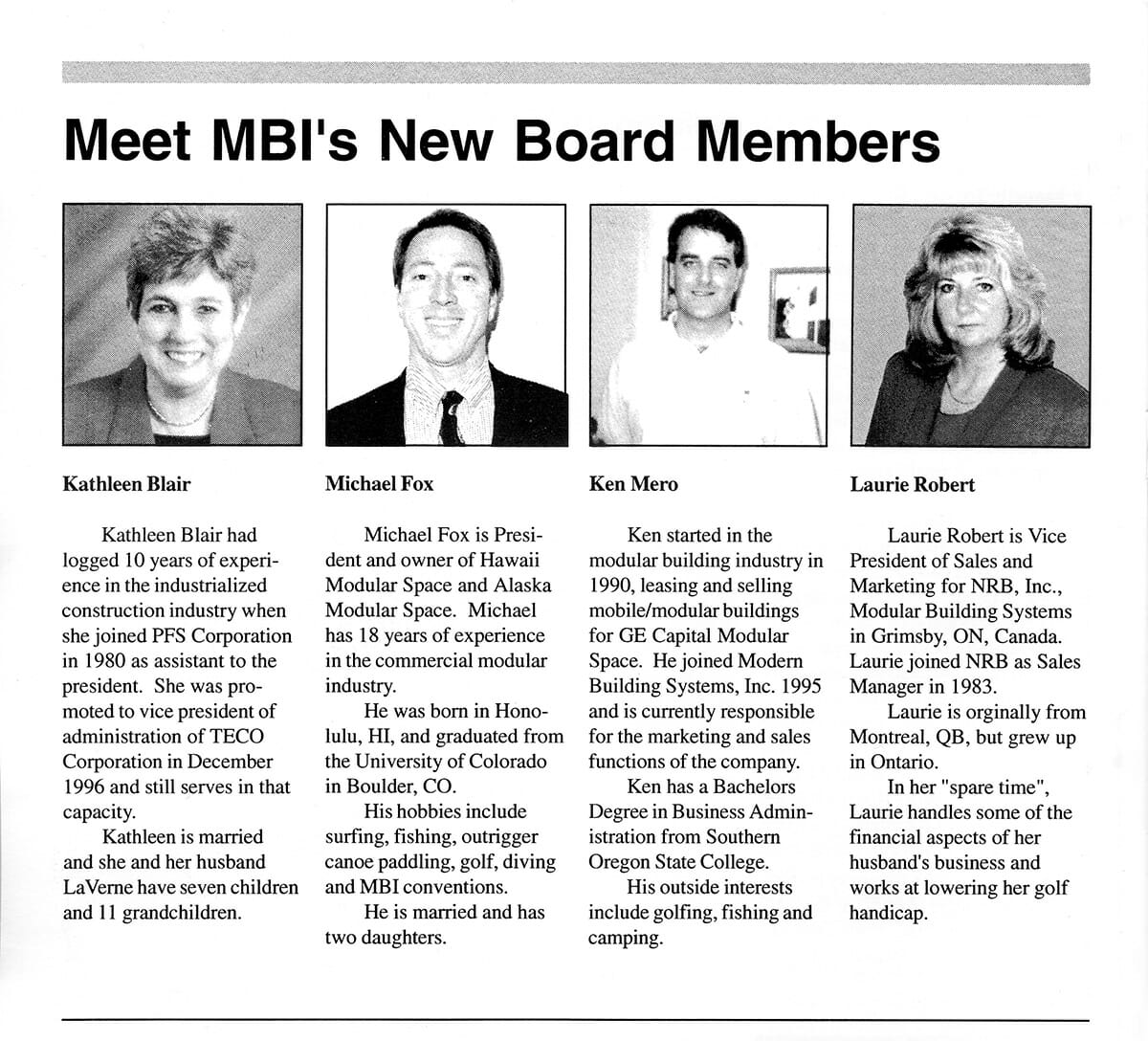
A clipping from MBI's May 1998 newsletter announcing Laurie Robert had joined its
Board of Directors.
She doesn’t see her accomplishments as finished, so she prefers to talk about what she helped influence during her years of service. She helped drive the MBI to creating its two distinct divisions: relocatable structures and permanent modular construction. She was also chairperson of the committee that selected Tom Hardiman as the replacement for Judy Smith as executive director.
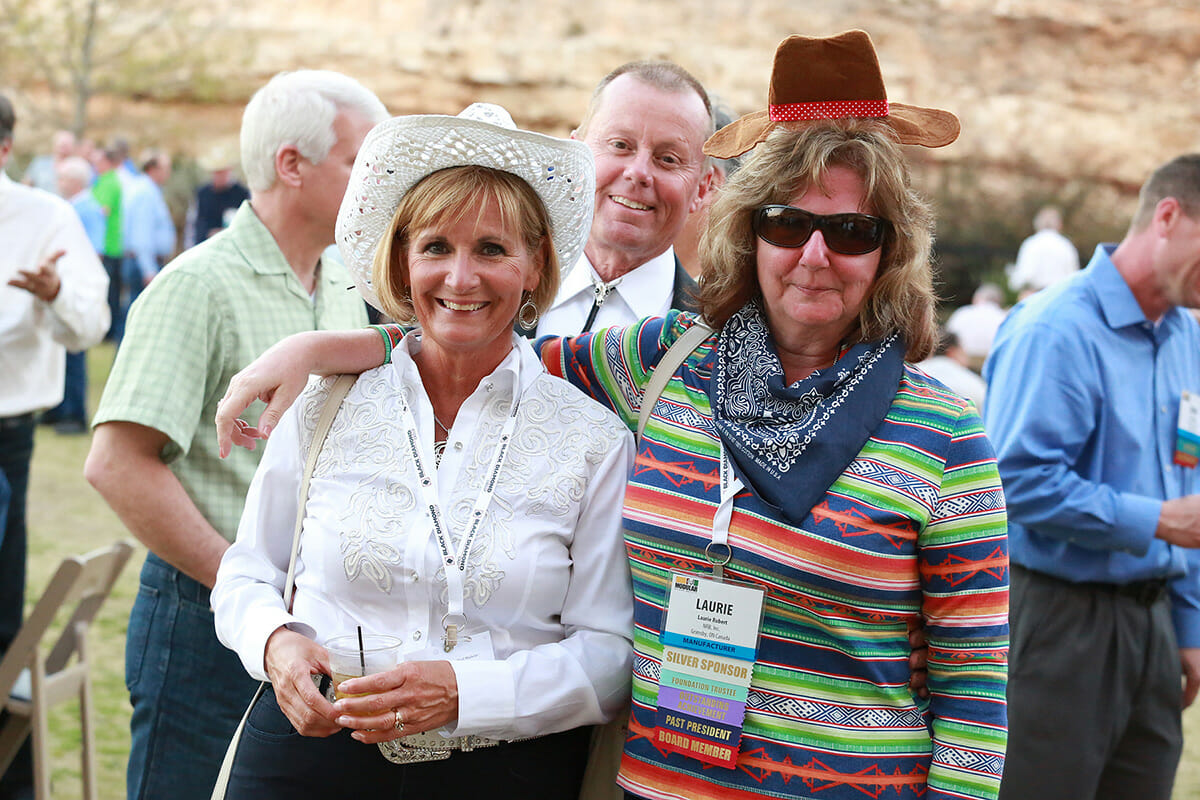
Laurie Robert and colleagues at the 2014 World of Modular convention and tradeshow in San Antonio, Texas.
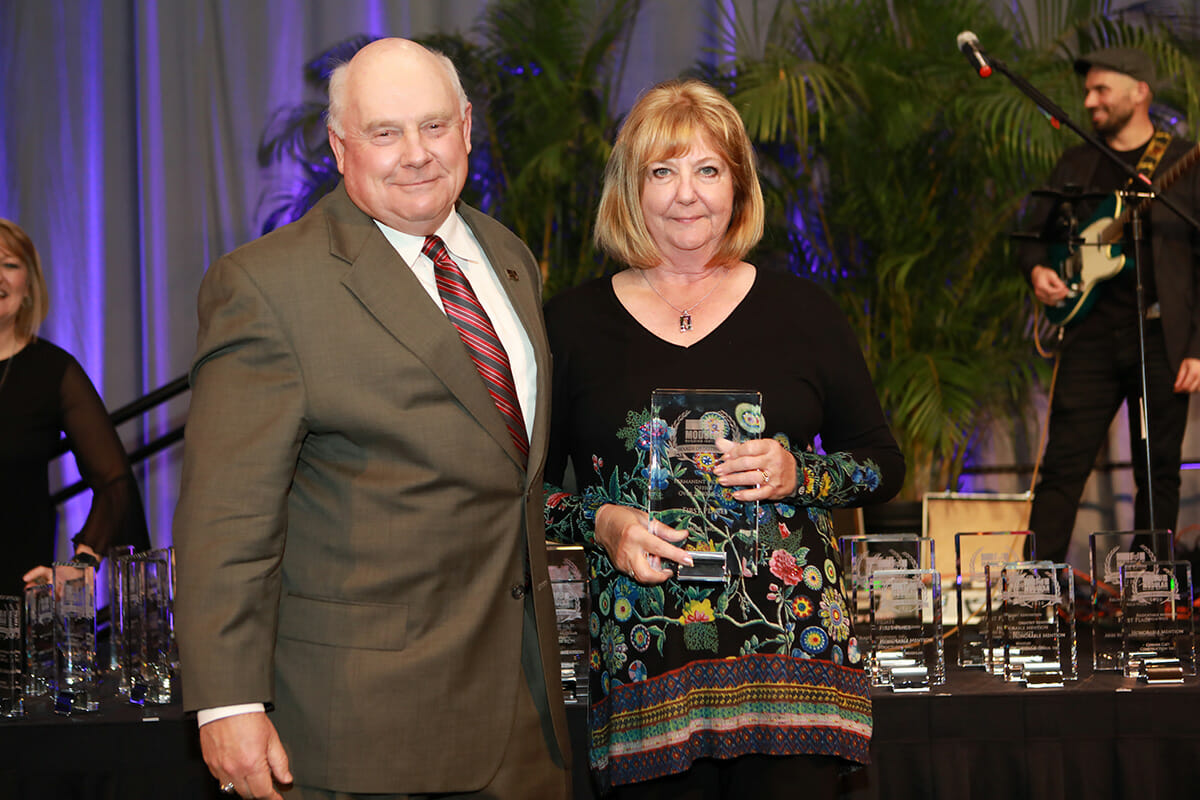
Laurie Robert accepts a first-place trophy at the MBI’s 2020 Awards of Distinction ceremony on behalf of NRB Modular Solutions.
Changing with the Times
As one would imagine, the industry has changed quite a bit through her career. The industry has embraced permanent modular construction in a way that was unheard of in the 80s. There is better understanding of the benefits of modular construction, even in the mainstream. Some of the relevant research and statistics that the industry has been clamoring for are now being published. Robert sees the future being about educating owners and architects on how it differs from traditional construction and how to work with it in their processes. This will take a collective effort, as have all the other accomplishments in MBI’s past.
“From a value proposition, MBI is kind of the hub,” she says. “It doesn’t just bring industry participants together to learn and discuss the opportunities, but it connects the industry with all of the relevant project stakeholders, owners, developers, architects, and general contractors. Without a trade association like MBI, it would be very difficult to accomplish the common goals and hit the common challenges that we really need to.”
MBI is well-placed to accomplish its goals, Robert says. The collaboration brought about by the industry leaders, sharing stories and case studies of both success and failure, gives the organization a unique ability to assist the industry with challenges and opportunities. “We can focus on our individual businesses and work to grow them according to the business models that we all have, but this industry’s unique in that no one company is likely able to move the needle alone. So, if we’re trying to gain more of the commercial construction market share, it needs to be done collectively.”
With the recent rise in construction demand such as affordable or long-term care housing, the modular market is entering a boom time. Robert stresses that the industry needs to commit to the market, increasing capacity and capability to meet the increasing demand. “If the market sees that the industry isn’t there, the first thing they’ll consider doing is to revert back to the way they’ve always built. It’s a balance where market needs to commit to industry, and conversely industry needs to commit to the market.”
Looking Ahead
Robert’s favorite memories of her time at MBI include being president, her Hall of Fame induction, and a couple of outstanding achievement awards. Professionally, her highlight was winning the first permanent modular construction project for NRB in 1993, when the company had no experience to back it up. But while her career meant a great deal to her, her eyes remain forward.
When asked about life after retirement, Robert said that her travel plans with husband Don were temporarily interrupted by COVID, but her golf game and round count have significantly improved! She also admitted that quitting the modular building industry “cold turkey” wasn’t in the cards. So, like many industry retirees, she is doing some work as a modular consultant.
Robert currently sits on the Board of Directors for the University of New Brunswick Off-site Construction Research Centre and through that, assists in the development of presentations. Robert also continues to work with CSA Group in the ongoing development of their modular standards and guidelines. “I have always had a passion for this industry, and if my experience is helpful to others in pursuing growth or overcoming challenges, I’m happy to contribute what I can,” Robert says.
“Nothing full time though - I’m enjoying the flexibility!”
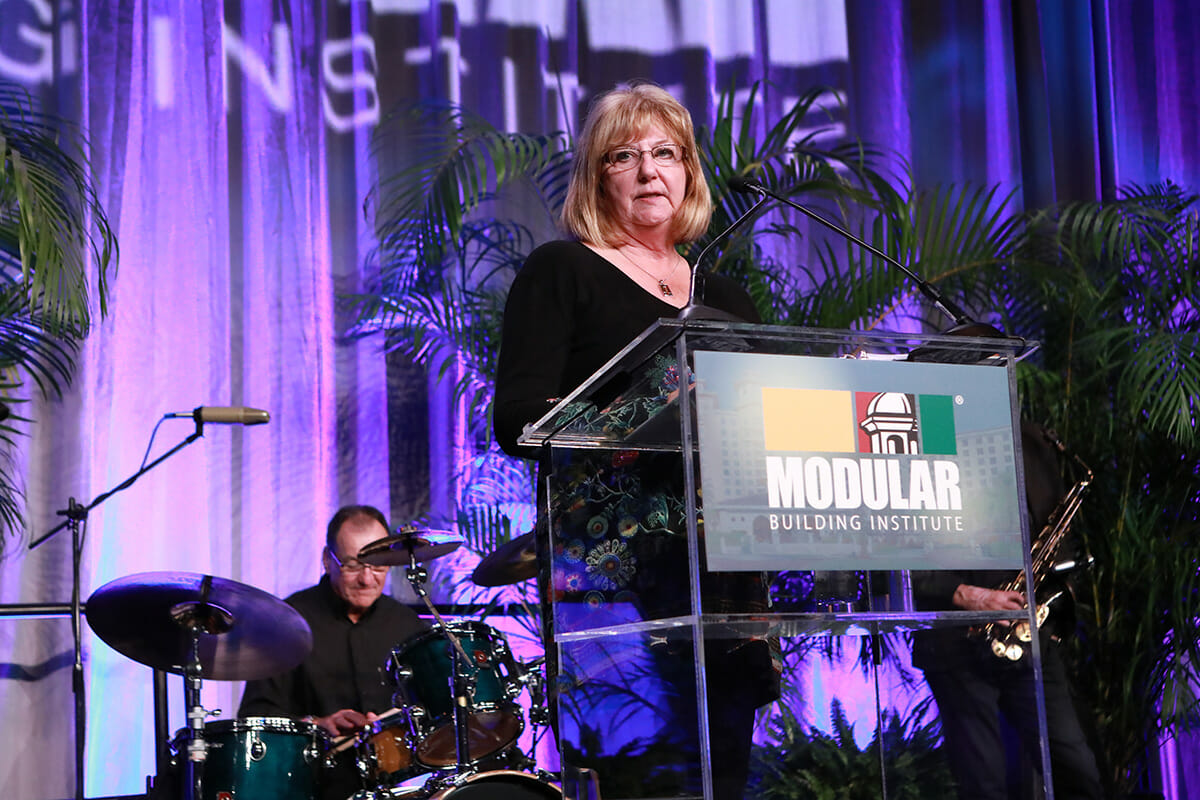
Laurie Robert speaks at the 2020 World of Modular following her induction into the Modular Building Institute’s Hall of Fame.
About the Author: Dawn Killough is a freelance construction writer with over 25 years of experience working with construction companies, subcontractors and general contractors. Her published work can be found at dkilloughwriter.com.
More from Modular Advantage
Mind the Gap: The Interface Between Onsite and Offsite Construction
Every design for manufacture and assembly (DfMA) project — modular, mass timber, or panelized — is really two projects joined at a seam. One is built in a controlled factory to millimeter tolerances; the other in the field, in weather, to the looser tolerances of poured concrete and human hands. Between them sits an interface: where the factory’s precision meets the site’s reality.
Rules, Rails & Repeatability: Applying DfMA to Modular Healthcare
DfMA offers several advantages for healthcare projects, with faster delivery among the most valuable. Schedule matters when building new facilities, expanding campuses, renovating existing space or bringing care closer to communities that need it.
Precision and Possibility: Demands of DfMA and What Modular Mass Timber Makes Possible
Mass timber does not automatically create an efficient modular building. Its precision makes early coordination more important: fabricated components will accurately reproduce both the team’s solutions and its mistakes. The material’s advantages are realized only when supported by an equally precise design and delivery process.
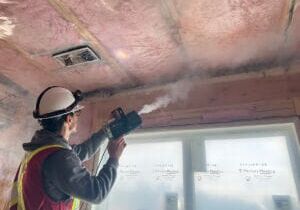
Catch It in the Factory, Not in the Field: Smarter Testing for Modular Builds
Integrating watertightness and airtightness testing into factory workflows transforms quality assurance from a reactive process into a proactive commissioning strategy. It ensures that every module shipped is field ready and resilient for transportation while also supporting the ability of the modular construction industry to make buildings better.
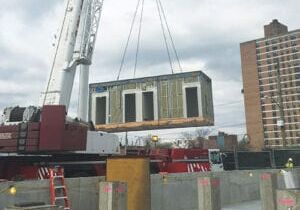
Modular Construction Contracts: Key Considerations for Successful Canadian Projects
Starting a modular project with a well-developed contract protects both the owner and the contractor. It will help keep the project on track and on budget, and it will improve quality from the factory floor to final installation on-site.
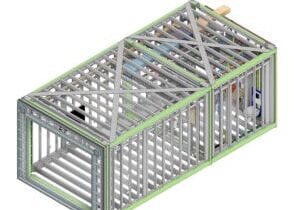
Modular by Design: Turning Architecture into a Manufacturing System
Modular construction is often presented as a faster way to build. Speed, however, is only one part of its value. The larger opportunity is to create a coordinated design and production system that improves quality, reduces uncertainty, and allows a building to move efficiently from concept design through manufacturing, transportation, installation, and completion.
Repeatability Begins with Trust: What Alora at Dry Creek Reveals About Scaling Modular Housing
Alora at Dry Creek, a 329-unit, multifamily community comprising five four-story buildings in Centennial, Colorado, demonstrates how repeatable design, standardized manufacturing and early collaboration can work together to create a model that is not only faster to deliver, but easier to replicate across future projects.
T.R. Arnold: The Art of Third-Party Inspections
T.R. Arnold (TRA), a third-party inspection company in Elkhart, Indiana, contracts with modular manufacturers across the US. Manufacturers register with each state to which they intend to send their modules and may be required to hire a third-party inspection company.
Creating an ‘Ecosystem for Innovation:’ 50+ Years of Modular Construction Oversight in Virginia
Virginia’s modular building program began in 1973, with the implementation of the Virginia Industrialized Building Unit and Mobile Home Safety Regulations. Now it’s leading the country in modular code adoption.
Understanding Thermal Barriers Compliance Methods & Emerging NFPA-275 Foam Plastic Technologies
New fire barrier technologies are improving total costs and margins in major areas of construction, such as commercial, government, union and prevailing wage projects. These benefits translate into other large fringe areas, such as agriculture, commercial cold storage facilities, grow houses, outbuildings, military and aviation hangars.