
Reimagining Temporary Infrastructure: Hilo Wastewater Treatment Plant Project
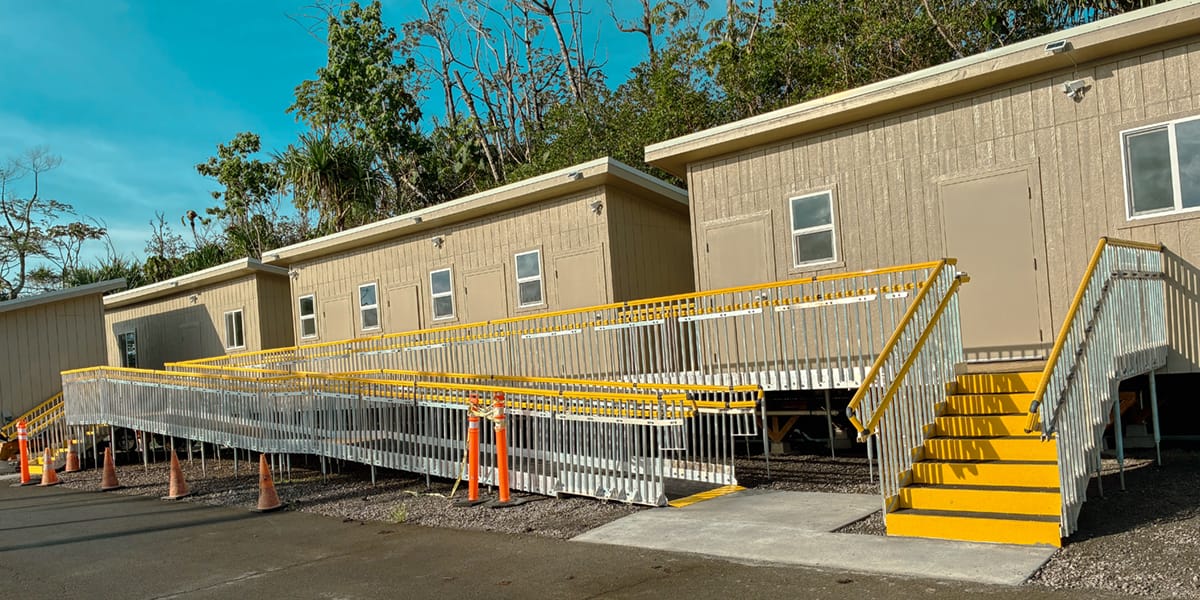

When Hawaiʻi County launched its ambitious $337 million rehabilitation of the Hilo Wastewater Treatment Plant, the project demanded thoughtful solutions to maintain safe, reliable access for staff throughout ongoing construction. Nan Inc, Hawaii’s largest locally owned general contractor, addressed this challenge with modular solutions to ensure compliance, consistent quality, and rapid deployment to deliver a highly time sensitive result. Modular construction was key to sustaining operations during a major municipal infrastructure upgrade.
Hilo, Infrastructure, and the Need for Continuity
Hilo is known for its cultural richness and dramatic landscapes, but behind the scenes, its wastewater infrastructure performs the critical task of treating roughly 3 million gallons of water each day for about 30,000 residents. Nan Inc had to develop a plan to relocate essential personnel to a temporary campus without derailing operations during rehabilitation efforts.
These temporary structures - modular buildings arranged to support administrative and operational continuity - needed to be quickly deployed and relocatable for future use throughout the course of rehabilitation. Nan Inc adopted modular techniques to quickly design, build, and deliver for immediate use. That’s when they encountered a major problem - establishing accessibility in a rapidly deployed temporary environment that required expertise well outside of their capabilities.
Traditional site‑built access solutions, such as poured‑in‑place concrete or custom‑fabricated steel ramps, were immediately ruled out due to cost, long lead times, and the difficulty of adjusting them as the project evolved. Likewise, the team noted that light duty aluminum ramps lacked stability, slip resistance, and reliability needed for daily, long‑term use in a wet coastal climate, let alone the durability to relocate with the buildings down the road.
The Challenge: A Compliance‑Driven, Fast‑Moving Environment
Nan Inc required an access system that was fully ADA and building code compliant, structurally robust, and flexible enough to integrate seamlessly with the modular buildings planned for the site. The system also needed to be assembled efficiently by onsite personnel with minimal disruption. The challenge was not only technical, but also logistical. Nan needed to deliver:
- A complete, code compliant access route between modular units.
- A solution that could be rapidly engineered, approved, shipped to Hilo, and installed with only limited on‑island support.
- A design that would withstand environmental exposure and heavy use.
- A system flexible enough to change along with the construction phasing.
The Approach: Modular Access as Infrastructure
Nan Inc. required an access system that mirrored the benefits of the modular buildings themselves: pre-engineered, scalable, and rapidly deployable. The chosen solution was RightWay Pro, a modular walkway, stair, and ramp system engineered for rapid deployment and long-term durability. Though modular access systems are often associated with simple temporary use cases, the Hilo project illustrates how they can act as strategic infrastructure - bridging the gap between permanent and temporary construction.
The design process focused on clarity and adaptability. Using pre-engineered components, the access system was configured to match site elevations, distances between structures, and required turning space. These elements were refined in days rather than weeks, critical in an active construction environment where schedules shift quickly.
Once approved, the full system was shipped to Hilo and installed with onsite personnel. No specialized subcontractors or complex fabrication steps were necessary. The universal modules arrived ready to assemble into walkway, ramp, and stair structures, providing predictable installation timeframes that fit the project’s tight schedule.
Field Experience: A One‑Week Transformation
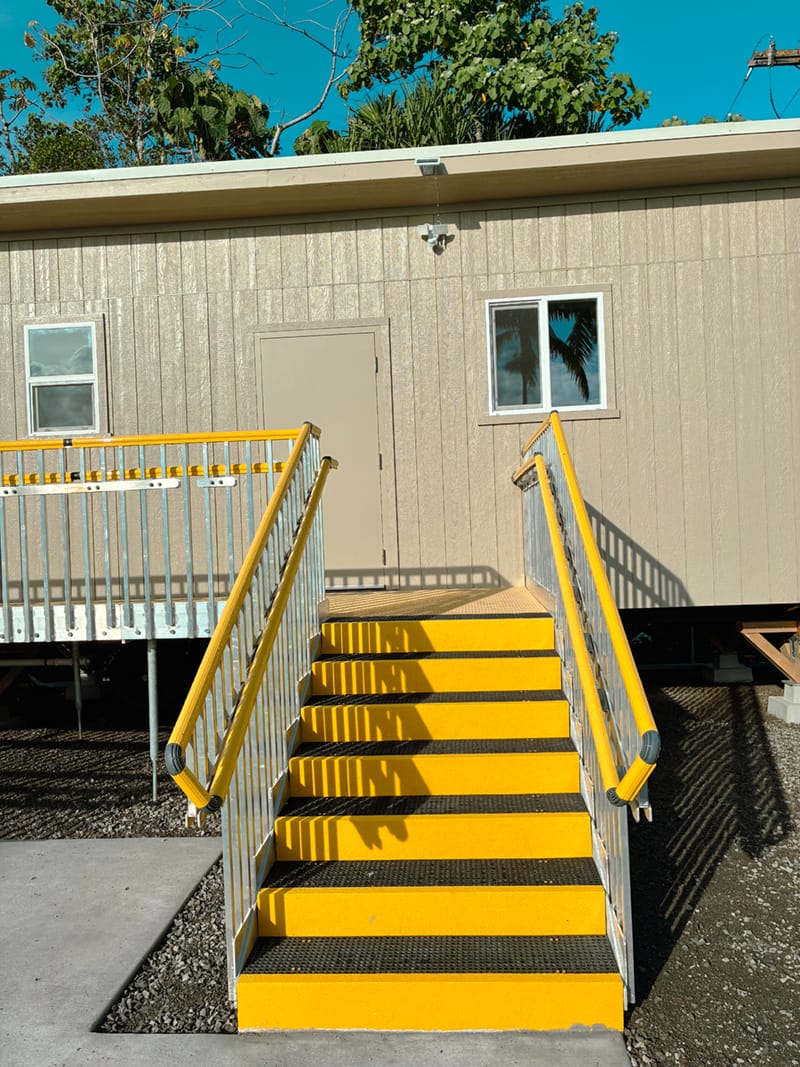
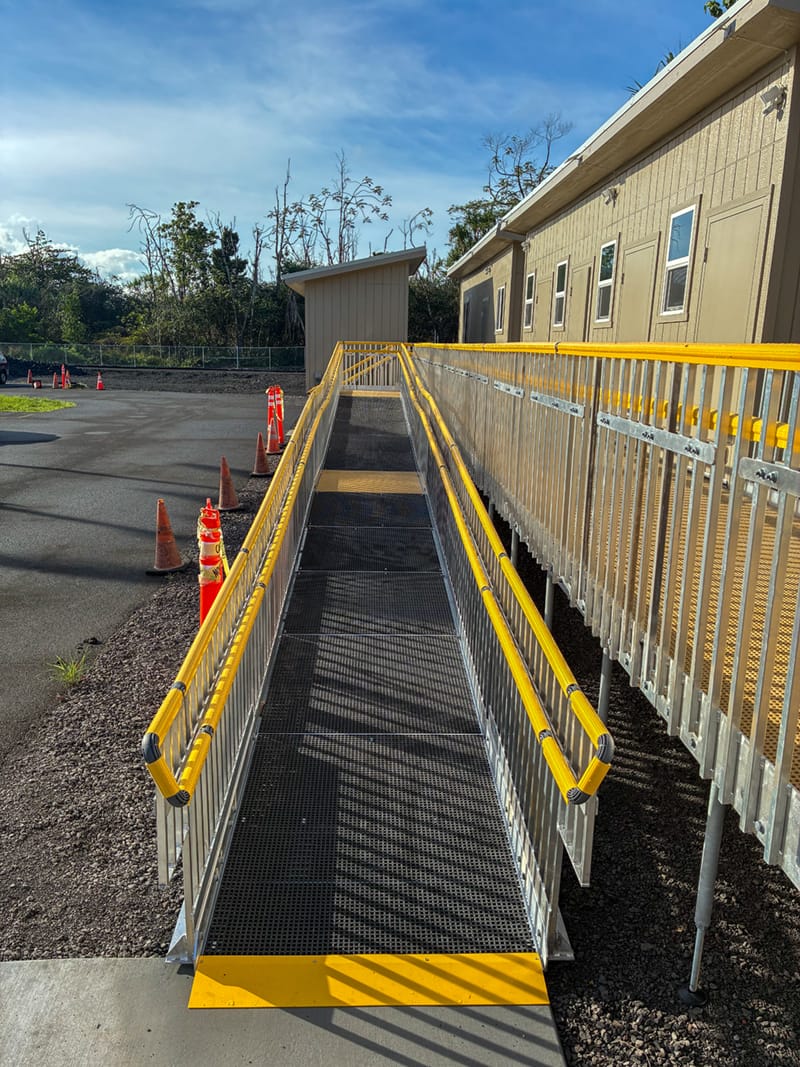
One of the most defining characteristics of this project was speed. Within just one week of starting installation, the temporary campus had a fully functional access system connecting multiple modular buildings. Crews were able to continue their work without navigating unsafe or improvised walkways, improving safety even during construction.
The system’s slip‑resistant FRP grating proved particularly important in Hilo’s rainy climate. Workers noted the increased stability underfoot compared to aluminum alternatives, which can become slick when wet or degrade more quickly in coastal environments.
Equally important was the non‑penetrating design, with the access system secure through weight and geometry alone. The adaptive leg system allowed for adjustments in the field for a reliable, level walking surface. This supported the need for rapid deployment by avoiding extensive, time consuming concrete work underneath the system.
Benefits to the Project Team
By treating the access system as a modular component of the total solution instead of a site-built afterthought, Nan Inc. realized several strategic advantages:
- Compressed Timelines: Design revisions took days, ensuring the campus was operational without delaying the broader rehabilitation schedule.
- Self-Performance Efficiency: The system’s "ready-to-assemble" nature allowed the onsite team to handle installation, eliminating the need for specialized subcontractors.
- Dynamic Adaptability: As the plant rehabilitation moves through different phases, the modular components can be disassembled and reconfigured, turning a project expense into a relocatable asset.
- Military-Grade Durability: Built to exceed the lifespan of the temporary project, the hardware remains available for reuse across future municipal sites.
Lessons for Modular Construction Practitioners
The Hilo project underscores the growing role of modular infrastructure. Not only for buildings, but for the systems that make those buildings usable.
Key takeaways include:
- Temporary does not mean low‑performance. Modular access delivers performance comparable to permanent construction.
- Pre‑engineered systems accelerate timelines. Where traditional design cycles can cause delay, modular repetition and predictability enable fast movement.
- Modularity supports adaptive phasing. As projects evolve, access systems that can move with them enable more efficient workflows.
- Safety should remain central, even in temporary conditions. The ability to meet ADA and building code standards quickly is critical in municipal and industrial environments. There is no provision for avoiding these requirements in temporary applications.
As municipalities modernize critical infrastructure, projects like the Hilo Wastewater Treatment Plant rehabilitation reveal how temporary environments must rise to the same standards of accessibility, safety, and reliability as permanent facilities. Nan Inc’s approach to constructing a safe, flexible, and rapidly deployable access campus demonstrates how modular systems can function as essential infrastructure during long-term upgrades.
This project illustrates a larger shift taking place across the construction industry, where modularity, speed, and resilience increasingly shape the way temporary and permanent environments are designed, built, and experienced.
More from Modular Advantage
How Stack Modular Is Using AI to De-Risk Mid- to High-Rise Modular Construction
Artificial intelligence is no longer a future concept in modular construction—it is already reshaping how complex buildings are evaluated, designed, and delivered.

Gearing Up for the 2026 World of Modular
The Modular Building Institute (MBI) is bringing its global World of Modular (WOM) conference and tradeshow back to Las Vegas in April, and with it comes some of the industry’s best opportunities for networking, business development, and education.

New High-Rise Modular Apartment in Abu Dhabi Points Toward the Future of Multifamily Construction
Eagle Hills International Properties chose the BROAD Holon Building for a 16-story market rate apartment building in Zayed City, a central business district of Abu Dhabi. The project highlights the potential of the Holon system of volumetric modular construction to accelerate housing delivery.
MBI Announces First Ever Industry Apprenticeship Program in Collaboration with Marshall Advanced Manufacturing Center
MBI recently agreed to partner with Marshall Advanced Manufacturing Center (MAMC) to provide bona fide USDOL-approved apprenticeship programs for the industry.
AoRa Development Aims for New York’s First Triple Net Zero Building Using Modular Methods
More cities are providing funding for newer infrastructure projects as long as they meet sustainability requirements. This is how modular can fit the bill, thanks to its lower waste production.
Developers and Designers: Lessons Learned with Modular Design
Modular construction is attractive to many developers because sitework and module construction can occur simultaneously, shortening the schedule and reducing additional costs.
UTILE: Putting Modular Building on a Fast Track
In Quebec, UTILE is taking the lead in creating affordable modular buildings to help decrease the student housing shortage. During the process, the company discovered what it takes to make the transition to modular building a success.

Sobha Modular Teaches Developers How to Think Like Manufacturers
With its 2.7 million square foot factory in UAE, Sobha Modular is bringing both its high-end bathroom pods to high-end residences to Dubai while developing modular projects for the U.S. and Australia.
RoadMasters: Why Early Transport Planning is Make-or-Break in Modular Construction
In modular construction, transportation is often called the “missing link.” While it rarely stops a project outright, poor planning can trigger costly delays, rerouting, and budget overruns.
Navigating Risk in Commercial Real Estate and Modular Construction: Insights from a 44-Year Industry Veteran
Modular projects involve manufacturing, transportation, and on-site assembly. Developers must understand exactly what they are responsible for versus what they subcontract. Risk advisors should research the developer’s contractors, subcontractors, and design-build consultants—especially the modular manufacturer.