
Speed by Design: New High-Rise Modular Apartment in Abu Dhabi Points Toward the Future of Multifamily Construction

Jeremy S. Zimman is the director of marketing of BROAD Group's Holon Modular Building System.

Valeria Ramirez-Salcedo is the design specialist for BROAD Group's Holon Modular Building System.
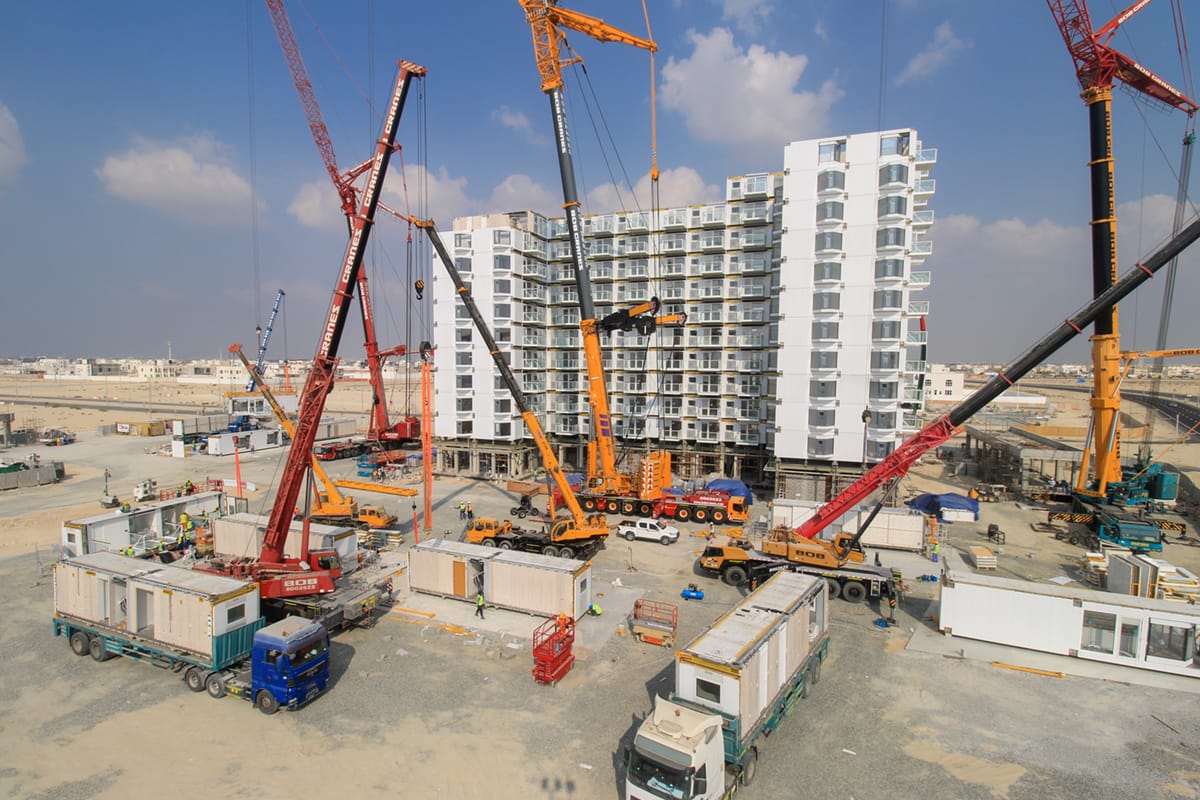
Multiple cranes working concurrently finish the 12th of 15 floors of BROAD Group's Earth Tower in Abu Dhabi.
BROAD believes that speed in modular construction is comprised of three components. Speed = Supply + Sequence + System. Supply is the prefabrication of the modules. Sequence is the order of module deployment: Transport from factory to job site, preparation of the modules on-site, hoisting the modules into position, and connecting the modules. System is the entire design-build-install process that underpins an efficient building delivery, including standardized design with interchangeable components, and the entire logistics process outlined below. The Earth Tower project in Abu Dhabi illustrates this formula for defining speed.
The UAE has been quick to embrace new construction methodologies and technologies, so it is no surprise a BROAD Holon volumetric high-rise modular multifamily building has gone up in Abu Dhabi. Eagle Hills International Properties, founded by Chairman Mohamed Alabbar of Emaar Group which built the Burj Khalifa, chose the BROAD Holon Building for a 16 story market rate apartment building in Zayed City, a central business district of Abu Dhabi. This is a pilot project that will lead to the extensive use of BROAD’s Holon modular building system in the Emirates.
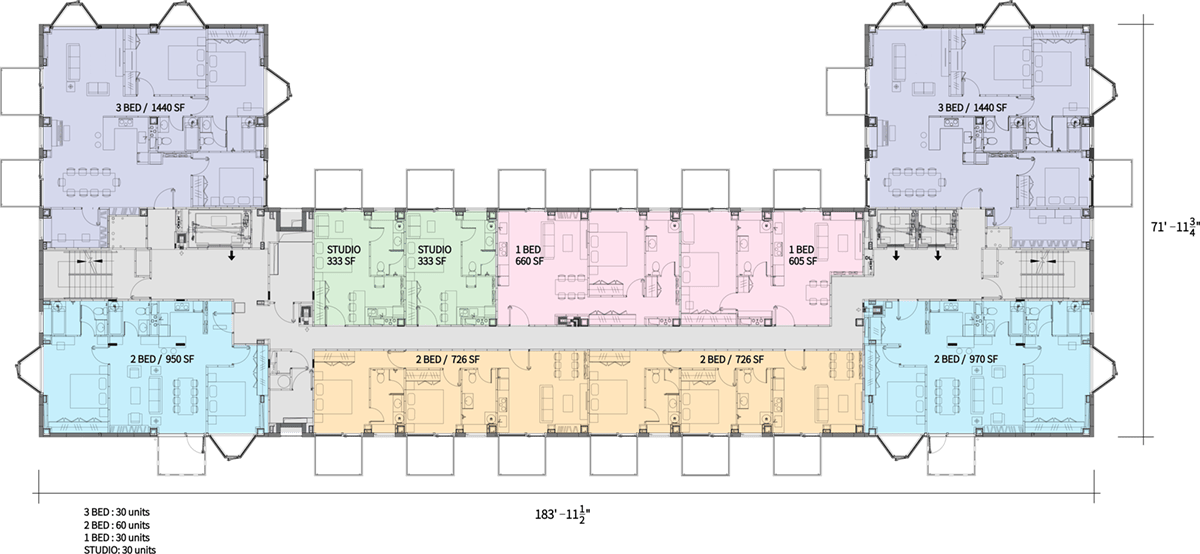
The project is called “Earth Tower,” which is a 16 story (1 podium level +15 floors), 164 feet high, 171,286 sf all steel building, with BROAD’s stainless steel framed building modules set on a 1 story steel podium housing retail outlets. The project is composed of 259 40HQ container-size modules set on the podium in a U-shaped building, with 150 units, 10 units per floor, with each floor comprising two Studio units, two 1 Bedroom units, four 2 Bedroom units, and two 3 Bedroom units as shown below. The internal walls of the Holon modular system are non-load bearing however, so unit configuration and unit area can be changed any time, and adjacent units can even be merged into larger units.
The Holon building uses BROAD’s sandwich structure “CORE” stainless steel slabs that are hot-air brazed at 2000° F to enhance the inherent mechanical properties of stainless steel. The CORE slab functions as the flooring and roofing systems. After factory prefabrication, the CORE floor slabs are folded into 40 ft container-size modules. Duplex stainless steel is used for columns and beams. The use of stainless steel for load-bearing members improves the building's durability and resilience. Stainless steel is resistant to corrosion, and its high ductility allows the structure to absorb tensile stress effectively—for instance, during a seismic event.
Supply
The modules were all manufactured in September 2025, and shipped to Abu Dhabi in October, arriving in 20 days. The Holon structure, interior finishes, and MEP are all 100% prefabricated on streamlined, automated production lines, similar to the automotive industry. The factory is highly automated with robotic production systems, and has a current production capacity of 27 Million sf per year, which translates into about 84,000 container-size modules, or 60,000 housing units. Almost all welding is automated in the factory, and the installation on the job site is through bolting which enables a very fast install.
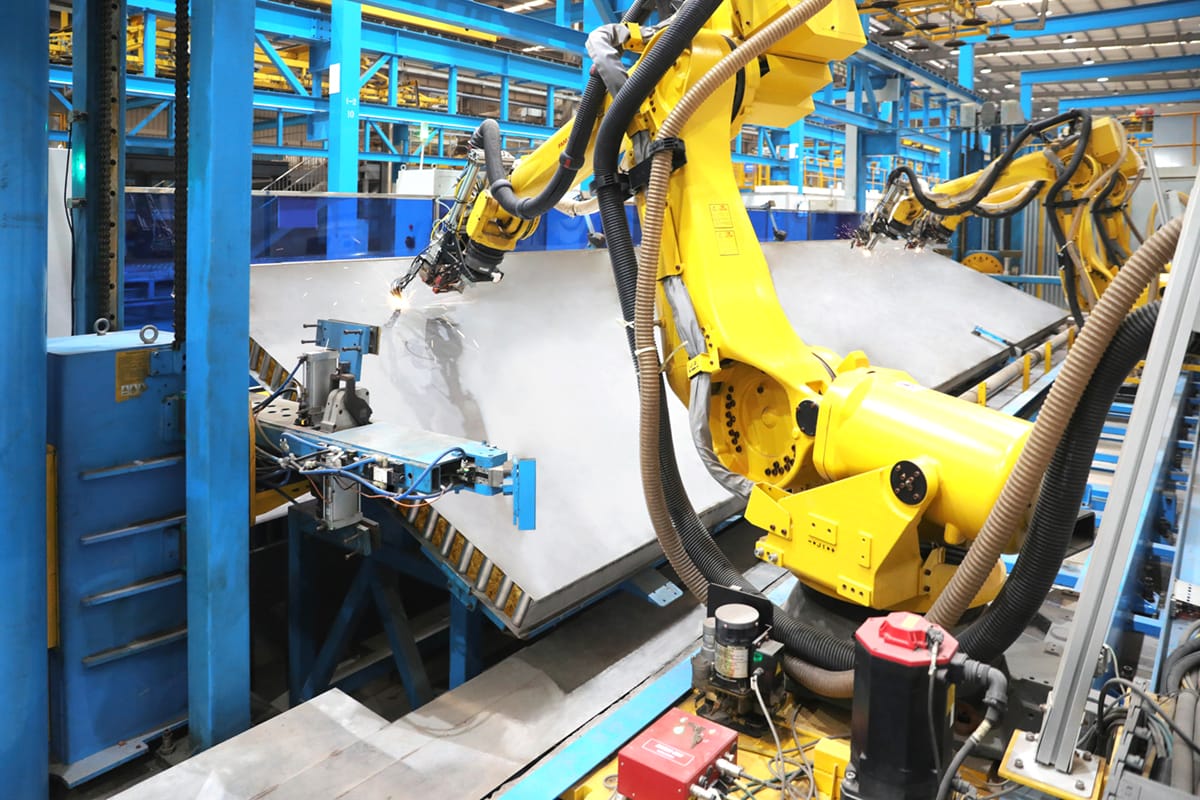
Fabrication of BROAD CORE slabs used in the Holon flooring and roofing systems.
The modules were all manufactured in September 2025, and shipped to Abu Dhabi in October, arriving in 20 days. The Holon structure, interior finishes, and MEP are all 100% prefabricated on streamlined, automated production lines, similar to the automotive industry. The factory is highly automated with robotic production systems, and has a current production capacity of 27 Million sf per year, which translates into about 84,000 container-size modules, or 60,000 housing units. Almost all welding is automated in the factory, and the installation on the job site is through bolting which enables a very fast install.
Sequence
We were fortunate that all 259 modules were stacked within a storage yard adjacent to the construction site, so a separate staging location was not needed. The modules were stacked in 2 layers.
Crane selection is of paramount importance in planning the installation. The selection is based on several key factors: Module hoisting weight (including the module, rigging, local wind load requirements, and safety factors), site conditions, building type, building height, scheduling requirements, and local regulations. For Earth Tower we had a fleet of nine mobile, truck-mounted cranes, including six 100t cranes and three 450t cranes. Of the six 100t cranes, 3 were used for loading the modules onto trucks in the stacking area, and the other 3 are used for unloading and assembly in the module forward preparation area next to the building. The three 450t cranes were then used to hoist the completed modules into their designated positions.
During the construction planning phase, hoisting zones were demarcated for each crane to avoid physical interference, and a sequence is established to avoid simultaneous operation of cranes that could potentially interfere with each other.
We were fortunate that all 259 modules were stacked within a storage yard adjacent to the construction site, so a separate staging location was not needed. The modules were stacked in 2 layers.
Crane selection is of paramount importance in planning the installation. The selection is based on several key factors: Module hoisting weight (including the module, rigging, local wind load requirements, and safety factors), site conditions, building type, building height, scheduling requirements, and local regulations. For Earth Tower we had a fleet of nine mobile, truck-mounted cranes, including six 100t cranes and three 450t cranes. Of the six 100t cranes, 3 were used for loading the modules onto trucks in the stacking area, and the other 3 are used for unloading and assembly in the module forward preparation area next to the building. The three 450t cranes were then used to hoist the completed modules into their designated positions.
During the construction planning phase, hoisting zones were demarcated for each crane to avoid physical interference, and a sequence is established to avoid simultaneous operation of cranes that could potentially interfere with each other.
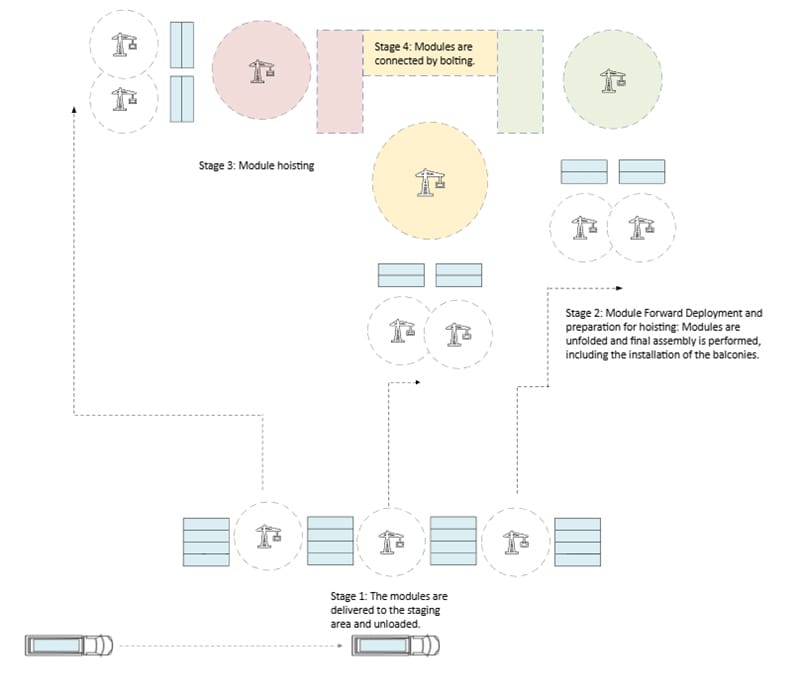
Sequence of Module Setting
Stage 1: The modules are delivered to the staging area and unloaded.
Stage 2: Module Forward Deployment and preparation for hoisting: The modules are transferred from the staging area by 100t cranes to within the operational range of the larger cranes. Another set of 100-ton ground crane picks and places the modules into the forward preparation area, and the modules are prepared for hoisting. Modules are unfolded and final assembly is performed, including the installation of the balconies.
Stage 3: Module hoisting: Three 450t cranes were positioned in three areas along the middle, left and right sides of the building to achieve full coverage of the working area. Within its own boom coverage area, each 450t crane lifts the module into position according to the site layout plan. In general, the crane selection for this step will be based on the actual size and height of the building, in this case a 450t crane was specified.
Stage 4: Modules are connected by bolting. This is then followed by electrical and mechanical connections and applying interior finishes.
Specialized frame spreaders are used for hoisting. Four locking pins of the spreader are inserted into the corner castings at the four corners of the module. The pins are then rotated to complete the locking process (similar to ISO container lifting). Before each module is fully hoisted, a trial lift must be performed: the module is lifted 0.5m (20 in) off the ground and held for 1–2 minutes to check for any abnormalities.
The hoisting sequence starts with the Circulation modules (which house elevators and stairwells and have a balanced weight and are equipped with prefabricated steps for personnel access), followed by the Room modules.
The installation of this building was performed by a local construction team of 90 working under our supervisors, organized into 3 groups of 30 working simultaneously.
Once hoisted and set into position, the modules are bolted together. The bolting method BROAD engineered for the Holon building enables a very fast method of construction.
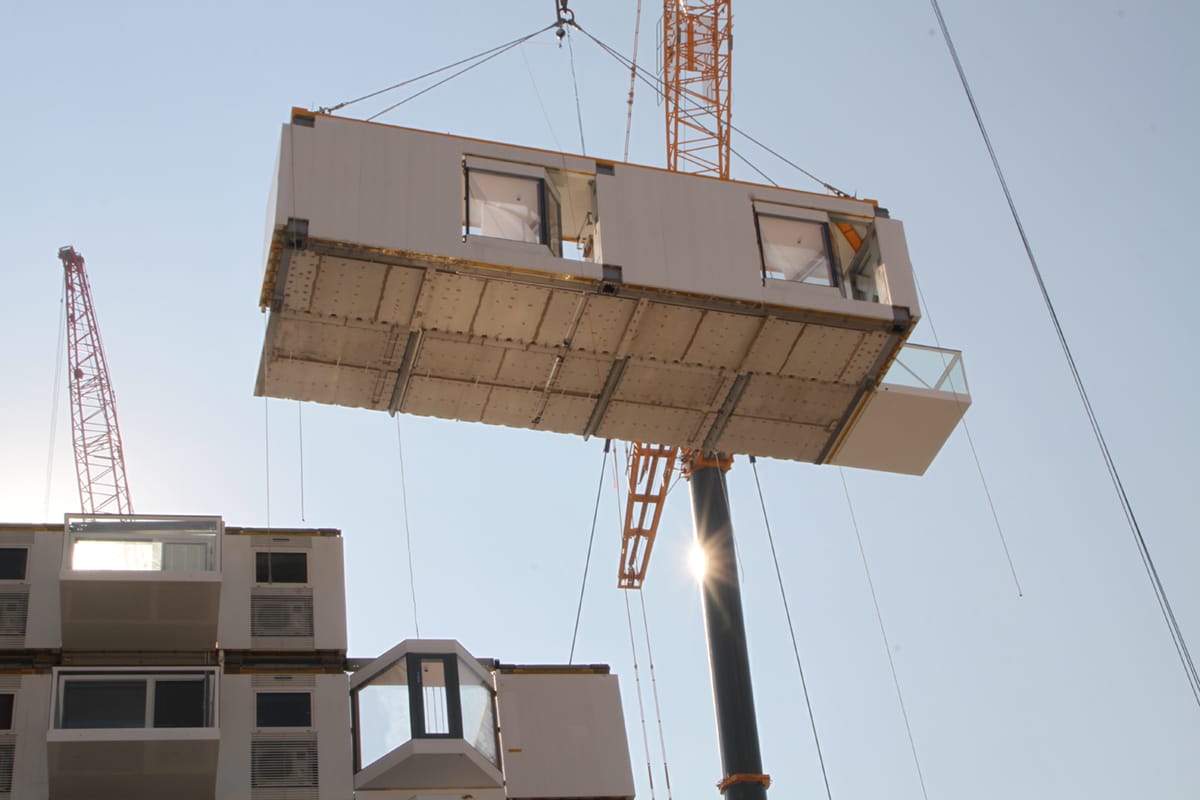
Hoisting a module on the job site.
System
The design, supply chain management, and manufacturing are AI-driven which improves efficiency and ultimately shortens the project cycle. Numerous intelligent robots are used in the automated production process, performing automated calibration and welding, and AI is continuously leveraged to improve cost efficiency.
Efficiency and speed of deployment is incorporated into the building design. The building is delivered to the job site in a turnkey manner with all MEP completed. One key aspect of Holon design is standardized modules. BROAD Holon buildings have just two basic module types: Room modules and Circulation modules that have elevator shafts, stairwells, and also the electricity risers that serve the room modules. Standardized modules can accommodate a Holon building of any building dimension, unit mix or unit area. This streamlines project timelines and better controls costs.
The containerized design of the modules further improves the efficiency and cost of transporting the building across both sea and land. On-site, an efficient bolting process to connect the modules with minimal welding further shortens the project timeline.
Eagle Hill selected the BROAD Holon system for this project for four primary reasons:
- Holon is a stainless steel structure using no concrete. Stainless steel has superior inherent flame retardance and fire resistance, is non corrosive and highly ductile while being 1/10 of the weight of reinforced concrete of the same area which factored into foundation and podium design and costs.
- Holon incorporates European Passive House energy-saving technology such as multi-paned windows, automated sunshades and internal thermal shades, and rock wool insulation to deliver an airtight structure that enables a saving of 90% of energy used for air-conditioning, which is an obvious advantage in the UAE.
- Holon incorporates a BROAD designed ERV (Energy Recovery Ventilation), itself one of the principles of Passive House design, which brings 100% outdoor air into the indoor space across a 3 step filtration with an air to air heat exchanger which cools the incoming air from the outside to about an 80% efficiency. This saves energy and maintains a healthy indoor environment.
- Holon is 100% factory made and delivered to the job site as a turnkey, finished building which simplifies supply chain bottlenecks that are frequently encountered in conventional construction. Shifting all building fabrication to the factory effectively ensures quality, significantly shortens the construction period, and reduces construction waste and carbon emissions, while minimizing disruption to the surrounding community. The fast installation of the building is especially important for the UAE, where temperatures in the summer reach well over 40 degrees C. The weather for this install was perfect, but for future projects, the very fast install will simplify on-site logistics in the UAE regardless of the season, particularly in the summer months which have limited working hours.
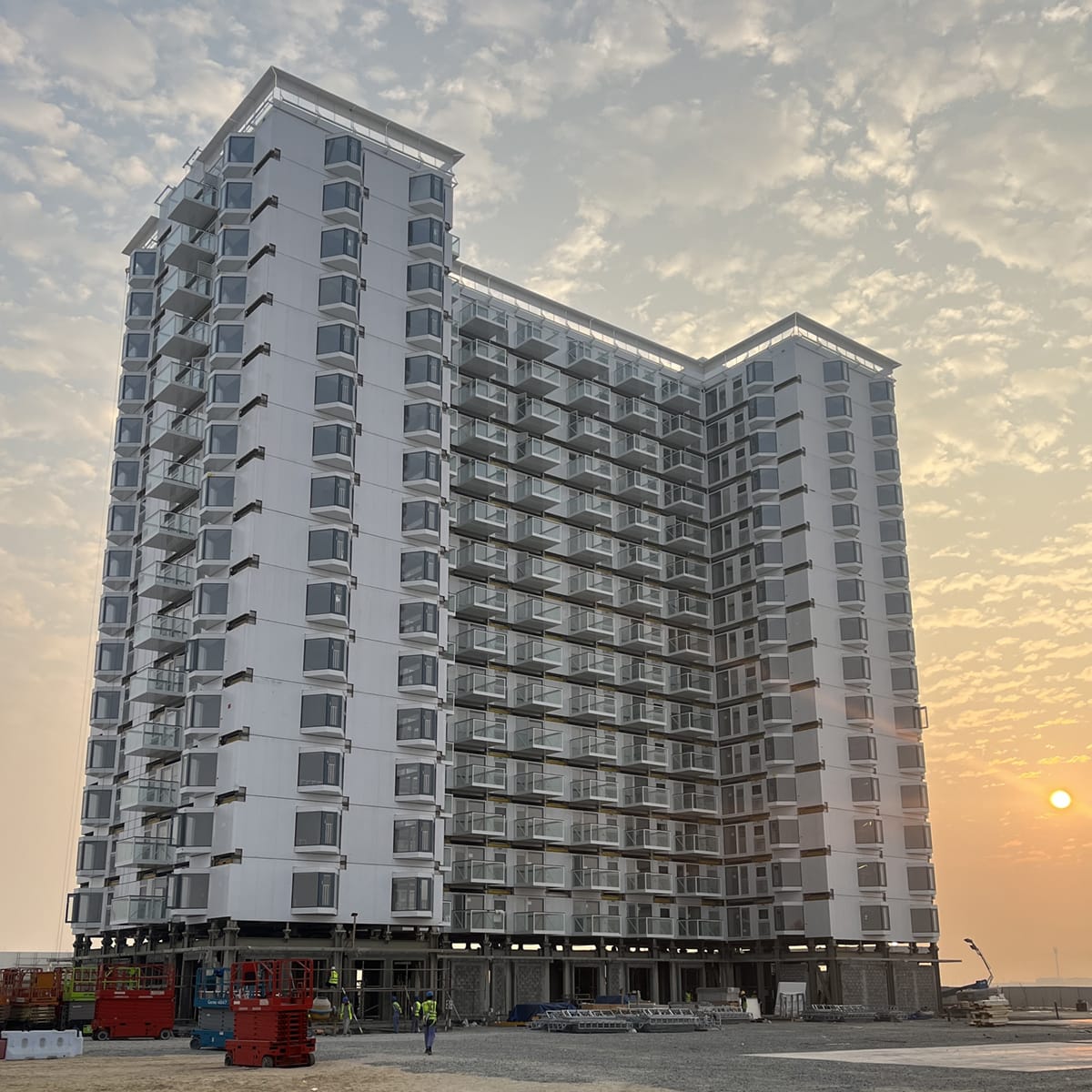
The installation of Earth Tower was completed in 96 hours of hoisting operations over an 12-day period in December 2025.
More from Modular Advantage
How Stack Modular Is Using AI to De-Risk Mid- to High-Rise Modular Construction
Artificial intelligence is no longer a future concept in modular construction—it is already reshaping how complex buildings are evaluated, designed, and delivered.

Gearing Up for the 2026 World of Modular
The Modular Building Institute (MBI) is bringing its global World of Modular (WOM) conference and tradeshow back to Las Vegas in April, and with it comes some of the industry’s best opportunities for networking, business development, and education.

MBI Announces First Ever Industry Apprenticeship Program in Collaboration with Marshall Advanced Manufacturing Center
MBI recently agreed to partner with Marshall Advanced Manufacturing Center (MAMC) to provide bona fide USDOL-approved apprenticeship programs for the industry.
AoRa Development Aims for New York’s First Triple Net Zero Building Using Modular Methods
More cities are providing funding for newer infrastructure projects as long as they meet sustainability requirements. This is how modular can fit the bill, thanks to its lower waste production.
Developers and Designers: Lessons Learned with Modular Design
Modular construction is attractive to many developers because sitework and module construction can occur simultaneously, shortening the schedule and reducing additional costs.
UTILE: Putting Modular Building on a Fast Track
In Quebec, UTILE is taking the lead in creating affordable modular buildings to help decrease the student housing shortage. During the process, the company discovered what it takes to make the transition to modular building a success.
Sobha Modular Teaches Developers How to Think Like Manufacturers
With its 2.7 million square foot factory in UAE, Sobha Modular is bringing both its high-end bathroom pods to high-end residences to Dubai while developing modular projects for the U.S. and Australia.
RoadMasters: Why Early Transport Planning is Make-or-Break in Modular Construction
In modular construction, transportation is often called the “missing link.” While it rarely stops a project outright, poor planning can trigger costly delays, rerouting, and budget overruns.
Navigating Risk in Commercial Real Estate and Modular Construction: Insights from a 44-Year Industry Veteran
Modular projects involve manufacturing, transportation, and on-site assembly. Developers must understand exactly what they are responsible for versus what they subcontract. Risk advisors should research the developer’s contractors, subcontractors, and design-build consultants—especially the modular manufacturer.
Art²Park – A Creative Application of Modular and Conventional Construction
Art²Park is more than a park building—it’s a demonstration of what modular construction can achieve when thoughtfully integrated with traditional materials. The use of shipping containers provided not only speed and sustainability benefits but also a powerful structural core that simplified and strengthened the rest of the building.