
Multifamily Housing
Mind the Gap: The Interface Between Onsite and Offsite Construction
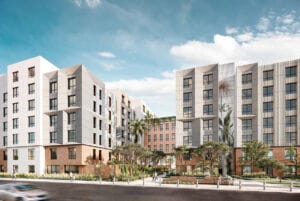
Every design for manufacture and assembly (DfMA) project — modular, mass timber, or panelized — is really two projects joined at a seam. One is built in a controlled factory to millimeter tolerances; the other in the field, in weather, to the looser tolerances of poured concrete and human hands. Between them sits an interface: where the factory’s precision meets the site’s reality.
Read MorePrecision and Possibility: Demands of DfMA and What Modular Mass Timber Makes Possible
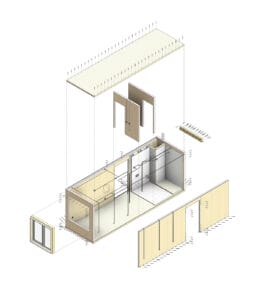
Mass timber does not automatically create an efficient modular building. Its precision makes early coordination more important: fabricated components will accurately reproduce both the team’s solutions and its mistakes. The material’s advantages are realized only when supported by an equally precise design and delivery process.
Read MoreModular by Design: Turning Architecture into a Manufacturing System
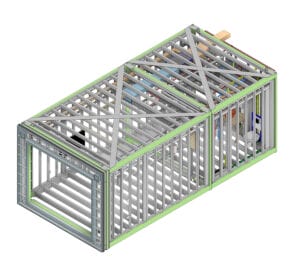
Modular construction is often presented as a faster way to build. Speed, however, is only one part of its value. The larger opportunity is to create a coordinated design and production system that improves quality, reduces uncertainty, and allows a building to move efficiently from concept design through manufacturing, transportation, installation, and completion.
Read MoreRepeatability Begins with Trust: What Alora at Dry Creek Reveals About Scaling Modular Housing
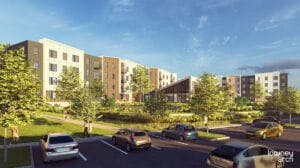
Alora at Dry Creek, a 329-unit, multifamily community comprising five four-story buildings in Centennial, Colorado, demonstrates how repeatable design, standardized manufacturing and early collaboration can work together to create a model that is not only faster to deliver, but easier to replicate across future projects.
Read MoreAffordable Housing, One Module at a Time
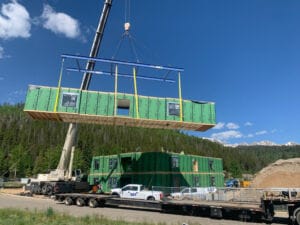
For builders and developers, modular factories offer significant scheduling and cost efficiencies compared with traditional site-built construction, regardless of whether the final product is workforce housing, single family homes, or apartment buildings.
Read MoreAdvancing Modular Housing Policy in California: An Interview With Tyler Pullen of Terner Labs/UC Berkeley’s Terner Center for Housing Innovation

Artificial intelligence is no longer a future concept in modular construction—it is already reshaping how complex buildings are evaluated, designed, and delivered.
Read MoreNew High-Rise Modular Apartment in Abu Dhabi Points Toward the Future of Multifamily Construction
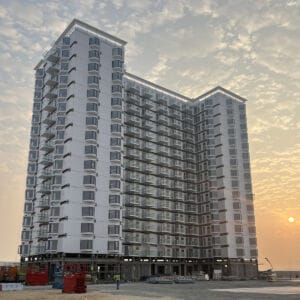
Eagle Hills International Properties chose the BROAD Holon Building for a 16-story market rate apartment building in Zayed City, a central business district of Abu Dhabi. The project highlights the potential of the Holon system of volumetric modular construction to accelerate housing delivery.
Read MoreAoRa Development Aims for New York’s First Triple Net Zero Building Using Modular Methods
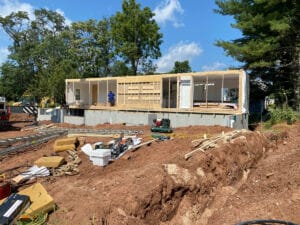
More cities are providing funding for newer infrastructure projects as long as they meet sustainability requirements. This is how modular can fit the bill, thanks to its lower waste production.
Read MoreUTILE: Putting Modular Building on a Fast Track
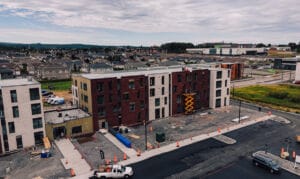
In Quebec, UTILE is taking the lead in creating affordable modular buildings to help decrease the student housing shortage. During the process, the company discovered what it takes to make the transition to modular building a success.
Read MorePomeroy Employee Housing
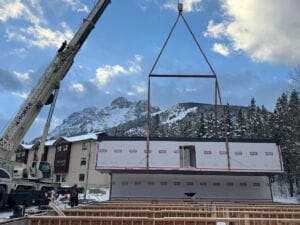
The Pomeroy Lodging Employee Housing complex in Kananaskis, AB, is a 24,194 sq. ft., three-story structure with 57 studio units and a communal main-level area, designed for full-time employees and comprised of 36 prefabricated modules.
Read More