European Company iQ Module Bets The Future on Shared Tech, Tools, and Partnerships
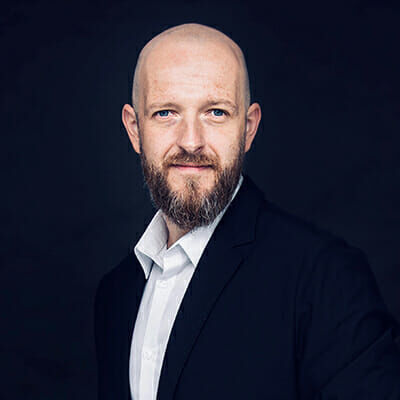
Kris Droszcz is the founder and CEO at iQ Module, partner at iQ Module|Bud-Invest Group, and business development manager and leading architect at the architectural studio Rebel Concept.
Kris Droszcz comes from a family of architects and engineers, as his father (who still works as an architect) and grandfather before him. Jokingly, he calls it the family curse. But as the CEO and founder of iQ Module and Rebel Concept, you could say his curse is now a real blessing for the modular construction industry. iQ Module—based out of Gdansk, Poland—has grown exponentially as a company, with offices in Germany and Denmark. The company has also embarked on an ongoing joint venture and partnership with Roger Krulak of FullStack Modular for projects in the U.S. and around the globe.
Design-wise, iQ Module has now developed over 200 projects since its inception as a spin-off of Rebel Concept in 2009. Their first project, a public bid on a six-story modular building in Gdynia, Poland, launched them into the world of modular construction.
As Droszcz puts it, it was quite the struggle as they had to not only translate zoning regulations and specs from other countries, to even reaching out to local construction companies like Marbud and Studio Kwadrat to help them design and construct the first ever modular building in the region.
“We had to find solutions across Europe and the United States, wherever we were traveling or reading about, and trying to make the building permit and the technical specs accurate, according to our local coding,” he said. “For the second bid, there was no one to apply for building the building because no one knew how to build this kind of structure. So we figured, ‘we can make a team and build it ourselves.’”
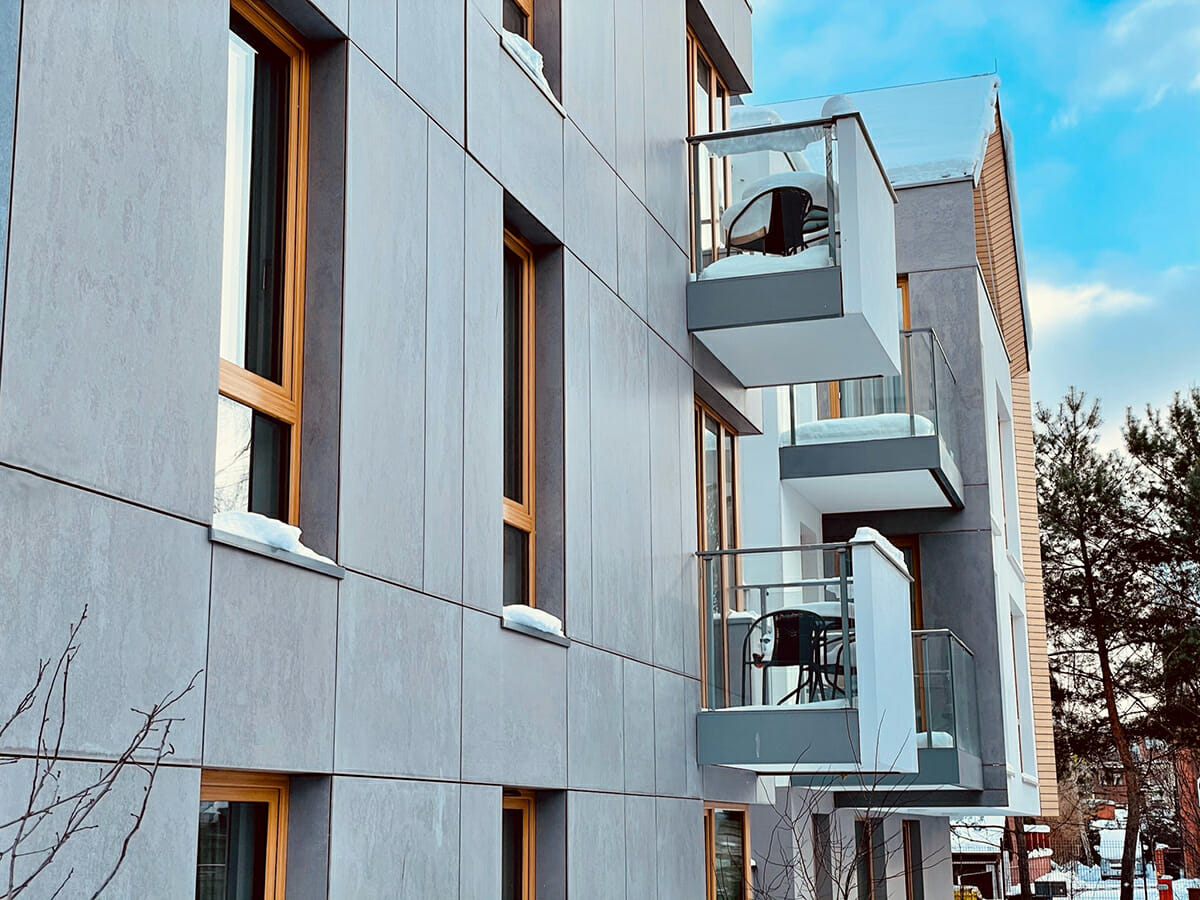
The team won a number of design awards for their innovative approach using modular building, giving them a platform to continue working in the industry. iQ Module and its partners have now designed and developed about 80 modular-specific projects, varying from three-story residential buildings to high-rise buildings for hospitality, student housing, and multi-family homes.
Say ‘Yes’ and Figure Out The Rest
The philosophy of saying yes to projects and working in partnership with others has served the business well over the past few years, especially when iQ was looking at how to pivot during the pandemic.
“We don’t have a limit. Some say, ‘the sky is the limit,’ but I don’t see a limit. You know, we can do Mars, or the Moon,” he joked. “But, that’s the best way to work. Don’t have any boundaries. Team up. Share. Learn from your failures, learn from your partners, and improve your technology by working together.”
As COVID-19 paused travel across the world, Droszcz and his company brainstormed ways to continue the expansion of iQ Module—which was poised at the time in 2020 to start projects in the U.S. They were cut off from their clients, says Droszcz, and couldn’t bring either materials or staff over to continue projects in the States.
“We had to figure out what to do, not as a huge production company, but to provide our design services to others, and partner remotely with a lot of companies to use their facilities and their resources to support any local market that we want,” he said.
That’s where the shift happened, where they started embodying what they consider to be the future of modular construction and the industry at large.
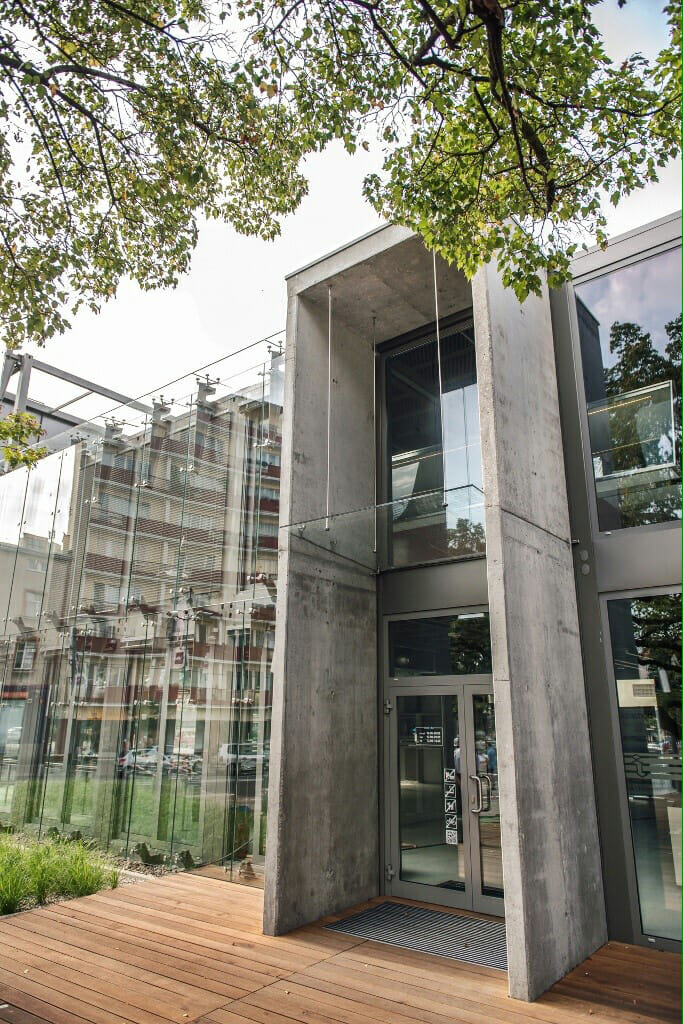
“Sharing is the future for all of us,” says Droszcz. “This is for all industry’s sake, and what we figured is the best to do.” Ultimately, the firm’s belief in striking partnerships across the globe has led to its largest partnership to date.
In the U.S., iQ Module is working with FullStack Modular to develop projects in California and New York. In Asia and the rest of the world? Kris and his team have some projects in the works there too—including a very large project in Saudi Arabia, the first of its kind in the Middle East. Details are mum for now, but you can expect to see some news soon.
The philosophy of sharing not only business, but clients, projects, and designs would not have been possible without building information modeling.
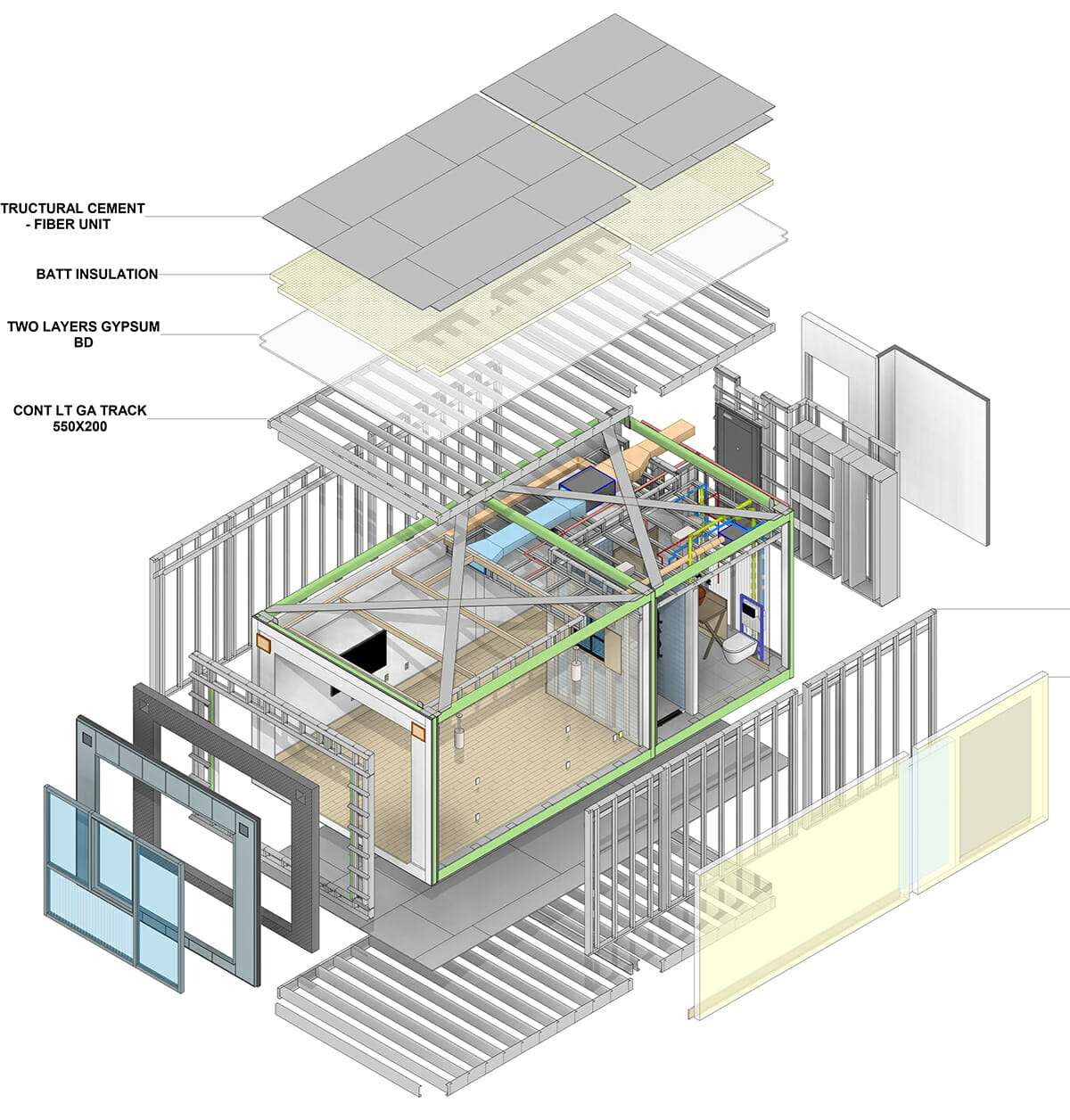
BIM is the Backbone of iQ Module
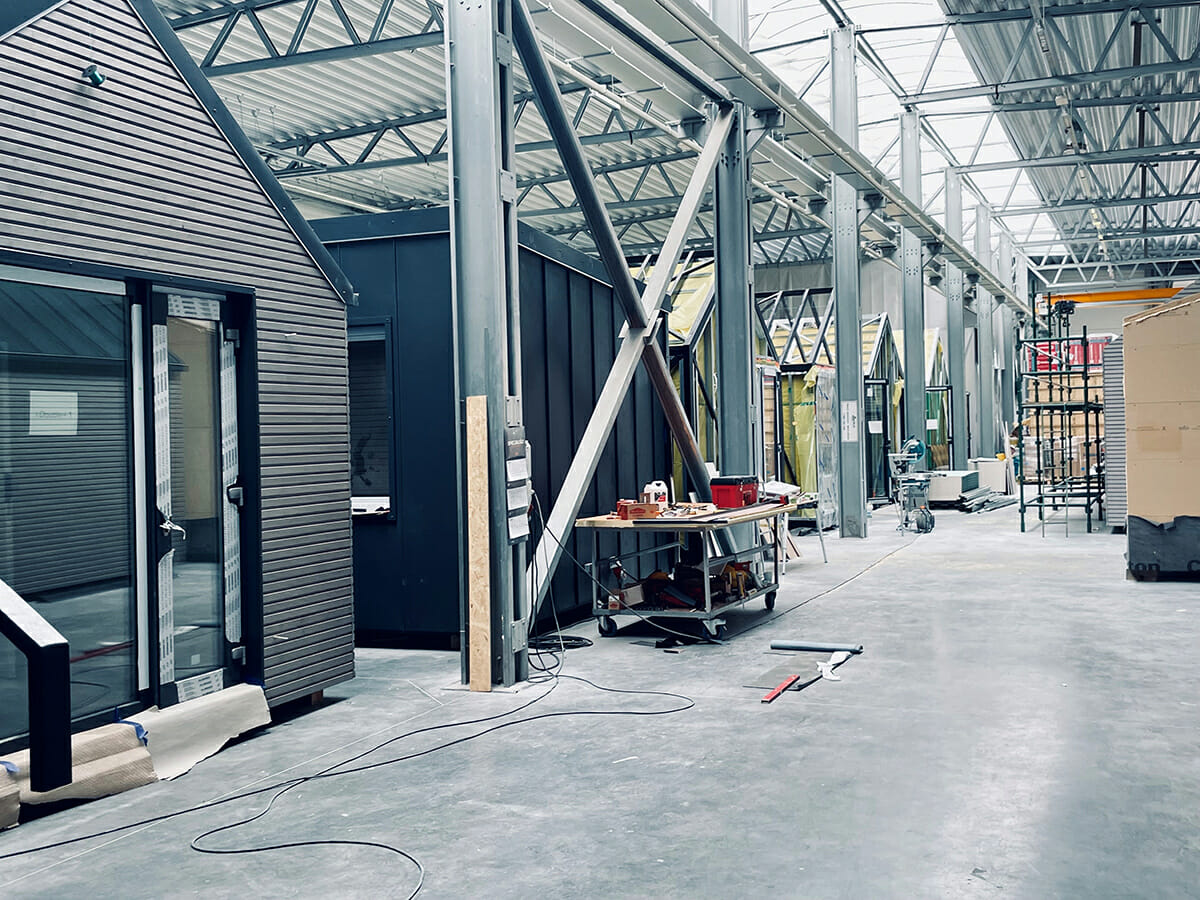
Over the years, iQ Module has evolved to be an all-in-one solutions based company for anyone interested in construction. For them, business is more than just developing designs, structural plans, and ensuring code compliance, leaving the rest up to general construction companies on the ground. BIM is woven throughout every step that iQ Module takes with the team when working on a new project, such as:
- Developing architecture plans alongside engineers and local code specialists
- Providing information on design loads, construction materials
- Existing climate concerns such as seismic loads, flooding, wind loads, and more
- Furniture production and interior design
The execution of a digital twin is crucial, says Droszcz, to see how a building will coexist with a surrounding neighborhood and remaining resilient to any ground conditions unique to the region.
It’s also one that iQ Module has bet its future on.
“I cannot imagine myself building anything today without a well-prepared design containing all the information and modeled elements of the building,” said Droszcz. “For us, it’s the integrity of the whole build process. So you can’t say it’s an add-on to your process. This is your process. This is how you should process the building design to execution.”
It has been quite a few years since the industry on the whole has evolved from using pen and paper to produce blueprints. Nowadays, tools like Autodesk Revit are now the most cost-effective way to execute a building from start to finish. The ability to have dynamic changes reflected in real time can mean the difference between meeting budget guidelines or spending a lot of capital to compensate for a small mistake.
“The design is the first thing that you have to invest the most in. If you don’t think that you have to spend a lot of money on the design process and preparation for the project, you’re going to fail,” says Droszcz.
Tack on augmented reality or VR tools, and it becomes possible to see yourself in a building of your own making. For example, you can manipulate the view of the steel structure of a high-rise hotel building, or look at how a material choice affects a multi-story residential building right in front of you.
The Future Is More Than Just Industry Growth
Alongside the technological advances made in the industry, Droszcz is hopeful that modular construction will take a larger piece of the pie. A world where 30 percent of the market is solely modular based building would be great, he says. And part of that is tied to ubiquity of BIM, which allows for companies like iQ Module to be successful through repetition and efficiency.
“We want to be able to listen to what the market needs and, and be responsive to what’s going on around us,” he says. “I think the best strategy is to listen to the world…[and to] get as efficient of a repeatable structure and product as you can, that you can also change easily.”
That said, there are just some things that you cannot escape, like meeting all the relevant zoning requirements set out by the city, state, and country for each project. When you layer on environmental or particular ground conditions, it becomes more than just making sure you check off all the boxes for compliance. Which can be challenging on top of simply designing a project, says Droszcz.
But on the whole, these challenges have not stopped iQ Module from growing. On top of two new offices in Denmark and Germany, the group has expanded to a staff of over 320 people. There are also the modules themselves, which have increased ten-fold per project, with about 1200+ modules scheduled to be designed by the Denmark office alone in 2023.
Over the next five years, iQ Module is looking to become one of the biggest modular building and design companies in the industry as well as internationally. One sign that they are well on their way is the reception to Droszcz’s talk at the MBI European Summit in October of 2022. While iQ Module’s work is largely based in the Northern Hemisphere, Droszcz says he was surprised by the worldwide interest.
He’s taken calls from interested parties from South American countries that want to work with iQ Module—and not just to design buildings. Some firms are looking for help in setting up tech solutions like BIM in existing facilities or to have iQ Module work in tandem with other companies’ R&D teams. All these requests fall in line with Droszcz’s business philosophy of sharing knowledge and developing partnerships in order to grow the modular building industry.
What to Expect from iQ Module at World of Modular
This is iQ Module’s fourth year attending World of Modular and Droszsz’s second time speaking. Combined with the 40th year anniversary, he is hoping this year will be bigger than ever. In fact, World of Modular has been one of the best networking opportunities for Droszcz and his team.
“[Attending] was one of the best decisions that we could make internationally for developing our contacts,” said Droszcz. “Through World of Modular, I have met a lot of my current partners, vendors, and most of the engineering company partners we work with.”
Droszcz is scheduled to lead a breakout session titled “How to BIM Your Project the Right Way!” He says the talk will feature not only case studies on how to use BIM effectively, but also 3D printed models, and opportunities for the audience to use AR and VR to interact with building models. He is also hoping to provide sneak peeks into upcoming iQ Module projects with FullStack Modular.
iQ Module will be at Booth #706 and #708 in partnership with FullStack Modular talking about their all-in-one modular integrated solutions.
About the Author: Karen P. Rivera is a freelance writer and editor with a passion for storytelling. She is a former United Nations-based reporter, with experience covering international breaking news, venture capital, emerging healthcare tech, and the video game industry.
More from Modular Advantage
MBI Town Halls 2026: Reflections from Boston
By the end of 2026 MBI’s Government Affairs team will have traveled over 6,000 air miles to bring Town Hall events to five different cities in two countries.
Mind the Gap: The Interface Between Onsite and Offsite Construction
Every design for manufacture and assembly (DfMA) project — modular, mass timber, or panelized — is really two projects joined at a seam. One is built in a controlled factory to millimeter tolerances; the other in the field, in weather, to the looser tolerances of poured concrete and human hands. Between them sits an interface: where the factory’s precision meets the site’s reality.
Rules, Rails & Repeatability: Applying DfMA to Modular Healthcare
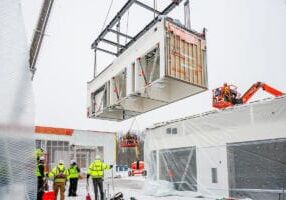
DfMA offers several advantages for healthcare projects, with faster delivery among the most valuable. Schedule matters when building new facilities, expanding campuses, renovating existing space or bringing care closer to communities that need it.
Precision and Possibility: Demands of DfMA and What Modular Mass Timber Makes Possible
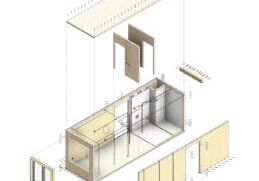
Mass timber does not automatically create an efficient modular building. Its precision makes early coordination more important: fabricated components will accurately reproduce both the team’s solutions and its mistakes. The material’s advantages are realized only when supported by an equally precise design and delivery process.
Catch It in the Factory, Not in the Field: Smarter Testing for Modular Builds
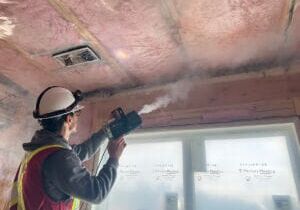
Integrating watertightness and airtightness testing into factory workflows transforms quality assurance from a reactive process into a proactive commissioning strategy. It ensures that every module shipped is field ready and resilient for transportation while also supporting the ability of the modular construction industry to make buildings better.
Modular Construction Contracts: Key Considerations for Successful Canadian Projects
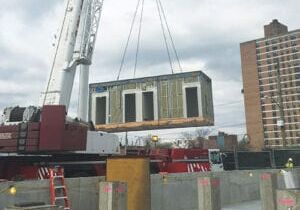
Starting a modular project with a well-developed contract protects both the owner and the contractor. It will help keep the project on track and on budget, and it will improve quality from the factory floor to final installation on-site.
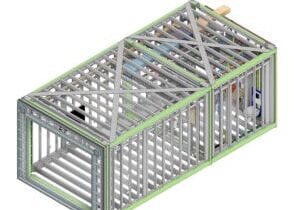
Modular by Design: Turning Architecture into a Manufacturing System
Modular construction is often presented as a faster way to build. Speed, however, is only one part of its value. The larger opportunity is to create a coordinated design and production system that improves quality, reduces uncertainty, and allows a building to move efficiently from concept design through manufacturing, transportation, installation, and completion.
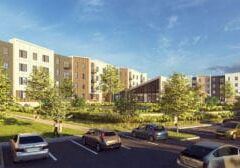
Repeatability Begins with Trust: What Alora at Dry Creek Reveals About Scaling Modular Housing
Alora at Dry Creek, a 329-unit, multifamily community comprising five four-story buildings in Centennial, Colorado, demonstrates how repeatable design, standardized manufacturing and early collaboration can work together to create a model that is not only faster to deliver, but easier to replicate across future projects.

T.R. Arnold: The Art of Third-Party Inspections
T.R. Arnold (TRA), a third-party inspection company in Elkhart, Indiana, contracts with modular manufacturers across the US. Manufacturers register with each state to which they intend to send their modules and may be required to hire a third-party inspection company.
Creating an ‘Ecosystem for Innovation:’ 50+ Years of Modular Construction Oversight in Virginia
Virginia’s modular building program began in 1973, with the implementation of the Virginia Industrialized Building Unit and Mobile Home Safety Regulations. Now it’s leading the country in modular code adoption.