MBI Leads the Charge for Passage of Amendment for New York’s Prevailing Wage Law, Protecting Modular Industry
- In December 2025, over MBI’s strenuous objections, New York Governor Kathy Hochul signed S.2536a, which expanded the state’s prevailing wage law to cover “off-site custom fabrication.” “Modules” were specifically cited for coverage under prevailing wage law.
- After close coordination between MBI, the bill’s sponsor, and Gov. Hochul’s office, the sponsor introduced A.9464, as a “clean-up bill” that explicitly stated “modules” were not to be considered “custom fabrication.”
- This amendment effectively exempts the modular industry from the fiscal and compliance burdens of prevailing wage.
Setting The Stage
Last year, at the end of the session, the New York State legislature quickly passed S.2536a, an enormous expansion of prevailing wage law. This bill brings prevailing wage coverage to “off-site custom fabrication,” specifically calling out “portions or modules of the building or [public works project].”
Given the explicit mention of “modules,” coupled with the mandate to enforce this law in other “jurisdiction[s] outside the state,” S.2536a as originally adopted posed an existential threat to our industry in New York and beyond.
While MBI advocated strongly for the legislature to vote against the bill, and again for the governor to veto it, ultimately, there was too much momentum and pressure from proponents in Albany to prevent it from becoming law.
MBI Action
MBI retained the services of a lobbying firm with deep connections to key state legislators and Governor Kathy Hochul’s office. Through a coordinated campaign of education and member activation, MBI was able to come to an agreement with the sponsor to introduce a “chapter amendment” or “clean-up bill”. That bill, A.9464 almost entirely exempts the modular industry from prevailing wage coverage.
In the images below, you can see clearly how the original bill would have directly impacted the modular industry, and how the chapter amendment reverses course.
Before:
Important Definitions - “Custom Fabrication” and “Significant Portion of Building or Work”

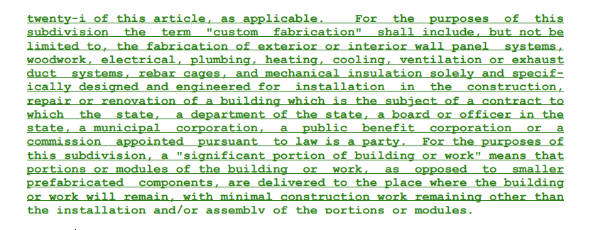
- “Custom fabrication” is defined without limitation [i.e., “the term ‘custom fabrication’ shall include, but not be limited to...”].
- “Significant portion of building or work” expressly included “portions or modules of the building or work.”
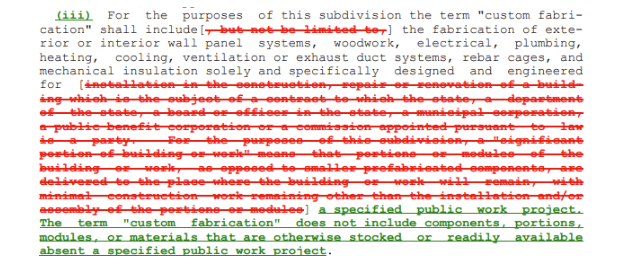
- “Custom fabrication” limited only to the listed components [“but not be limited to” is struck out], and expressly excludes “components, portions, modules, or materials that are otherwise stocked or readily available absent a specified public work project.”
- The qualifying language “otherwise stocked or readily available” is concerning. However, we will advocate for clarity during the administrative rulemaking process ahead of the law’s implementation.
Out-Of-State Enforcement
Before:
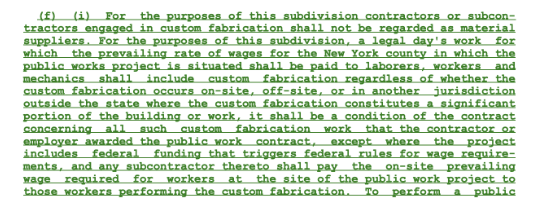
- Payment of prevailing wage required “whether the custom fabrication occurs on-site, off-site, or in another jurisdiction outside the state...”
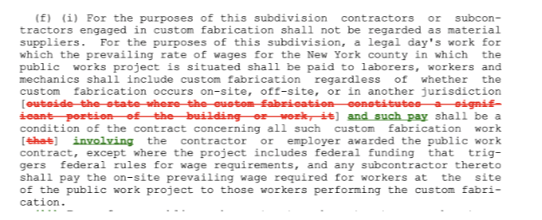
- “Outside the state” was struck out.
- While the definition of “jurisdiction” is unclear, we will strive to narrow it down as much as possible during rulemaking.
- Because rates still may be set through contracts, it is imperative that if you engage on public projects in New York, you enquire early on about wage rates.
Acknowledgements and Next Steps
MBI would like to thank the bill’s sponsor Assembly Member Harry Bronson, Gov. Kathy Hochul’s office, and other industry stakeholders for their collective effort to hear our concerns.
This chapter amendment represents a significant compromise between all parties, and we appreciate every participant’s time and consideration for our industry’s needs. We believe this legislation - as amended - will allow the modular industry in New York to continue to thrive.
Read Additional Monthly Updates
MBI Town Halls 2026: Reflections from Boston
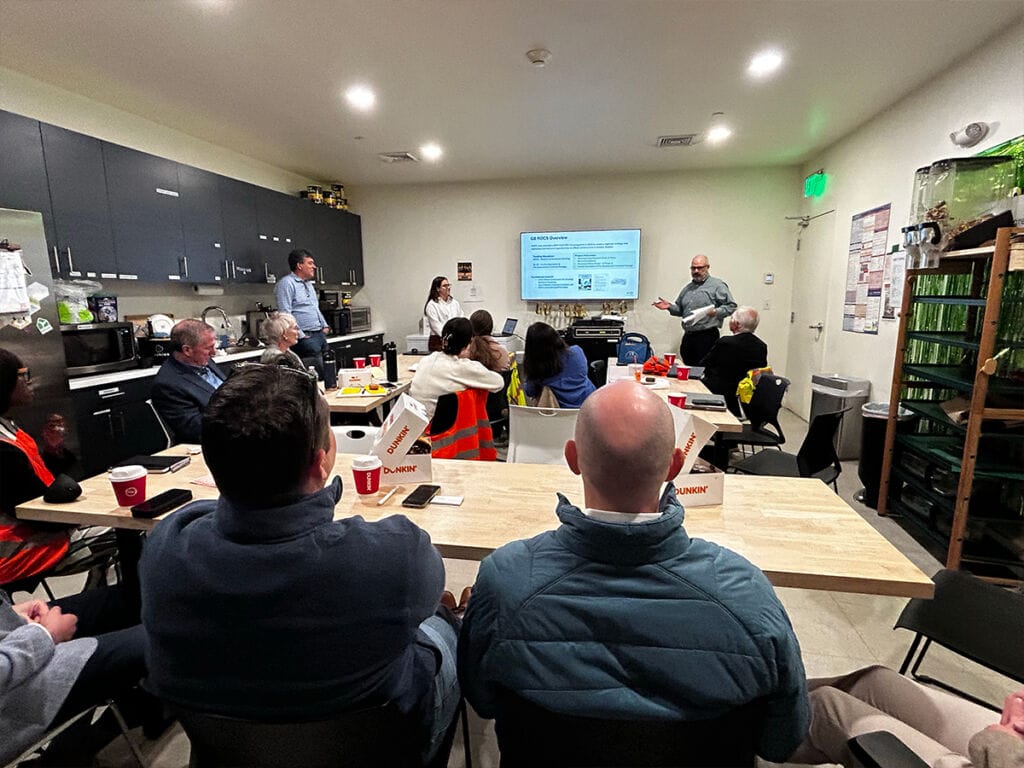
By the end of 2026 MBI’s Government Affairs team will have traveled over 6,000 air miles to bring Town Hall events to five different cities in two countries.
MBI Statement on Sen. Bill Hagerty’s Freedom To Build Act
MBI Statement on Sen. Bill Hagerty’s Freedom To Build Act The Modular Building Institute is proud to offer its strong support for Sen. Bill Hagerty’s (R-TN) Freedom to Build Act. Introduced in March, the Freedom to Build Act addresses several of MBI’s longstanding policy goals by confronting two severe pain points in the modular development process: lack of…
MBI Statement on SB 908 Passing Labor & Industry Committee
MBI Statement on SB 908 Passing Labor & Industry Committee Earlier this week, Senate Bill 908, which would expand prevailing wage into modular factories, passed 11-0 out of the Labor & Industry Committee. MBI is disappointed to see unanimous support for a policy that will almost certainly destroy the modular industry’s ability to participate in…
MBI Hails Washington State House Passing ICC/MBI 1200 Standards Adoption Bill, Urges Senate To Follow
MBI Hails Washington State House Passing ICC/MBI 1200 Standards Adoption Bill, Urges Senate To Follow With housing a top issue for policymakers across the country, legislators in Washington are taking meaningful steps to increase the supply in the Evergreen State. First, we want to applaud the State House of Representatives for their unanimous passage of House Bill 2151, which will tackle one of…