
The Blueprint for Smart and Ethical AI Integration in Your Business

José Manuel Mateu de Ros is the Founder and CEO of IQube and Zertia.
In 1997, a milestone in artificial intelligence (AI) was reached when IBM’s supercomputer Deep Blue defeated world chess champion Garry Kasparov. For the first time, a machine outplayed a human in a game long considered the pinnacle of strategic thinking. Fast forward to today, and AI isn’t just winning games—it’s driving cars, diagnosing diseases, and even designing living organisms, such as plants or bacteria for biofuel production. AI is defined as any technology that simulates human intelligence, although in the case of Deep Blue, we could argue it even surpassed it. But what does it mean to be intelligent? It’s the ability to learn to recognize patterns and project those patterns into the future.
To illustrate this concept, consider a simple example: we wouldn’t attribute intelligence to a rock, but a dog certainly qualifies. Take Pavlov’s famous experiment—his dogs learned to associate the sound of a bell with food, leading them to salivate even before seeing the food. This ability to identify patterns and anticipate outcomes is a fundamental form of intelligence, much like what AI systems do when analyzing data to identify trends and make predictions.
But how did AI evolve from winning chess games to becoming such a transformative force in our daily lives? The turning point came in November 2022, when, for the first time, the public gained free access to a highly advanced AI model through an intuitive user interface. This type of AI—known as generative AI—differs from traditional AI. While traditional AI is designed to analyze and interpret existing data, generative AI focuses on creating entirely new content. For example, where traditional AI might suggest a movie, generative AI can write an original story, generate an image, or even design a product from scratch.

The Impact of AI
Generative AI has the potential to automate 60% to 70% of current workplace activities, increasing labor productivity by 0.1% to 0.6% annually through 2040. The use of AI in business can lead to significant improvements in efficiency and profitability by automating repetitive tasks and streamlining workflows. For instance, Amazon leverages AI to optimize logistics and supply chains, improving delivery speed while cutting expenses. Additionally, AI chatbots have proven to increase customer service productivity by up to 45%, handling inquiries faster and more effectively.
Beyond automation, AI enhances decision-making by analyzing vast datasets in real time, allowing companies in finance and manufacturing to optimize operations like route planning, fraud detection, and predictive maintenance. Moreover, AI fosters innovation, particularly in research and development. A concrete example includes algorithms developed at top institutions like the University of California that have reached 92% accuracy in diagnosing diseases up to six years earlier than traditional methods by detecting patterns that are often invisible to doctors.
Best Practices for AI Integration
However, for AI to deliver its full potential, it is crucial to integrate it with strategic intent rather than indiscriminately applying AI in the hope of solving various issues. The organizations that succeed in implementing AI do not view it as a “hammer in search of a nail.” Instead, they use AI as a targeted tool to address specific problems, whether these challenges are internal or pertain to customer needs.
The first step in this process is to clearly define your intention behind the implementation of AI. A recommended approach is to start by identifying the specific problems you aim to solve. For example, you might find that customer service response times have increased by 30% this quarter, or that customer acquisition costs have risen significantly over the year.
Once the key pain points have been identified, the next step is to analyze which of these challenges could be addressed through AI. Investing time in learning about AI’s potential is key.
Another effective strategy is to approach the process from a use-case perspective. To do this, create an inventory of all the activities you perform on a daily basis, documenting each task in detail. Once you have this comprehensive list, you can reflect on which activities are particularly time-consuming, repetitive, involve handling large amounts of data, require making predictions, or are centered on content generation and text-heavy tasks.
Track the time spent on each task per month, their frequency, and assign a value to the potential benefit automation could bring. It is also advisable to start by implementing pilot projects with a small group of users, testing the effectiveness of AI tools before investing in a widespread rollout. Each employee in the group can apply one of the two methodologies used; for example, sales representatives might use AI to automate personalized email responses, while analysts could leverage AI to generate more precise and faster reports. Setting clear KPIs over a 90-day period will allow businesses to track how AI is solving problems or increasing efficiency compared to how tasks were performed without these tools.
By closely monitoring the use of AI tools, organizations can pinpoint areas where the technology delivers real value and identify where additional training or adjustments are needed. This also helps in deciding whether to scale up or down on AI investments. Additionally, pilot programs can reveal internal champions—employees who not only witness firsthand the benefits of AI but are also passionate about technology and naturally adept at using it.
Another common pitfall in AI adoption is assuming that merely implementing technology will automatically create value. Despite substantial investments in artificial intelligence by companies like Chevron, many businesses continue to struggle with realizing its full potential. Chevron’s recent efforts to implement AI tools such as Microsoft Copilot and internal chatbots have not yet yielded concrete results, leading its CIO to question the effectiveness of these technologies. For AI to truly take root, employees need tailored training programs that address their specific needs and roles. Relying solely on vendor-provided training can be limiting, as it often focuses on the technical aspects of the product without addressing how AI integrates into day-to-day business operations.
Mitigating Key Risks in AI Adoption
Other risks to consider for sustainable implementation that companies need to monitor are AI hallucinations, data privacy and security, change management, and regulatory compliance.
Hallucinations occur when AI systems generate false or misleading information. This phenomenon can be especially dangerous, as AI may present fabricated facts as if they are accurate. For instance, in recent legal cases, lawyers faced severe consequences after relying on AI-generated fictitious precedents. This highlights the importance of viewing AI as an assistant that complements human work rather than as an autonomous creator.
Data privacy and security are paramount concerns in the era of AI. AI systems rely on vast amounts of data for their operation and training, which can introduce new vulnerabilities. Poor data handling, such as insecure storage, unencrypted transmission, or unauthorized access, can lead to significant privacy violations. Furthermore, many AI systems interact with external applications and services through APIs, which, if not properly secured, can provide attackers with opportunities to exploit these systems.
Change management is crucial when transitioning to AI technologies, as resistance often arises from fears of job displacement and skill obsolescence. To successfully manage this transition, companies must clearly define and communicate the goals of AI adoption, ensuring that all stakeholders understand the intended outcomes.
Regulatory compliance is a major challenge as governments struggle to keep up with the rapid evolution of AI, and many countries lack a clear framework. Combined with differing national regulations, establishing universal standards is nearly impossible, creating uncertainty for businesses. Therefore, one of the biggest challenges is for companies to stay up-to-date with regulations affecting their models and remain agile to ensure compliance.
The journey toward smart and ethical AI integration involves crafting a strategic vision that aligns AI’s transformative potential with your organizational goals. True success with AI is measured by its capacity to enhance human capabilities, foster sustainable growth, and generate value for all stakeholders while actively avoiding ethical pitfalls and harmful risks.
More from Modular Advantage

MBI Town Halls 2026: Reflections from Boston
By the end of 2026 MBI’s Government Affairs team will have traveled over 6,000 air miles to bring Town Hall events to five different cities in two countries.

Mind the Gap: The Interface Between Onsite and Offsite Construction
Every design for manufacture and assembly (DfMA) project — modular, mass timber, or panelized — is really two projects joined at a seam. One is built in a controlled factory to millimeter tolerances; the other in the field, in weather, to the looser tolerances of poured concrete and human hands. Between them sits an interface: where the factory’s precision meets the site’s reality.

Rules, Rails & Repeatability: Applying DfMA to Modular Healthcare
DfMA offers several advantages for healthcare projects, with faster delivery among the most valuable. Schedule matters when building new facilities, expanding campuses, renovating existing space or bringing care closer to communities that need it.

Precision and Possibility: Demands of DfMA and What Modular Mass Timber Makes Possible
Mass timber does not automatically create an efficient modular building. Its precision makes early coordination more important: fabricated components will accurately reproduce both the team’s solutions and its mistakes. The material’s advantages are realized only when supported by an equally precise design and delivery process.

Catch It in the Factory, Not in the Field: Smarter Testing for Modular Builds
Integrating watertightness and airtightness testing into factory workflows transforms quality assurance from a reactive process into a proactive commissioning strategy. It ensures that every module shipped is field ready and resilient for transportation while also supporting the ability of the modular construction industry to make buildings better.

Modular Construction Contracts: Key Considerations for Successful Canadian Projects
Starting a modular project with a well-developed contract protects both the owner and the contractor. It will help keep the project on track and on budget, and it will improve quality from the factory floor to final installation on-site.
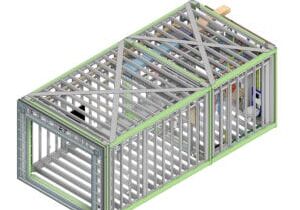
Modular by Design: Turning Architecture into a Manufacturing System
Modular construction is often presented as a faster way to build. Speed, however, is only one part of its value. The larger opportunity is to create a coordinated design and production system that improves quality, reduces uncertainty, and allows a building to move efficiently from concept design through manufacturing, transportation, installation, and completion.

Repeatability Begins with Trust: What Alora at Dry Creek Reveals About Scaling Modular Housing
Alora at Dry Creek, a 329-unit, multifamily community comprising five four-story buildings in Centennial, Colorado, demonstrates how repeatable design, standardized manufacturing and early collaboration can work together to create a model that is not only faster to deliver, but easier to replicate across future projects.

T.R. Arnold: The Art of Third-Party Inspections
T.R. Arnold (TRA), a third-party inspection company in Elkhart, Indiana, contracts with modular manufacturers across the US. Manufacturers register with each state to which they intend to send their modules and may be required to hire a third-party inspection company.

Creating an ‘Ecosystem for Innovation:’ 50+ Years of Modular Construction Oversight in Virginia
Virginia’s modular building program began in 1973, with the implementation of the Virginia Industrialized Building Unit and Mobile Home Safety Regulations. Now it’s leading the country in modular code adoption.