
Catch It in the Factory, Not in the Field: Smarter Testing for Modular Builds

Eric Watters , P.Eng. is Associate, Senior Engineer at RDH Building Science Inc.
Modular construction is known for speed, predictability, and repeatability—but those strengths only translate into durable building enclosures when manufacturers treat the factory as the primary commissioning environment. Early-stage enclosure testing, particularly around window installations and module airtightness, consistently shows that the factory is the best location to perform this testing. Often, the factory is the only place to catch water and air leakage issues before they become systemic.
This article outlines how factory-based watertightness and airtightness testing, including standardized water penetration tests and qualitative air leakage checks, can significantly improve modular window performance. Factory-based testing can also prevent enclosure deficiencies before they spread across an entire production run. Practical, repeatable commissioning steps can be integrated into manufacturing workflows to reduce costly field rework, minimize shipping-related damage, and strengthen enclosure reliability across module fleets.
Repetition, Climate Control & the Modular Advantage
Modular construction thrives on repetition. Every module is built using consistent details, materials, and installation sequences. This consistency offers an inherent quality control opportunity.
In a climate-controlled factory, installers benefit from stable temperatures, predictable lighting, and consistent sequencing. Adhesives cure reliably, membranes behave consistently, and crews refine their methods through dozens or hundreds of repeated installations. When executed well, windows arrive on-site requiring little or no adjustment.
But repetition cuts both ways. If a membrane fold is incorrect, a sill flashing misaligned, or a tie‑in detail misunderstood, that error can be repeated across an entire building’s worth of modules. The factory is therefore the most impactful stage for influencing window installation performance and long‑term enclosure quality.
Many commissioning teams describe modular factories as the ideal environment for early correction. In this controlled setting, small improvements can be scaled instantly, and early testing can prevent widespread deficiencies.
What Early Testing Means for Modular Construction
By integrating a recognized water penetration test standard into early production stages, manufacturers can fundamentally change how they manage quality.
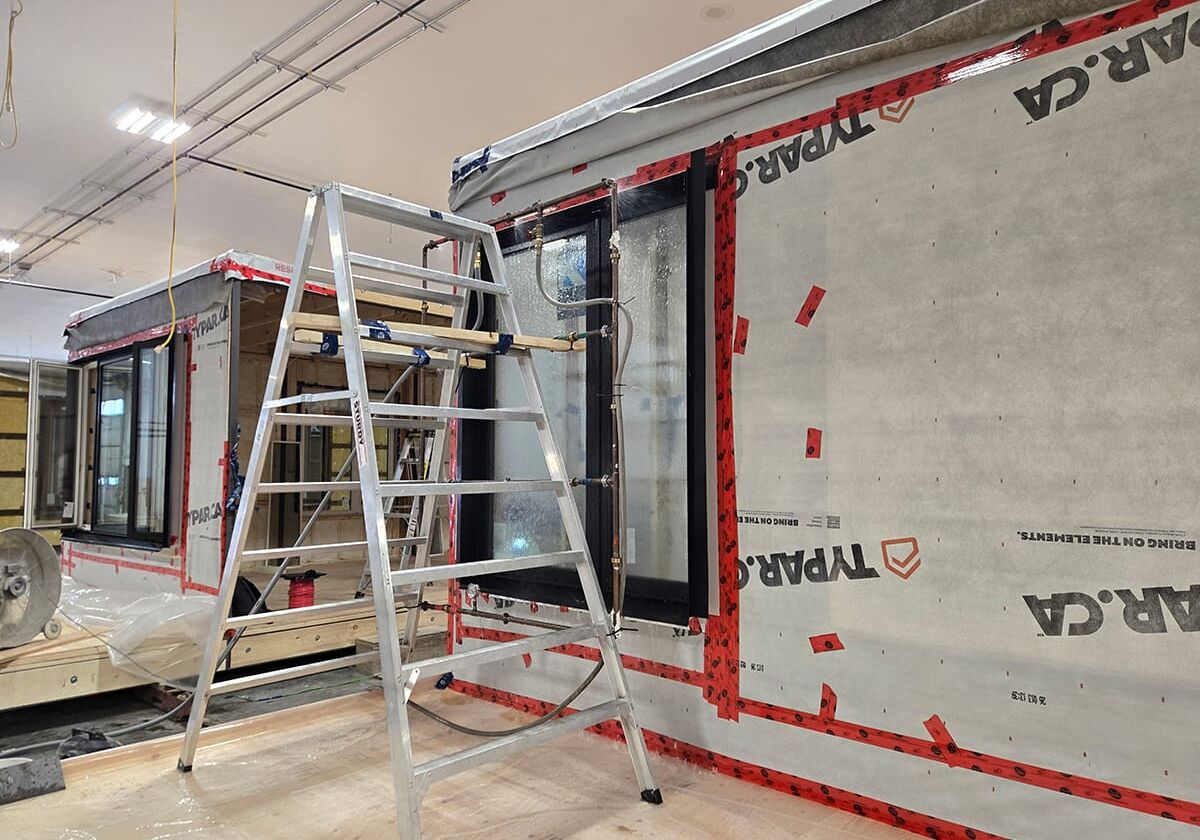
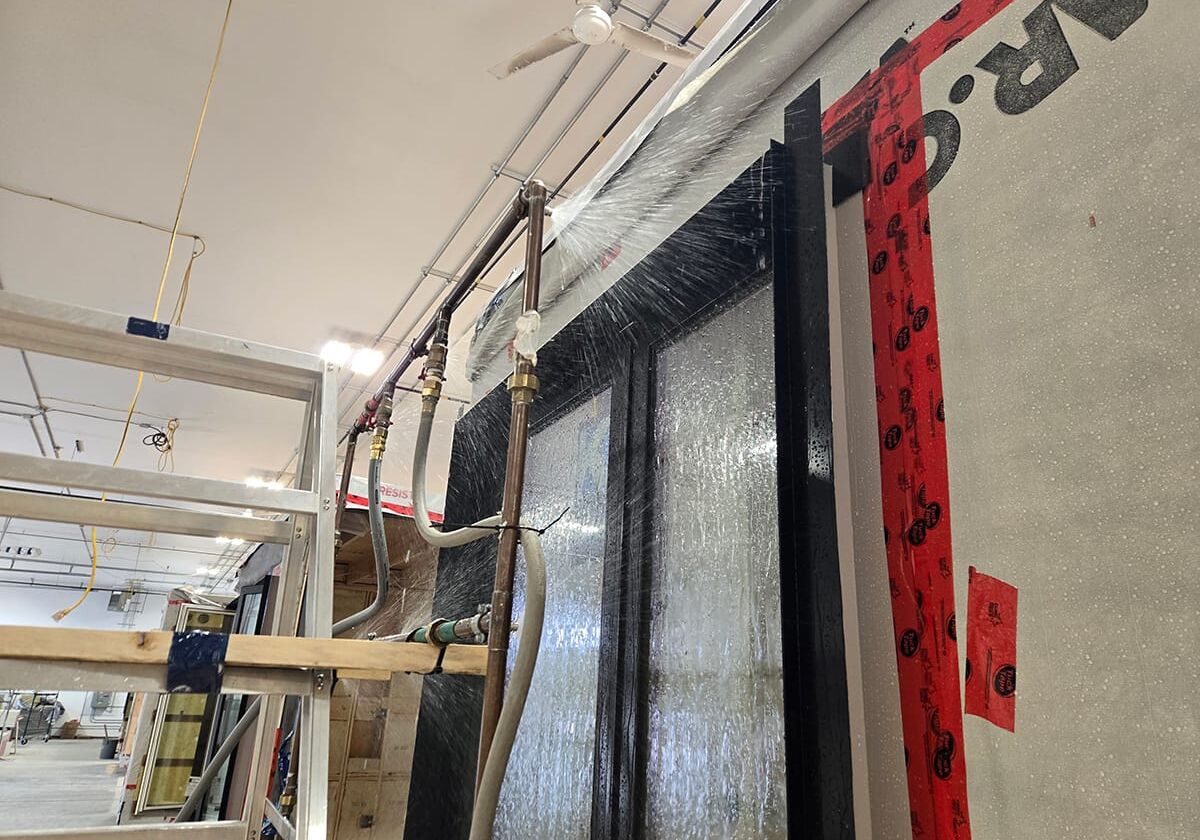
Testing the first few window installations validates detailing, membrane continuity, and tie‑in performance before mass production begins. A common best‑practice approach is to test the first installation, refine the details, test again, and lock in the final sequence before scaling.
Once production ramps up, repeating tests at suitable intervals will confirm ongoing compliance. A suitable interval may be every 10–20 modules or per a representative percentage. This cadence transforms water testing from a reactive field procedure into a proactive, factory‑based quality assurance tool. Manufacturers who adopt early testing consistently see:
- Fewer field deficiencies
- More consistent installation quality
- Reduced rework by factory installers or field trades
- Stronger confidence in enclosure performance before shipping
- Fewer transit‑related moisture issues
For a modular project we were involved with, early testing identified a subtle membrane discontinuity at the sill corners that caused intermittent leakage. Because the issue was caught early, the manufacturer corrected the detail before producing the remaining modules. This correction allowed the manufacturer to avoid deficiencies that would have been extremely difficult to repair once the modules were positioned on-site.
Why Testing in the Factory Matters
Once modules reach the site, access to window perimeters becomes limited. The ability to inspect, test, and/or repair window details is often restricted due to module positioning, cladding and flashing installation, and typical site access constraints. Any deficiencies discovered at this stage are difficult and often more costly to correct. Furthermore, they often indicate that similar issues are likely repeated and may exist across many modules.
Factory testing catches problems early so they are then isolated and easy to resolve. It ensures modules arrive on-site ready for installation with reduced risk and fewer surprises.
Methods for Testing Windows—Focus on Watertightness
Modular manufacturers have several options for evaluating window water‑penetration resistance: spray‑rack testing, spray wand testing, depressurized test chambers, manufacturer protocols, and field‑based verification. Among these, ASTM E1105 remains the industry standard for assessing water penetration under controlled air‑pressure differentials.
Typical water testing simulates wind‑driven rain by applying a calibrated water spray to the exterior of the window while inducing a negative pressure across the assembly via an interior test chamber. Alternatively, calibrated spray wands can be used to provide pressurized water spray at windows. These tests evaluate the entire system: rough‑opening membrane continuity, sealant continuity, sill and jamb flashing, window installation sequencing, and tie‑ins to adjacent materials.
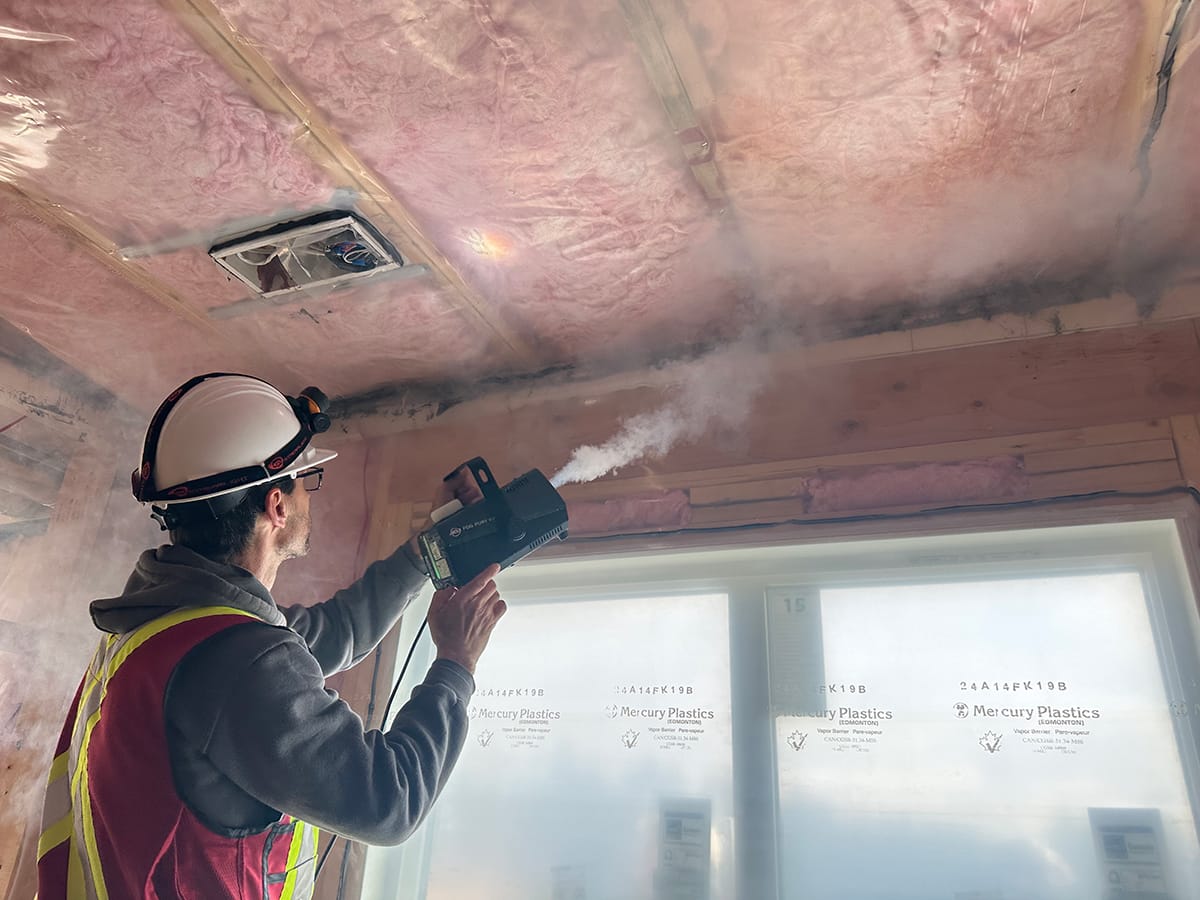
Watertightness testing is most effective when paired with airtightness checks, even if those checks are informal or qualitative. Air leakage often reveals the same discontinuities that lead to water leakage. These discontinuities may include gaps in membrane adhesion, irregular deficiencies with window systems or accessories, or incomplete tie‑ins to adjacent enclosure assemblies.
Airtightness and Transit Protection
Airtightness is not only an enclosure‑performance issue—it is also a shipping and transit durability issue. Modules often travel long distances on highways, ferries, ships, or on rail. During transport, uncontrolled air leakage can:
- Draw in water during rain events
- Introduce moist air that condenses inside cavities
- Create mold risks in concealed spaces
- Lead to staining or deterioration of interior finishes
Based on our experience, minor air leakage paths, when undetected in the factory, may allow water ingress during transport. Water ingress can result in mold growth before the modules ever reach the site. Qualitative airtightness checks in the factory are one of the most effective ways to prevent these issues.
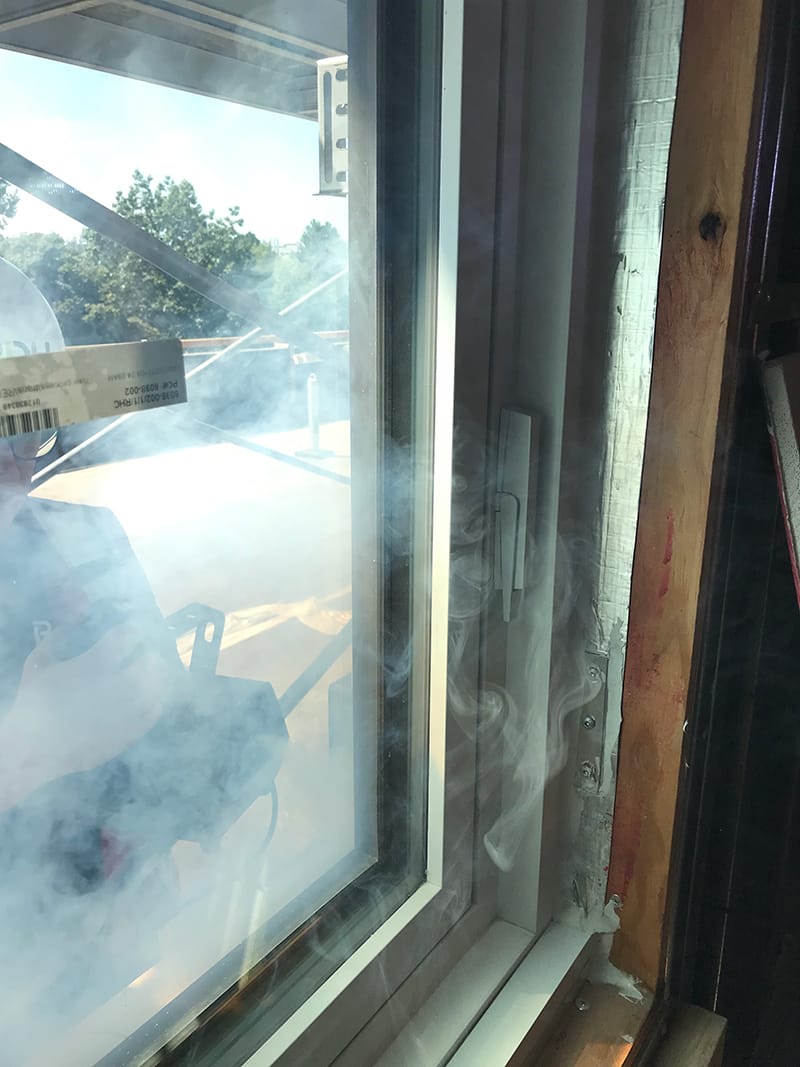
Before modules leave the factory, many manufacturers perform a “transit airtightness check” on a sample of modules. This check involves a quick depressurization process paired with smoke tracing (Figure 4). Manufacturers use this step to verify that temporary closures, window perimeters, and mechanical penetrations are sealed and protected, reducing the risk of moisture intrusion during transport.
Methods for Testing Modules—Focus on Airtightness
Airtightness testing in modular factories is typically qualitative, fast, and highly effective. Common methods include:
- Smoke pencils or foggers to visualize air leakage paths
- Hand‑feel checks during temporary depressurization
- Portable fans to induce pressure and expose air barrier discontinuities
- Tactile inspection of membrane transitions and penetrations
These methods require minimal setup, provide immediate feedback, and reveal discontinuities that may also cause water leakage. They are ideal for installer training and quality control documentation.
Closing — The Impact of Factory vs. Field Testing
Factory‑based watertightness and airtightness testing provides repeatable conditions, immediate feedback, and stronger quality control. Field testing, by contrast, often reveals issues too late—when access is constrained and deficiencies may already be widespread or troublesome to correctly address.
Across modular projects, early testing consistently:
- Elevates project performance
- Reduces on-site rework and schedule impacts
- Improves enclosure reliability across all modules
- Strengthens manufacturer confidence in their installation methods
- Prevents shipping‑related moisture and mold issues
- Supports higher‑performing modular buildings
For modular manufacturers, the takeaway is clear: catch deficiencies in the factory, not in the field. Integrating watertightness and airtightness testing into factory workflows transforms quality assurance from a reactive process into a proactive commissioning strategy. It ensures that every module shipped is field‑ready and resilient for transportation while also supporting the ability of the modular construction industry to make buildings better.
More from Modular Advantage

MBI Town Halls 2026: Reflections from Boston
By the end of 2026 MBI’s Government Affairs team will have traveled over 6,000 air miles to bring Town Hall events to five different cities in two countries.

Mind the Gap: The Interface Between Onsite and Offsite Construction
Every design for manufacture and assembly (DfMA) project — modular, mass timber, or panelized — is really two projects joined at a seam. One is built in a controlled factory to millimeter tolerances; the other in the field, in weather, to the looser tolerances of poured concrete and human hands. Between them sits an interface: where the factory’s precision meets the site’s reality.
Rules, Rails & Repeatability: Applying DfMA to Modular Healthcare
DfMA offers several advantages for healthcare projects, with faster delivery among the most valuable. Schedule matters when building new facilities, expanding campuses, renovating existing space or bringing care closer to communities that need it.
Precision and Possibility: Demands of DfMA and What Modular Mass Timber Makes Possible
Mass timber does not automatically create an efficient modular building. Its precision makes early coordination more important: fabricated components will accurately reproduce both the team’s solutions and its mistakes. The material’s advantages are realized only when supported by an equally precise design and delivery process.
Modular Construction Contracts: Key Considerations for Successful Canadian Projects
Starting a modular project with a well-developed contract protects both the owner and the contractor. It will help keep the project on track and on budget, and it will improve quality from the factory floor to final installation on-site.
Modular by Design: Turning Architecture into a Manufacturing System
Modular construction is often presented as a faster way to build. Speed, however, is only one part of its value. The larger opportunity is to create a coordinated design and production system that improves quality, reduces uncertainty, and allows a building to move efficiently from concept design through manufacturing, transportation, installation, and completion.

Repeatability Begins with Trust: What Alora at Dry Creek Reveals About Scaling Modular Housing
Alora at Dry Creek, a 329-unit, multifamily community comprising five four-story buildings in Centennial, Colorado, demonstrates how repeatable design, standardized manufacturing and early collaboration can work together to create a model that is not only faster to deliver, but easier to replicate across future projects.

T.R. Arnold: The Art of Third-Party Inspections
T.R. Arnold (TRA), a third-party inspection company in Elkhart, Indiana, contracts with modular manufacturers across the US. Manufacturers register with each state to which they intend to send their modules and may be required to hire a third-party inspection company.

Creating an ‘Ecosystem for Innovation:’ 50+ Years of Modular Construction Oversight in Virginia
Virginia’s modular building program began in 1973, with the implementation of the Virginia Industrialized Building Unit and Mobile Home Safety Regulations. Now it’s leading the country in modular code adoption.
Understanding Thermal Barriers Compliance Methods & Emerging NFPA-275 Foam Plastic Technologies
New fire barrier technologies are improving total costs and margins in major areas of construction, such as commercial, government, union and prevailing wage projects. These benefits translate into other large fringe areas, such as agriculture, commercial cold storage facilities, grow houses, outbuildings, military and aviation hangars.