
MBI Welcomes R.I. Group Founder & President Salvatore Tafuro to the Industry’s Hall of Fame
In 1973, Salvatore Tafuro, only in his twenties and already supporting a family of three children, set out to realize his entrepreneurial dream. From a humble garage in Leverano, in the heart of Salento, he began producing metal structures and aluminum fixtures for the construction industry.
His early focus on modular solutions laid the foundation for what would become a global leader in modular construction. Over the decades, his small workshop grew into R.I. Group, which today is recognized as one of the world’s leading companies in modular system design and construction.
Employing over 200 people globally and backed by a team of experts with entrepreneurial drive, R.I. Group has completed projects across Italy, Africa, America, Australasia, Europe, and the Middle East.
This worldwide footprint underscores Tafuro’s visionary leadership in adapting and expanding the company over more than 50 years.

Salvatore Tafuro and his wife accept an award at MBI's 2025 Awards of Distinction ceremony on behalf of R.I. Group.
One of the most critical moments in the company’s history came during the COVID-19 lockdown, when NATO’s NSPA requested R.I. Group to develop mobile field hospitals and modular bio-containment solutions.
These innovations were vital in saving lives during the pandemic, showcasing the company’s agility and innovative capacity in responding to global emergencies.
These milestones, along with strong partnerships with governments, international organizations like the UN, the European Union, and NATO, highlight the undeniable success of R.I. Group.
“During my career,” says Tafuro, “there have been several significant milestones I’m particularly proud of; each of them underscore the resilience required to deliver transformational solutions. One of the key moments was securing our first contract with the United Nations, which marked the beginning of an incredible journey. Another standout experience was the mission in Afghanistan, which included the construction of a military camp in extremely difficult conditions. Operating in a dangerous and war-torn environment, we faced numerous logistical and security challenges, making the successful completion of the project a major achievement. Lastly, securing my first contract with Leonardo for the development of mobile modular telescopic towers was a pivotal accomplishment, as it opened the door to several fruitful collaborations that followed. Each of these moments has shaped my career and contributed to my growth.”
Operating out of Puglia, Italy - a region more associated with agriculture and tourism than with industrial innovation - Salvatore Tafuro has turned R.I. Group into a shining example of industrial ingenuity. The company’s patented technologies include advanced bio-containment units, modular energy systems, and remote-controlled border control towers, each of which reflects a deep commitment to Italian design tradition and a forward-looking approach to solving complex global problems.
One of its most notable innovations is the development of the world’s first telescopic armored defense tower, a product that has been widely recognized and even envied internationally. This, along with other innovations like energy-autonomous modular housing, has garnered recognition from the Modular Building Institute itself, cementing R.I. Group’s status as a leader in the field.
R.I. Group has always placed corporate social responsibility at the heart of its operations, exemplified through its crisis-response activities both in Italy and abroad. During global emergencies, the company’s commitment to national welfare often takes precedence over internal economic interests.
The company’s engagement extends into the civil sector, supporting cultural and charitable initiatives, such as its sponsorship of Lecce Football Club, and contributions to the Umberto Veronesi Foundation. Furthermore, R.I. Group has donated modular churches to communities in Lebanon, Haiti, and Afghanistan, highlighting the company’s humanitarian efforts.

Salvatore Tafuro was introduced by outgoing MBI Board Chair John Buongiorno.
In a particularly notable achievement, Salvatore recently co-founded “Hospitals Without Borders,” a non-profit organization focused on addressing healthcare access disparities through modular medical facilities.
“R.I. Group is focusing significantly on modular healthcare solutions and developing modular education and training programs as key elements of its future strategy. We believe that modularity is the key to creating flexible, scalable, and efficient medical infrastructures that can adapt to the rapidly changing needs of healthcare systems worldwide. This approach allows us to deliver innovative solutions that can be deployed quickly and effectively, whether for urban hospitals, rural clinics, or mobile units.
“We recently established the Hospitals Without Borders Foundation in collaboration with other high-level partners. This initiative is dedicated to bringing modular medical solutions to regions affected by conflicts or humanitarian crises. Our mission is to ensure that even in the most challenging circumstances, people have access to the medical care they need.”
Salvatore Tafuro’s legacy is not only defined by past achievements but also by a forward-looking vision that promises continued innovation and leadership in the modular construction industry.
“Through the combination of cutting-edge technologies and a global network of expertise, our goal is to make a lasting impact in the most critical contexts and inspire future generations of modular architects and engineers to develop solutions that better contribute to the well-being and progress of humanity.”
“Being inducted into MBI’s Hall of Fame is a profound honor and a testament to the hard work, dedication, and passion I’ve poured into this field over the years,” concludes Tafuro. “It signifies not just personal achievement but also the collective success of the teams, mentors, and colleagues who have supported and inspired me along the way. For me, this recognition represents a commitment to continue striving for excellence, overcoming challenges, pushing boundaries, and contributing to the growth and innovation in our industry. It’s incredibly humbling to join a group of such distinguished individuals whose accomplishments I deeply admire.”
More from Modular Advantage
MBI Town Halls 2026: Reflections from Boston
By the end of 2026 MBI’s Government Affairs team will have traveled over 6,000 air miles to bring Town Hall events to five different cities in two countries.
Mind the Gap: The Interface Between Onsite and Offsite Construction
Every design for manufacture and assembly (DfMA) project — modular, mass timber, or panelized — is really two projects joined at a seam. One is built in a controlled factory to millimeter tolerances; the other in the field, in weather, to the looser tolerances of poured concrete and human hands. Between them sits an interface: where the factory’s precision meets the site’s reality.
Rules, Rails & Repeatability: Applying DfMA to Modular Healthcare
DfMA offers several advantages for healthcare projects, with faster delivery among the most valuable. Schedule matters when building new facilities, expanding campuses, renovating existing space or bringing care closer to communities that need it.
Precision and Possibility: Demands of DfMA and What Modular Mass Timber Makes Possible
Mass timber does not automatically create an efficient modular building. Its precision makes early coordination more important: fabricated components will accurately reproduce both the team’s solutions and its mistakes. The material’s advantages are realized only when supported by an equally precise design and delivery process.
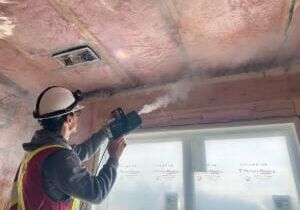
Catch It in the Factory, Not in the Field: Smarter Testing for Modular Builds
Integrating watertightness and airtightness testing into factory workflows transforms quality assurance from a reactive process into a proactive commissioning strategy. It ensures that every module shipped is field ready and resilient for transportation while also supporting the ability of the modular construction industry to make buildings better.
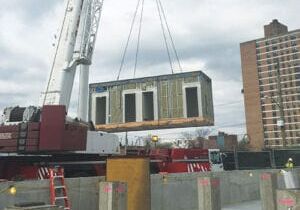
Modular Construction Contracts: Key Considerations for Successful Canadian Projects
Starting a modular project with a well-developed contract protects both the owner and the contractor. It will help keep the project on track and on budget, and it will improve quality from the factory floor to final installation on-site.
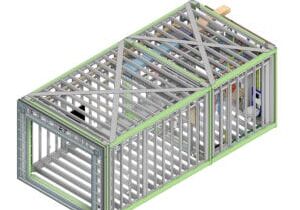
Modular by Design: Turning Architecture into a Manufacturing System
Modular construction is often presented as a faster way to build. Speed, however, is only one part of its value. The larger opportunity is to create a coordinated design and production system that improves quality, reduces uncertainty, and allows a building to move efficiently from concept design through manufacturing, transportation, installation, and completion.
Repeatability Begins with Trust: What Alora at Dry Creek Reveals About Scaling Modular Housing
Alora at Dry Creek, a 329-unit, multifamily community comprising five four-story buildings in Centennial, Colorado, demonstrates how repeatable design, standardized manufacturing and early collaboration can work together to create a model that is not only faster to deliver, but easier to replicate across future projects.
T.R. Arnold: The Art of Third-Party Inspections
T.R. Arnold (TRA), a third-party inspection company in Elkhart, Indiana, contracts with modular manufacturers across the US. Manufacturers register with each state to which they intend to send their modules and may be required to hire a third-party inspection company.
Creating an ‘Ecosystem for Innovation:’ 50+ Years of Modular Construction Oversight in Virginia
Virginia’s modular building program began in 1973, with the implementation of the Virginia Industrialized Building Unit and Mobile Home Safety Regulations. Now it’s leading the country in modular code adoption.