An Insider’s Guide to the 2025 World of Modular
The Modular Building Institute is bringing its global World of Modular (WOM) event back to Las Vegas, and with it comes some of the industry’s best opportunities for networking, business development, and education. Over the course of the conference’s four days, there will be numerous opportunities for attendees to connect, learn, and leverage event resources to get the most out of the conference.
While the World of Modular agenda has been carefully designed to include numerous opportunities for education and networking each day, many attendees overlook some of the best ways to engage with new and unfamiliar faces.
Maximizing Day 1
Though the first day of World of Modular is mostly known for its golf outing and the event’s opening party, the afternoon of Day 1 also offers all attendees that chance to get oriented to the event (and with MBI) at the day’s lone breakout session: Maximizing Your WOM Experience.
“I always encourage attendees to utilize MBI staff at the show to make personal introductions with new contacts and potential business partners, and Day 1 is a great time to do that,” says Dave Sikora, MBI’s business development director. “And attending the Maximizing Your WOM Experience session on Day 1 is a fantastic way to get introduced to MBI’s staff and make connections with new attendees.”
Day 1 is also a great time to download and get acquainted with the World of Modular app. Though it’s made available for download in the days preceding the show (registered attendees should keep an eye on their email!), getting proficient with the app will give attendees access to a host of features, including—perhaps most importantly—direct communication to facilitate introductions and meetings.
“The app is a critical tool for this conference,” says John McMullen, PCM, marketing director for MBI. “You can see your fellow attendees, send direct messages to anyone that’s registered, get conference updates, advertise your presence at the show…and since we keep it active for a period after the show, it’s really the best way to maximize the value of your attendance.”
Navigating the Exhibit Hall
Without question, the second and third days of World of Modular are the busiest. It’s during these two days that the exhibit hall—World of Modular’s most attended function—is open and active, and though the buzz in the air is palpable, navigating the exhibit hall itself can be an overwhelming experience.
With more exhibit booths in 2025 than ever before, creating a plan—and leaning on WOM’s event resources and MBI’s staff—can help new and long-time attendees alike.
Tips for success include:
- Refer to the onsite brochure. The onsite contains a floorplan of the exhibit hall and identifies what companies are in each booth. Take a few minutes before entering the hall to identify key exhibitors and mark those booths on the floorplan.
- Keep the event app handy. MBI does its best to secure everything long before the event, but last-minutes changes happen. The event app will have the latest information about exhibitors and their locations.
- Visit the MBI booth. Clearly identified on the floorplan, MBI’s booth is the best place to find staff members who can assist with introductions and answer questions.
On Day 3, World of Modular will welcome some special guests to the exhibit hall: Tremco’s Rising Stars program returns to WOM. Students from local trade schools have been invited to learn about the industry and visit exhibitors, so be ready for your chance to connect with up-and-coming members of the industry!
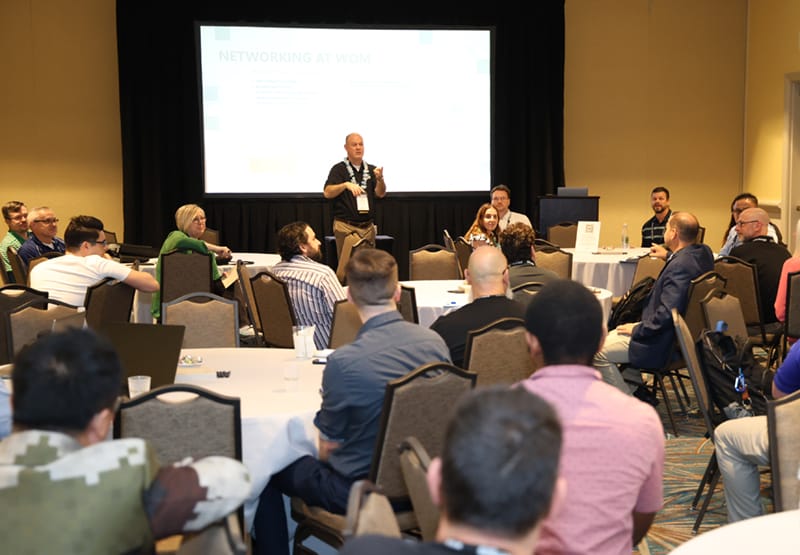
Tom Hardiman, MBI's executive director, plus members of MBI's staff, lead the "Maximizing Your WOM Experience" session at the 2024 World of Modular.
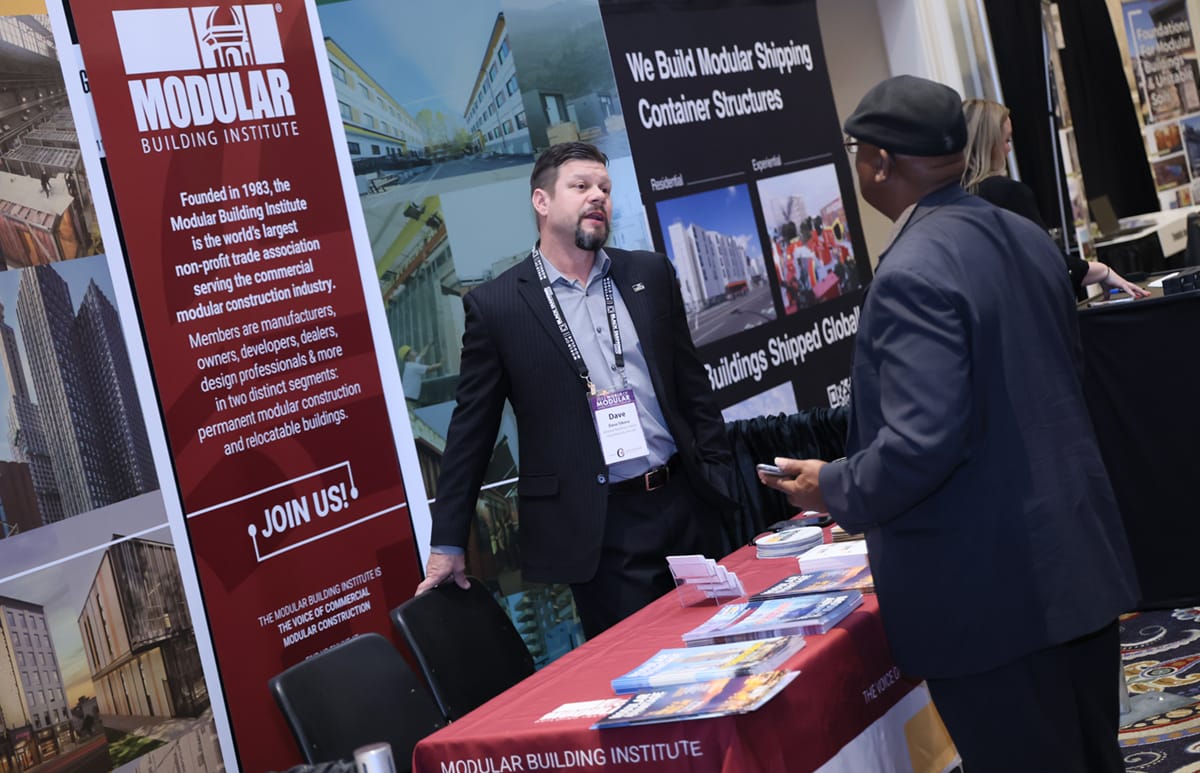
Dave Sikora, MBI's business development director, answers questions at the MBI booth in the World of Modular exhibit hall.
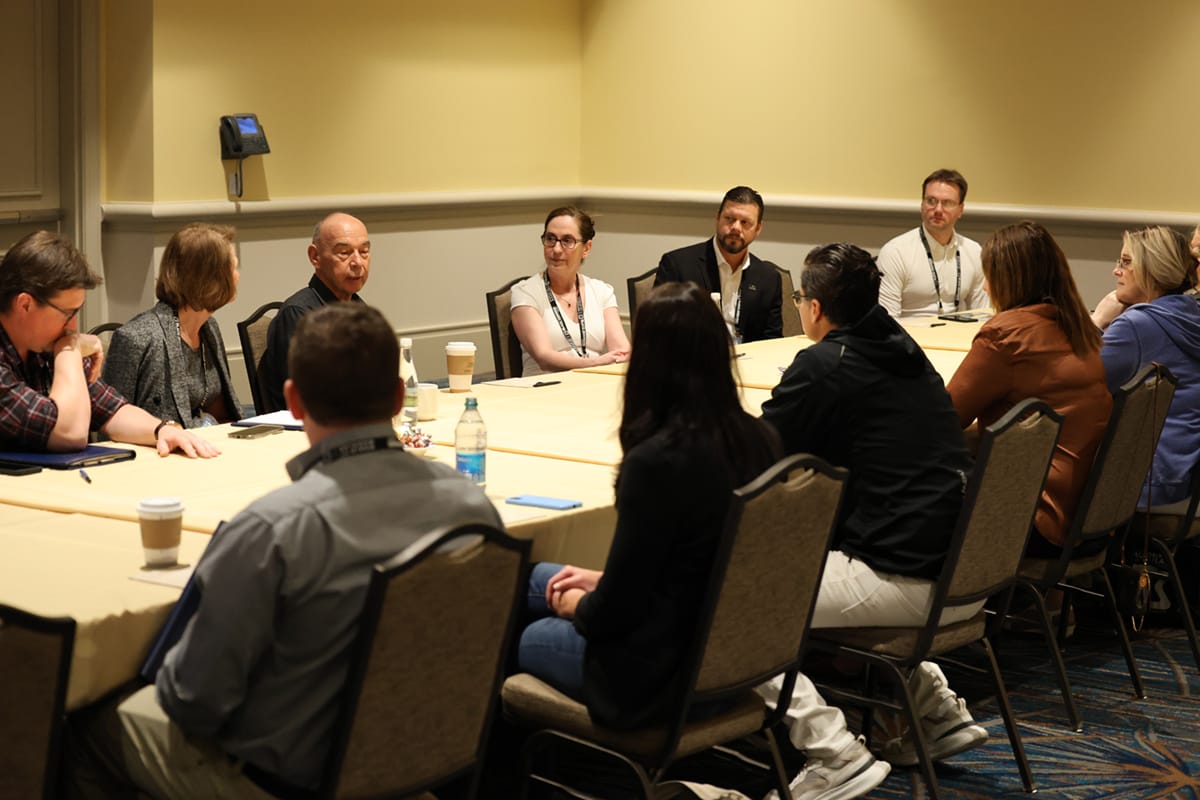
MBI staff members engage with attendees during breakout sessions.
Organized & Focused Education
Besides featuring speakers and industry experts from across the industry and around the world, this year’s educational sessions have again been organized with attendees’ interests in mind.
“Attendee feedback from prior WOMs led us to develop tracks for the educational breakout sessions,” says Heather Packard, MBI’s professional and workforce development director. “After having success with these last year, we’ve developed this year’s tracks to address different aspects of the industry and to support learning across a variety of attendee role types.”
- Design, Build, & Install: This track will feature case studies of completed projects and innovative approaches and techniques across the design, build, and install phases of commercial modular construction. New for World of Modular 2025, this track will also include sessions specifically for those that are new to or looking to learn more about modular construction as well as technical sessions geared towards seasoned industry professionals.
- Development Opportunities & Sustainable Practices: This track will feature practical approaches owners, developers, contractors, and other industry stakeholders are taking to spur development within a variety of markets as well as practices and techniques that can reduce the environmental impact of construction.
- Government & Regulatory Affairs: Sessions in this track are geared toward government agencies, officials, and other stakeholders interested in keeping pace with industry advocacy efforts, updates, regulatory challenges, and opportunities for modular construction.
- Managing Your Business: This track offers techniques and practices that can improve the efficiency, longevity, profitability, and culture of attendee organizations.
- Research & Innovation: This track highlights recent research and emerging technologies that are underpinning and driving change in the industry.
Session and track details can be found in the onsite event brochure but be sure to keep the event app handy onsite as it will contain the latest updates on sessions and locations.
Making the Most of WOM
“The single most important thing is to participate,” says Sikora. “By that I mean attend as many breakouts as you can, visit with as many exhibitors as you can, and attend all the networking functions. And throughout, don’t be afraid to introduce yourself to other attendees; WOM attendees absolutely welcome new connections and conversations.”
And though active participation is key, there are several additional ways that companies can bring greater attention to their presence at WOM.
- Leverage sponsorships. World of Modular offers dozens of sponsorships, and each can bring greater awareness to your company in different ways. From the opening night party to the awards dinner on the final evening, sponsorships can bring visibility and recognition throughout the event.
- Message attendees before, during, and after the event. The World of Modular app offers direct messaging to individuals at the show, it also allows for communication to ALL registered attendees. A coordinated messaging campaign—both within the event app and through MBI’s other year-round channels—can lead to significant engagement with your company.
- Use social media while onsite. There’s no better way to make your attendance known to the world than by making good use of social media at the event. Take pictures, post selfies, tag peers, and leverage the #WOM25 hashtag to connect your posts with those from MBI and other attendees.
- Engage with MBI at—and beyond—WOM. Diving head-first into World of Modular will no doubt yield results, but staying engaged with MBI throughout the year will guarantee continued exposure, recognition, and branding for your company. Join one of MBI’s councils, submit news and articles for publication, attend town halls and webinars, volunteer for a working committee, visit the MBI Learning Center, and/or join MBI at one of four sponsored Offsite Construction Summits to continue conversations, learning, and networking throughout the year.
“I have seen this event—and MBI—grow mostly through more architects, engineers, traditional contractors, owners, developers and government agencies attending,” concludes Sikora. “The growth directly correlates to more learning, networking, and business development across all aspects of the industry for attendees & exhibitors alike.
“My best advice is to just get involved. There’s never been a better time.”
About the Author: John McMullen, PCM, is the marketing director for the Modular Building Institute. You can reach him directly at mcmullen@modular.org or on LinkedIn.
More from Modular Advantage
MBI Town Halls 2026: Reflections from Boston
By the end of 2026 MBI’s Government Affairs team will have traveled over 6,000 air miles to bring Town Hall events to five different cities in two countries.

Mind the Gap: The Interface Between Onsite and Offsite Construction
Every design for manufacture and assembly (DfMA) project — modular, mass timber, or panelized — is really two projects joined at a seam. One is built in a controlled factory to millimeter tolerances; the other in the field, in weather, to the looser tolerances of poured concrete and human hands. Between them sits an interface: where the factory’s precision meets the site’s reality.
Rules, Rails & Repeatability: Applying DfMA to Modular Healthcare
DfMA offers several advantages for healthcare projects, with faster delivery among the most valuable. Schedule matters when building new facilities, expanding campuses, renovating existing space or bringing care closer to communities that need it.
Precision and Possibility: Demands of DfMA and What Modular Mass Timber Makes Possible
Mass timber does not automatically create an efficient modular building. Its precision makes early coordination more important: fabricated components will accurately reproduce both the team’s solutions and its mistakes. The material’s advantages are realized only when supported by an equally precise design and delivery process.
Catch It in the Factory, Not in the Field: Smarter Testing for Modular Builds
Integrating watertightness and airtightness testing into factory workflows transforms quality assurance from a reactive process into a proactive commissioning strategy. It ensures that every module shipped is field ready and resilient for transportation while also supporting the ability of the modular construction industry to make buildings better.
Modular Construction Contracts: Key Considerations for Successful Canadian Projects
Starting a modular project with a well-developed contract protects both the owner and the contractor. It will help keep the project on track and on budget, and it will improve quality from the factory floor to final installation on-site.
Modular by Design: Turning Architecture into a Manufacturing System
Modular construction is often presented as a faster way to build. Speed, however, is only one part of its value. The larger opportunity is to create a coordinated design and production system that improves quality, reduces uncertainty, and allows a building to move efficiently from concept design through manufacturing, transportation, installation, and completion.

Repeatability Begins with Trust: What Alora at Dry Creek Reveals About Scaling Modular Housing
Alora at Dry Creek, a 329-unit, multifamily community comprising five four-story buildings in Centennial, Colorado, demonstrates how repeatable design, standardized manufacturing and early collaboration can work together to create a model that is not only faster to deliver, but easier to replicate across future projects.

T.R. Arnold: The Art of Third-Party Inspections
T.R. Arnold (TRA), a third-party inspection company in Elkhart, Indiana, contracts with modular manufacturers across the US. Manufacturers register with each state to which they intend to send their modules and may be required to hire a third-party inspection company.

Creating an ‘Ecosystem for Innovation:’ 50+ Years of Modular Construction Oversight in Virginia
Virginia’s modular building program began in 1973, with the implementation of the Virginia Industrialized Building Unit and Mobile Home Safety Regulations. Now it’s leading the country in modular code adoption.