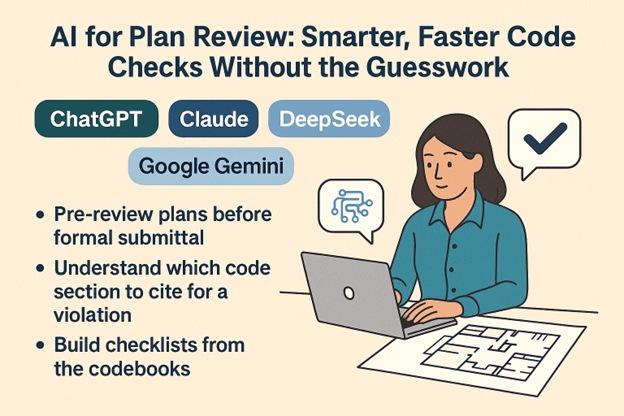
AI for Plan Review
Smarter, Faster Code Checks Without the Guesswork

Rahul Bajaj, PE, MCP, is the Associate Director of Modular Plan Review, Central Region, at PFS TECO.
Everyone’s Talking About AI — Here’s What It Can Really Do for Plan Reviewers
You’ve probably heard the buzz — AI is everywhere. Tools like ChatGPT, Claude, DeepSeek, and Google Gemini are being used for everything from writing emails to passing law exams. It seems like everyone is jumping on the AI train. But what can these tools really do for professionals in modular construction and plan review? Let’s break down how AI can be a powerful assistant — cutting down hours of code research, helping you prep for certification exams, and even expanding your understanding of the codes you work with every day.
AI: What It Is and Why It Matters
AI tools like ChatGPT and Claude are examples of what’s called “large language models” (LLMs). In simple terms, they’re trained on a massive amount of text from books, websites, and documents. They use this information to answer questions, summarize documents, and help generate ideas. Think of them as supercharged search engines that can talk back. The more specific your question, the more useful and relevant the answer can be.
How AI Helps with Code Compliance
Let’s say you come across something unfamiliar in a plan — this morning, for example, I reviewed a building with optional solar panels. I didn’t know which NEC sections applied off the top of my head. Rather than digging through the entire NEC table of contents, I asked AI:
Example prompt: “Which NEC 2020 sections apply to solar panel installation on modular buildings?”
Within seconds, it pointed me toward relevant sections like Article 690 (Solar Photovoltaic Systems) AI for Plan Review and gave me key concepts to look out for. I still reviewed the codebook myself — but AI saved me 30-60 minutes by showing me where to start.
AI Dos and Don’ts
Do: Use AI to Train Yourself and Your Team
Preparing for code certification exams? AI can quiz you.
Example prompt: “Write 120 multiple choice questions with answers based on 2021 IBC for the ICC Building Plans Examiner test. Make it a 2-hour exam format.”
You can use similar prompts for the IAPMO tests or state-specific exams like Wisconsin’s UDC Certification. You can even fine-tune the difficulty: “Make half the questions easy, a quarter medium, and a quarter hard.”
Don’t: Use AI to Skip the Code Book
AI is not a replacement for reading the code. It can be a shortcut to knowing what part of the code to read. If you’re citing something in your review comment or correction notice, verify it against the actual code language.
Do: Ask for Example Prompts Before You Use AI
Try these prompts:
- “What are the egress requirements for a modular dorm building under 2021 IBC?”
- “Give me a summary of key IECC 2015 requirements for factory-built buildings.”
- “How do I check compliance for ADA reach ranges inside a restroom module?”
Don’t: Upload Client Plans to Public AI Tools
Never copy-paste client plans, PDF files, or proprietary project info into ChatGPT, Gemini, or any other free/public AI tool. These tools do store your data and may be used to train future models.
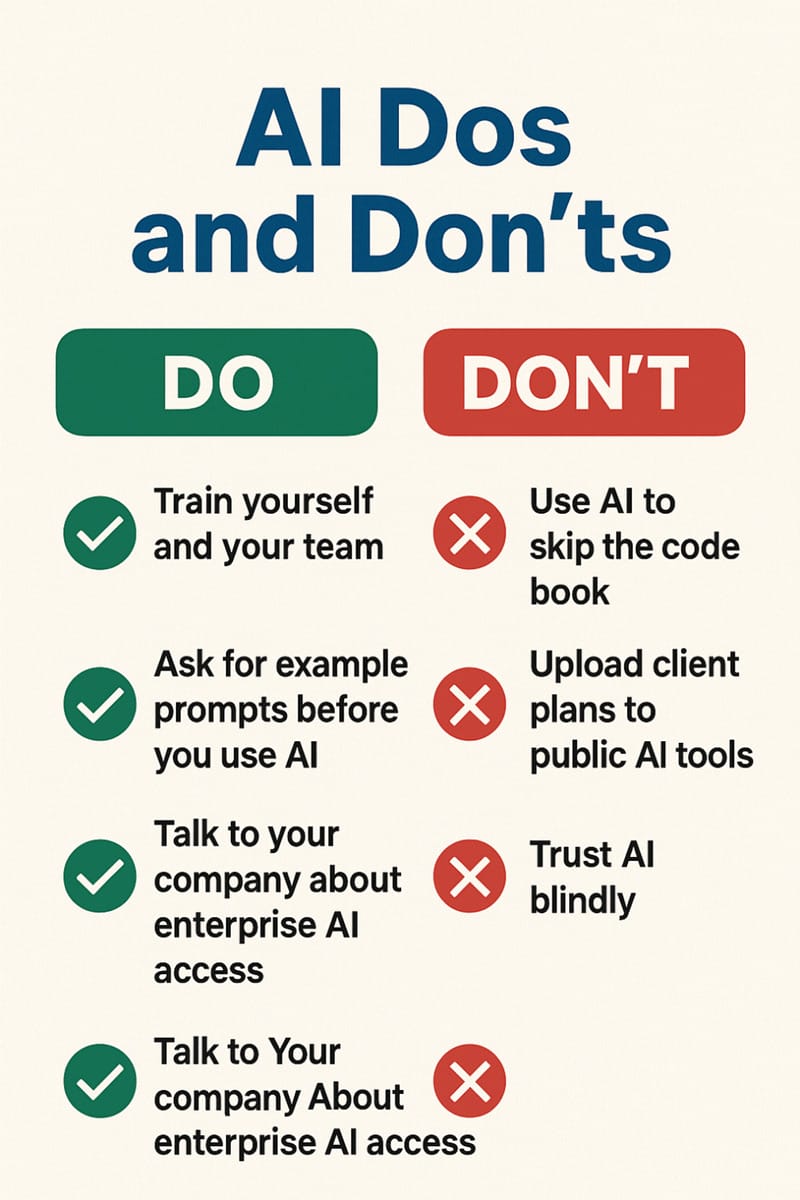
Do: Talk to Your Company About Enterprise AI Access
If you’re serious about using AI at work, push your company to get an enterprise license. Enterprise versions (like ChatGPT Enterprise or Microsoft Copilot) offer data privacy and encryption.
Don’t: Trust AI Blindly
AI sometimes “hallucinates” and gives wrong answers. Always cross-check with the code. Treat AI like a junior coworker who’s fast but not always right.
Do: Use AI to Translate Code into Plain English
Not sure how to explain a code section to a client or team? Ask AI to paraphrase it in simpler language.
Example prompt: “Explain IBC 1010.1.1 in plain English for a non-engineer.”
Don’t: Assume AI Knows Local Amendments
AI tools often don’t include state or jurisdiction-specific amendments unless you provide them. Always double-check with your AHJ or local code supplements.
Do: Use AI to Translate Code into Plain English
Trying to understand what’s changed between 2015 and 2021 IBC? Ask AI to show you a comparison.
Example prompt: “Compare stairway requirements between 2015 IBC and 2021 IBC.”
Don’t: Use AI During Secure Exams
If you’re taking an online or in-person certification test, do not use AI or any external help. It’s unethical and could result in permanent disqualification.
Do: Log Prompts That Work Well
If a prompt gives a great answer, save it in a personal reference doc. Over time, you’ll build a library of prompts that improve your speed and quality.
Don’t: Use AI Output as Legal Code Interpretation
AI can summarize, compare, and guide — but it cannot interpret the law or code in an enforceable way. Always defer to the adopted code text and AHJ interpretations.
AI sometimes “hallucinates” and gives wrong answers. Always cross-check with the code. Think of it like an intern — fast, tireless, but not licensed. Use it to get started, not to finish your work.
AI for Managers, Not Just Reviewers
AI isn’t just helpful for individual plan reviewers — it’s also a valuable tool for managers overseeing review teams. You can use AI to:
- Create standardized checklists to improve consistency across reviewers
- Quickly train new hires with AI-generated quizzes and study guides
- Summarize complex code updates or memos into bullet points for your team
- Draft internal SOPs or review templates based on codebooks
Example prompt: “Write a standard operating procedure for reviewing factory-built restroom modules under 2021 IBC, IPC, and 2012 TAS.”
Extra Tip: Use AI to Summarize Lengthy Memos. Got a dense memo from the state AHJ or a long code update? Drop it in AI (if it’s not sensitive information) and ask: “Summarize this in bullet points in plain English.”
Outlook
AI tools are improving quickly. Already, some plug into BIM or CAD programs to check plans directly against code logic. Eventually, you might see plugins that pre-check submittals for local jurisdictional rules or that keep up with code updates in real time. As these tools evolve, modular professionals — especially those in plan review — stand to benefit the most, because our work is repetitive, rule-based, and data-heavy.
Final Thoughts
AI is here to stay — and it’s only getting better. It can’t replace your experience, judgment, or license. But it can save you time, make you more consistent, and help you level up faster. Think of it as a sidekick — not a threat.
More from Modular Advantage

Mind the Gap: The Interface Between Onsite and Offsite Construction
Every design for manufacture and assembly (DfMA) project — modular, mass timber, or panelized — is really two projects joined at a seam. One is built in a controlled factory to millimeter tolerances; the other in the field, in weather, to the looser tolerances of poured concrete and human hands. Between them sits an interface: where the factory’s precision meets the site’s reality.
Rules, Rails & Repeatability: Applying DfMA to Modular Healthcare
DfMA offers several advantages for healthcare projects, with faster delivery among the most valuable. Schedule matters when building new facilities, expanding campuses, renovating existing space or bringing care closer to communities that need it.
Precision and Possibility: Demands of DfMA and What Modular Mass Timber Makes Possible
Mass timber does not automatically create an efficient modular building. Its precision makes early coordination more important: fabricated components will accurately reproduce both the team’s solutions and its mistakes. The material’s advantages are realized only when supported by an equally precise design and delivery process.

Catch It in the Factory, Not in the Field: Smarter Testing for Modular Builds
Integrating watertightness and airtightness testing into factory workflows transforms quality assurance from a reactive process into a proactive commissioning strategy. It ensures that every module shipped is field ready and resilient for transportation while also supporting the ability of the modular construction industry to make buildings better.
Modular Construction Contracts: Key Considerations for Successful Canadian Projects
Starting a modular project with a well-developed contract protects both the owner and the contractor. It will help keep the project on track and on budget, and it will improve quality from the factory floor to final installation on-site.
Modular by Design: Turning Architecture into a Manufacturing System
Modular construction is often presented as a faster way to build. Speed, however, is only one part of its value. The larger opportunity is to create a coordinated design and production system that improves quality, reduces uncertainty, and allows a building to move efficiently from concept design through manufacturing, transportation, installation, and completion.

Repeatability Begins with Trust: What Alora at Dry Creek Reveals About Scaling Modular Housing
Alora at Dry Creek, a 329-unit, multifamily community comprising five four-story buildings in Centennial, Colorado, demonstrates how repeatable design, standardized manufacturing and early collaboration can work together to create a model that is not only faster to deliver, but easier to replicate across future projects.

T.R. Arnold: The Art of Third-Party Inspections
T.R. Arnold (TRA), a third-party inspection company in Elkhart, Indiana, contracts with modular manufacturers across the US. Manufacturers register with each state to which they intend to send their modules and may be required to hire a third-party inspection company.

Creating an ‘Ecosystem for Innovation:’ 50+ Years of Modular Construction Oversight in Virginia
Virginia’s modular building program began in 1973, with the implementation of the Virginia Industrialized Building Unit and Mobile Home Safety Regulations. Now it’s leading the country in modular code adoption.

Understanding Thermal Barriers Compliance Methods & Emerging NFPA-275 Foam Plastic Technologies
New fire barrier technologies are improving total costs and margins in major areas of construction, such as commercial, government, union and prevailing wage projects. These benefits translate into other large fringe areas, such as agriculture, commercial cold storage facilities, grow houses, outbuildings, military and aviation hangars.