
From Model to Machine: Why Modular Scale Is Becoming a Software Problem, not a Material One

İsmet Gökhan is the Sales Engineer at Arkitech Advanced Construction Technologies
For two decades, construction has struggled to translate industrialisation into productivity gains. McKinsey analysis shows that between 2000 and 2022, global labour productivity climbed only about 10 percent in construction, against roughly 90 percent in manufacturing [1]. Across that same stretch, construction firms have historically put less than one percent of revenue into information technology, under a third of what automotive and aerospace companies spend [1].

The industry's response has been modular construction, and it has grown well past the fringe. According to the Modular Building Institute, permanent modular construction accounted for 6.64 percent of new construction starts in 2023, up from 2.14 percent in 2015, and 42.9 percent of the projects in MBI's sample were steel framed [2].
By software problem, this article does not mean software procurement. It means whether design intent, manufacturing constraints and machine instructions stay connected as one continuous data structure, from the architectural model to the forming line, rather than being rebuilt by hand at each handoff.
Why Rated Capacity and Delivered Output Diverge
Every production line carries a rated capacity: a machine spec measured under ideal conditions, with the file already sitting ready to go. It depends on how much engineering has to happen between a signed-off design and a machine-ready instruction set, and how often that work gets repeated whenever something changes.
One peer-reviewed study of modular factory operations cites prior estimates that cycle-time variability and manual-labour bottlenecks can account for up to 15 percent of work time [3]. More telling is what the literature does not contain at all: no rigorous published utilisation figure exists specifically for modular construction factories.
How Design Intent Degrades on the Way to the Line
- Fabrication models get rebuilt instead of derived. Structural information typically arrives as drawings, so detailers end up reconstructing the three-dimensional model within their own environment, re-entering geometry that already existed further upstream.
- Exchange standards alone do not close this gap. Peer-reviewed testing that ran four CAD and six CAE packages against IFC 2x3 and IFC 4 found measurable data loss and loss of parameterisation on round trips, especially when moving toward analysis software [4].
- Revisions show up as documents, not parameters.
- Data gets replaced by questions. Across 1,362 projects containing 1.1 million requests for information, researchers found an average of 796 RFIs per project, roughly 1,080 dollars each at 2013 labour rates, with a median 9.7 days before closure [5].
The aggregate cost figure everyone still cites is a 2004 NIST study, which put the cost of inadequate interoperability to the U.S. capital-facilities industry at 15.8 billion dollars in 2002, with owners and operators shouldering 10.6 billion of that [6]. An FMI study covering nearly 600 construction leaders pinned 48 percent of all reworks on poor project data and miscommunication, though that work was vendor commissioned [7].
How Design Intent Degrades on the Way to the Line
Light Gauge Steel (LGS) itself supplies the clearest evidence that closing this seam pays off, and readers of this magazine have already seen it. A 2025 study in the ASCE Journal of Construction Engineering and Management, summarised for Modular Advantage last autumn, followed a Canadian off-site project of 47 modules and roughly 2,500 square metres running a continuous semi-automated workflow from BIM (Building Information Modeling) model to CNC instruction, with the manual re-drawing step removed [8] [9], and it is worth stating plainly as the strongest evidence in this article.
Task durations fell 38.11 percent on average, quantity accuracy improved 10.77 percent, and the investment paid back in 10 months and 26 days.
Adopting an open standard is not the same as achieving this. IFC 4.3 is published as ISO 16739-1 and buildingSMART maintains a list of software implementations, but the organisation says outright that it does not verify vendor claims on that list [10], [11]. Supporting IFC and surviving the trip intact are separate achievements. The same caution applies to design for manufacture and assembly, whose headline benefits of 20 to 50 percent part-count reduction come from manufacturing consultancy practice rather than independent construction research [12].
One Seam, Split Across Two Suppliers
In the industry's most typical setup, one supplier provides the machinery and another provides the software, which turns the seam between model and machine into a contractual boundary as well as a technical one.
The alternative is having the forming logic live inside the model rather than alongside it. When the same party that engineers the roll-forming line also writes the software generating its instructions, machine capability becomes a design input instead of something discovered downstream, and tolerance behaviour is known rather than estimated from a spec sheet. Arkitech has taken this integrated approach within a single engineering environment, developing the roll-forming systems used in light gauge steel production alongside the software that carries a project from architectural model through to machine-ready output.

Light gauge steel modules on the factory floor — the physical output of a continuous workflow that carries a project from BIM model to CNC-formed structure.

Arkitech develops its roll-forming systems alongside the software that drives them — so machine capability becomes a design input rather than something discovered downstream.
Counter-Evidence That Deserves Serious Weight
The most visible modular failures of the last five years do not back a data-first explanation. Katerra raised over 2 billion dollars, employed more than 8,000 people at its peak, and went bankrupt in 2021 [13]. Veev raised around 600 million and shut down in 2023 once a fundraise fell through [14]. Entekra built a 35-million-dollar plant in California rated for 3,000 homes a year and never got close, dissolving in 2023 after its majority owner found no external investment interest [15]. In each case the immediate cause was orders and capital, not lost information.
The data seam constrains conversion; it does not threaten existence. It sets how much of a factory’s capacity turns into delivered buildings. It does not generate the demand that fills the order book.
That history draws an honest boundary around the claim. Factories that closed for lack of orders never got far enough for the seam to become their binding constraint. Factories that do have demand hit it fast. The productivity comparisons underpinning much of this argument have themselves been debated, particularly around how construction output is measured and how heterogeneous construction activities are aggregated [16].
Where This Investment Does Not Pay Off
Continuity is necessary, not sufficient. Research covering 167 organisation-wide change efforts at North American architecture, engineering, and construction firms found that adoption success tracked change-agent effectiveness, measured benchmarks, realistic timeframes, and communicated benefits, not the technology itself [17]. Install software on top of unchanged handoff conventions and it reproduces those conventions faster.
Volume matters too. The literature offers no peer-reviewed breakeven threshold specific to modular automation, so the honest version is qualitative: without a repeatable product family and a committed backlog, investing in the seam is a bet on demand that has not shown up yet. For genuinely bespoke, low-volume work, conventional workflows still hold their own.
For modular manufacturers that have already secured demand and repeatable volume, the next major constraint may no longer be forming capacity itself. Increasingly, it is the continuity of the information feeding that capacity. The next productivity breakthrough in modular construction may therefore come not from making machines faster, but from making the journey from model to machine shorter, cleaner and more deterministic.
References
[1] McKinsey & Company, "Delivering on Construction Productivity Is No Longer Optional," 2024.
[2] Modular Building Institute, "2024 Permanent Modular Construction Annual Report," 2024.
[3] R. Panahi, J. Louis, A. Podder, C. Swanson and S. Pless, "Bottleneck Detection in Modular Construction Factories Using Computer Vision," Sensors, vol. 23, no. 8, p. 3982, 2023.
[4] S. Gerbino, L. Cieri, C. Rainieri and G. Fabbrocino, "On BIM Interoperability via the IFC Standard: An Assessment from the Structural Engineering and Design Viewpoint," Applied Sciences, vol. 11, no. 23, p. 11430, 2021.
[5] Navigant Construction Forum, "Impact and Control of RFIs on Construction Projects," 2013.
[6] M. Gallaher, A. O'Connor, J. Dettbarn and L. Gilday, "Cost Analysis of Inadequate Interoperability in the U.S. Capital Facilities Industry," NIST GCR 04-867, 2004.
[7] FMI and PlanGrid, "Construction Disconnected," 2018.
[8] A. Mehdipoor, I. Iordanova and M. Al-Hussein, "Enhancing the Manufacturing Process in Light-Gauge Steel Off-Site Construction Using Semiautomation," ASCE Journal of Construction Engineering and Management, vol. 151, no. 6, p. 04025055, 2025.
[9] A. Mehdipoor and I. Iordanova, "Accelerating Light-Gauge Steel Construction: A Semi-Automated Digital Workflow for Off-Site Projects," 2025. Available: https://www.modular.org/2025/10/31/accelerating-light-gauge-steel-construction-a-semi-automated-digital-workflow-for-off-site-projects/
[10] buildingSMART International, "Industry Foundation Classes (IFC): IFC 4.3.2.0 / ISO 16739-1:2024," 2024. Available: https://technical.buildingsmart.org/standards/ifc/ifc-schema-specifications/
[11] buildingSMART International, "Software Implementations (self-reported; claims not verified by buildingSMART)," 2024. Available: https://technical.buildingsmart.org/resources/software-implementations/
[12] Boothroyd Dewhurst, Inc., "What is DFMA?," Available: https://www.dfma.com/resources/what-is-dfma.asp
[13] B. Cogley, "Katerra Is Shutting Down," Architectural Record, 2 June 2021. Available: https://www.architecturalrecord.com/articles/15166-katerra-is-shutting-down
[14] S. Council, "Once a Bay Area Unicorn, $1B Company to Fold with Few Houses Built," SFGATE, 28 November 2023. Available: https://www.sfgate.com/tech/article/veev-homes-startup-hayward-bankrupt-18519602.php
[15] Pro Builder, "Entekra Exit: The Off-Site Construction Company Will Shut Down by June 30," 2023. Available: https://www.probuilder.com/construction/off-site-construction/article/55198562/entekra-exit-the-off-site-construction-company-will-shut-down-by-june-30
[16] G. de Valence, "Recent Research on Construction Productivity," 25 October 2024. Available: https://gerarddevalence.substack.com/p/recent-research-on-construction-productivity
[17] O. Maali, B. Lines, J. Smithwick, K. Hurtado and K. Sullivan, "Change Management Practices for Adopting New Technologies in the Design and Construction Industry," Journal of Information Technology in Construction (ITcon), vol. 25, pp. 325-341, 2020.
More from Modular Advantage

Who Will Define Modular Products for AI?
Artificial intelligence is making building configurators easier and less expensive to create. This makes urgent manufacturers’ need portable product definitions, stable identities, and shared interfaces regardless of how others’ software is produced.
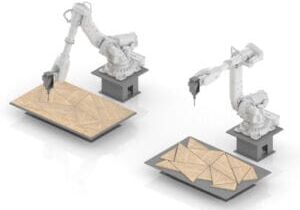
From BIM to Robotic Production: A Digital Workflow for Customized Components in Volumetric Modular Construction
For volumetric modular manufacturers, the value of this workflow is not simply the use of robotics. Its real value is continuity.
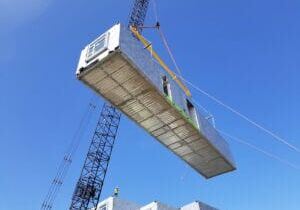
Helping Build a Common Framework for Modular Construction in Canada
Canada’s modular construction sector continues to gain momentum, but scaling it successfully will depend on shared expectations across design, manufacturing, approvals, and project delivery. CSA Z251 helps provide that common foundation.
Edges, Exits & Equipment: A Modular Builder’s Guide to Rooftop Access
Rooftop access belongs in the factory design. Before the modules ship, the project team should identify each route’s users, confirm applicable requirements, coordinate with the roof system and structure, and assign responsibility.
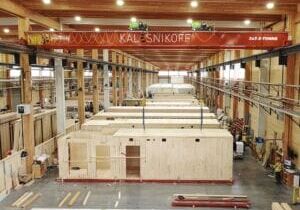
When Timber Production and Modular Construction Share One System
As demand for multifamily and workforce housing continues to outpace what conventional construction timelines can deliver, models that reduce the number of handoffs between structural fabrication and modular assembly are likely to draw more attention.
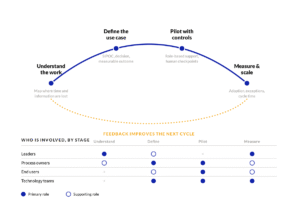
Your AI Strategy Is an Enablement Strategy
Tools will change. Teaching employees only the steps in one platform creates a narrow capability. Involving them in problem definition, process mapping, data assessment, controls, and measurement gives the organization a way to improve its systems as technology evolves.

By-Right Permitting: The Missing Lever for Scaling Modular Multifamily
Modular has already proven it can outperform traditional building methods on speed and cost per unit. The next frontier is outside the factory in the front end of the process, where projects either clear a path to construction or get stuck in review.
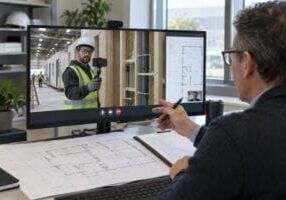
Remote Inspections and The Future of Factory Oversight
Remote inspection is becoming a practical part of modular construction oversight. Its value is greatest when it is used selectively, governed by clear procedures, and supported by complete traceability.
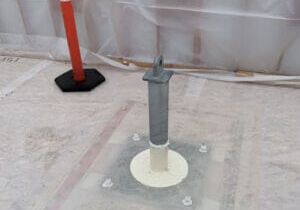
Reimagining Dry-In: How a Temporary-to-Permanent Roofing Strategy Mitigates Risk Between Modular Installation and Final Roof Construction
As volumetric modular projects continue to increase in scale and complexity, the Temporary-to-Permanent FiberTite Roof System represents an example of how traditional trade scopes can be reimagined through Design for Manufacturing and Assembly (DfMA) principles.
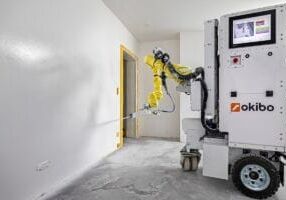
The Robotic Advantage: Addressing Labor and Quality Challenges in Construction Finishing
The off-site industry has already moved construction from an unpredictable jobsite into a controlled manufacturing environment. The next evolution is to make that environment increasingly intelligent, adaptable and automated.