
The Best-Kept Secret in Housing
A Call to Arms

Salvatore (Sal) Patalano is the CEO at ARCbuild Systems Global.
Talk about déjà vu! I once again find myself involved in an industry where our products are one of the best kept secrets. I lived through a similar scenario in the 80s when the general population was still getting its collective head around microcomputers and software. The difference this time is the overwhelming demand, and the deep emotional weight tied to home ownership. What was once the American Dream is now, for many, starting to feel more like a nightmare. Modular solutions are the future – plain and simple.
Since making the decision to step away from a 35-year career in the software industry, I am nothing short of amazed at the sheer size of the Total Addressable Market (TAM). Our market opportunity is as “green field” as I have ever seen, unlike the software space where selling is like a knife fight in a phone booth. There is no limit to the number of potential home buyers in the marketplace, be they B2B or B2C.
I am not implying that solving the housing crisis is simple, it’s extremely complex. What I am proposing is that we, as an industry, have an opportunity to present a non-traditional solution that is, in many ways, superior to what people typically consider when purchasing a home.
I was fortunate to have had the pleasure of working with Steve Jobs early on in my career, and I remain a fan of his many quotes. One in particular came to mind while writing this article. While hosting a planning retreat with the Mac team in 1982, someone on the team thought they should do market research to see what customers wanted. Steve replied by telling them no. His position was, “…customers don’t know what they want until we’ve shown them.” This needs to be our mantra! We need to shout it from the mountain top…tell the market that we have the solution…that we hold the future in our hands and it’s there for the taking.
So, let’s show them!

ARCbuild vineyard cabana
We have all read the statistics informing us that there is a housing shortage in America to the tune of 6 to 8 million homes. The more we read these numbers, the more desensitized we become to them, not unlike the barrage of tragic news thrust upon us daily. However, this shortage is no less tragic than any other disaster played out repeatedly over the airwaves and internet. The one critical difference being that we, as an industry, can actually do something about it. We have it within our purview to make a difference. And collectively, we are a force to be reckoned with. I am not necessarily proposing coopetition, but at a minimum a recognition of the situation beyond the obvious, short-term financial opportunity it presents.
So, let’s begin with a short refresher on how we got here because, as aptly stated by philosopher George Santayana, “Those who cannot remember the past are condemned to repeat it.” This is where it begins to get complex. The good news is that as suppliers, we are not overly impacted by any of these factors.
I would submit that there were five circumstances that occurred over the last 5-7 years and one event going back almost two decades—that being the Great Recession which created the housing shortage. We’ll eliminate the GR from this discussion since the more recent events are more germane. The five circumstances are:
- The Pandemic – Volumes have been written on the myriad of short- and long-term effects of the Pandemic – the worst being the horrors of the illness itself and the tragic death tolls. With respect to the global economy, the dramatic disruption of the supply chain lingers to the extent that even now we see signs of its long tail. Some would argue that supply chain constraints were a reality before the Pandemic hit—a point I would not debate. However, things were grossly exacerbated by the Pandemic.
- Inflation – As inflation grew the Fed used their favored control mechanism, interest rates, which correlate directly to mortgage rate increases. Inflation also impacts the material costs and the supply of affordable labor—both of which became almost untenable for several years.
- Interest Rates – In an effort to control inflation, the Fed raised rates, and we know that as mortgage rates pass the magic milestone of 6% - 6.5%, homebuyers exit the market. Less buyers means less housing starts. Builders began targeting high volume markets where price per foot is significantly higher than the national average and demand is driven by a large population inflow, leaving those in need of starter homes or affordable housing with fewer, if any, options.
- Millennials – Believe it or not, the age range of today’s Millennials is 29 to 44 years old; a reasonable time to enter the market as first time home buyers. Despite the popular belief that Millennial’s prefer to rent, I can assure you—as the
parent of a Millennial—that was then, and this is now. - Institutional Investors – This is a factor with which I have personal experience having sold into that market several years ago. For years large institutional investors have been buying up single family homes in quantity and making them available as rentals, only to see a recent cooling. While not directly responsible for the shortage, over 12M single family homes are rented in the U.S. today.
What can we do to right the ship, overcome these circumstances, capitalize on the opportunity, and address this epidemic in the housing sector? It’s easier than you might think. Let’s begin by articulating an apples-to-apples comparison and emphasizing the value proposition of modular homes. For example, consider that traditionally built homes take considerable capital and time to build; much more time and capital than do modular homes. Now while there are certainly other factors in play, as modular builders we have distinct advantages - and I submit that the time to move is now! Quality modular homes are the solution. To cite only a few advantages, we are less expensive, our delivery times are shorter, we are rarely impacted by delayed builds due to weather, and our inspection times are fractional. These simple advantages, and many more, are lost in all the noise. The average home buyer is not aware that there is an alternative.
So, let’s tell them!

ARCbuild vineyard cabana (interior)
At ARCbuild, we chose to take things a bit further. As a B2B supplier, our homes are structurally designed to be sustainable, avoiding the use of lumber, making us fire defensible and hurricane resistant. Our homes are significantly stronger than traditional stick-built and can be green-engineered to be fully grid-independent, smart homes. We believe in our product, and we believe that what we do will impact lives.
It’s time to dispel the stigmas and educate the uninformed. What we do is the future of residential living. Like electric vehicles which may never completely replace gas engines (at least not for this muscle car buff), modular homes will continue to grow in popularity based on both necessity and appeal, and it’s our job to fuel that growth. So many industries are crowded with countless solutions looking for a problem. It’s quite the opposite in our world. The problem has come to us, and we have the solution. We have been given the rare opportunity to help others while building a thriving business and achieving success.
At ARCbuild, we’re taking on this mission with affordable residential homes that dispel the myths, while putting the American Dream back in the hands of Americans.
More from Modular Advantage
From Model to Machine: Why Modular Scale Is Becoming a Software Problem, not a Material One
For modular manufacturers that have already secured demand and repeatable volume, the next major constraint may no longer be forming capacity itself. Increasingly, it is the continuity of the information feeding that capacity.
Who Will Define Modular Products for AI?
Artificial intelligence is making building configurators easier and less expensive to create. This makes urgent manufacturers’ need portable product definitions, stable identities, and shared interfaces regardless of how others’ software is produced.
From BIM to Robotic Production: A Digital Workflow for Customized Components in Volumetric Modular Construction
For volumetric modular manufacturers, the value of this workflow is not simply the use of robotics. Its real value is continuity.
Helping Build a Common Framework for Modular Construction in Canada
Canada’s modular construction sector continues to gain momentum, but scaling it successfully will depend on shared expectations across design, manufacturing, approvals, and project delivery. CSA Z251 helps provide that common foundation.

Edges, Exits & Equipment: A Modular Builder’s Guide to Rooftop Access
Rooftop access belongs in the factory design. Before the modules ship, the project team should identify each route’s users, confirm applicable requirements, coordinate with the roof system and structure, and assign responsibility.
When Timber Production and Modular Construction Share One System
As demand for multifamily and workforce housing continues to outpace what conventional construction timelines can deliver, models that reduce the number of handoffs between structural fabrication and modular assembly are likely to draw more attention.
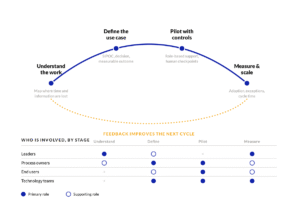
Your AI Strategy Is an Enablement Strategy
Tools will change. Teaching employees only the steps in one platform creates a narrow capability. Involving them in problem definition, process mapping, data assessment, controls, and measurement gives the organization a way to improve its systems as technology evolves.
By-Right Permitting: The Missing Lever for Scaling Modular Multifamily
Modular has already proven it can outperform traditional building methods on speed and cost per unit. The next frontier is outside the factory in the front end of the process, where projects either clear a path to construction or get stuck in review.

Remote Inspections and The Future of Factory Oversight
Remote inspection is becoming a practical part of modular construction oversight. Its value is greatest when it is used selectively, governed by clear procedures, and supported by complete traceability.

Reimagining Dry-In: How a Temporary-to-Permanent Roofing Strategy Mitigates Risk Between Modular Installation and Final Roof Construction
As volumetric modular projects continue to increase in scale and complexity, the Temporary-to-Permanent FiberTite Roof System represents an example of how traditional trade scopes can be reimagined through Design for Manufacturing and Assembly (DfMA) principles.