
Why Modular Companies Need Working Capital

Jim Park is the Founder of Park Place Business Capital & Park Place Modular Capital
Modular construction is built around efficiency. More of the work can be completed in a controlled environment, schedules can be easier to manage, quality can be more consistent, and projects can move faster than many traditional construction methods.
But there is one part of the business that can still slow everything down: cash flow.
A modular company may have a full pipeline of projects and a strong backlog, yet still feel pressure on its bank account. The reason is simple. The company often has to spend money well before it receives all of the money from the customer.
Materials have to be ordered. Employees have to be paid. Factory space has to stay productive. Transportation has to be scheduled. New projects may be starting while payments from earlier projects are still coming in.
That is where working capital can become extremely valuable.
Working capital gives a business access to money that can support everyday operations and growth. For a modular company, it may help pay for materials, payroll, inventory, equipment, project costs, receivables, production needs, or expansion.
The real benefit is financial flexibility. It helps keep the business moving when the timing of expenses and customer payments does not line up perfectly.

The Cash Flow Gap is Normal
A modular manufacturer may receive a new order that is profitable and well structured. Before the company receives all of the revenue from that project, it may need to purchase lumber, steel, windows, appliances, electrical components, plumbing materials, and other supplies.
Payroll, rent, insurance, utilities, and transportation continue as well.
Nothing is necessarily wrong with the company. The business may be profitable. The problem is timing.
Cash is going out before all of the cash from the project comes in.
Working capital can help bridge that gap.
Keep Materials and Production Moving
For many modular companies, materials are one of the largest expenses at the beginning of a project. If the company has to wait for a customer payment before placing the next order, production can slow down and delivery dates can be affected.
Access to working capital can give a company the ability to order materials when they are needed instead of when the bank balance happens to allow it.
It may also give the company more flexibility when suppliers offer better pricing for larger orders or early purchases.
The benefit is straightforward. The factory can keep moving.
Protect Payroll and Everyday Operations
A successful modular company depends on people.
Factory workers, project managers, installers, drivers, office staff, and subcontractors all need to be paid on time regardless of when a customer payment arrives.
Working capital can provide additional liquidity when several projects are moving at once or when receivables are taking longer than expected.
That extra cushion can help management focus on production, customers, and growth instead of worrying about whether one late payment will create a problem elsewhere in the business.
Say "Yes" to Larger Opportunities
Growth can create its own cash flow problem.
A larger contract may require a much bigger material purchase, more labor, more project management, and more money upfront.
Without enough available capital, a company may have to turn down work it is fully capable of completing.
The right working capital solution can help a company take on larger projects without using every dollar of available cash.
This can be especially important when a modular company begins moving into commercial projects such as hotels, schools, medical buildings, apartments, workforce housing, and offices.
Growth should be exciting. It should not create a cash crisis.

Build Capacity Before You Need It
A modular company may need additional employees, more factory space, equipment, vehicles, technology, inventory, or another production line before the added revenue begins to arrive.
Working capital can help a business prepare for growth before capacity becomes a problem.
The question changes from “Can we afford to take on more business?” to “What capital do we need to take on more business responsibly?”
That is a much better position for an owner to be in.
Create More Financial Flexibility
Every business has surprises.
A supplier may require a larger deposit. Equipment may need repair. A project may require more labor than expected. A customer payment may arrive later than planned.
When a company has very little available cash, every surprise feels urgent.
Working capital can create breathing room. It gives the company another financial resource that can be used when there is a legitimate business need.
That can reduce the pressure to make rushed decisions or move money away from another project just to solve a short term problem.
The key is to use capital with a purpose. Working capital should support the business, not replace good financial management.
Match the Financing to the Need
There is no single financing product that is right for every modular company.
A business line of credit may be useful for recurring needs such as materials, payroll, inventory, and receivables.
A term loan may make more sense for a specific expansion or larger project.
Equipment financing can help preserve cash when the company needs machinery, vehicles, or production equipment.
SBA financing may be available for eligible companies that need capital for expansion, equipment, acquisitions, or other qualified business purposes.
There are also commercial financing options outside of SBA programs for companies with needs that do not fit a traditional bank loan.
The most important thing is to match the financing to the reason the money is needed.
Prepare Before the Need Becomes Urgent
The best time to look for capital is usually before the company is under pressure.
Keep financial statements current. Know monthly expenses. Track receivables and payables. Keep a current list of active projects and backlog. Understand how much cash is required to start and complete each project.
Good information makes it easier to explain the business, the financing request, and how the capital will be used.
It also gives the owner more time to compare options and choose a solution that makes sense.
Working Capital Should Help a Good Company Grow
Modular companies already understand the value of planning. Designs are coordinated. Production is scheduled. Materials are ordered. Transportation is arranged. Installation is planned.
Capital deserves the same attention.
The right working capital solution can help a modular company keep materials moving, protect payroll, take on larger projects, add capacity, and manage the normal gap between paying expenses and collecting revenue.
That is what working capital is really about.
It gives a strong company more flexibility to operate, compete, and grow.
Park Place Modular Capital, a specialized division of Park Place Business Capital, helps modular manufacturers, builders, ADU companies, and industry suppliers explore working capital and commercial financing solutions for materials, payroll, inventory, equipment, project costs, receivables, production needs, and expansion.
More from Modular Advantage
From Model to Machine: Why Modular Scale Is Becoming a Software Problem, not a Material One
For modular manufacturers that have already secured demand and repeatable volume, the next major constraint may no longer be forming capacity itself. Increasingly, it is the continuity of the information feeding that capacity.

Who Will Define Modular Products for AI?
Artificial intelligence is making building configurators easier and less expensive to create. This makes urgent manufacturers’ need portable product definitions, stable identities, and shared interfaces regardless of how others’ software is produced.
From BIM to Robotic Production: A Digital Workflow for Customized Components in Volumetric Modular Construction
For volumetric modular manufacturers, the value of this workflow is not simply the use of robotics. Its real value is continuity.
Helping Build a Common Framework for Modular Construction in Canada
Canada’s modular construction sector continues to gain momentum, but scaling it successfully will depend on shared expectations across design, manufacturing, approvals, and project delivery. CSA Z251 helps provide that common foundation.
Edges, Exits & Equipment: A Modular Builder’s Guide to Rooftop Access
Rooftop access belongs in the factory design. Before the modules ship, the project team should identify each route’s users, confirm applicable requirements, coordinate with the roof system and structure, and assign responsibility.
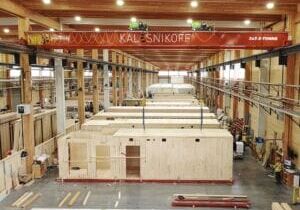
When Timber Production and Modular Construction Share One System
As demand for multifamily and workforce housing continues to outpace what conventional construction timelines can deliver, models that reduce the number of handoffs between structural fabrication and modular assembly are likely to draw more attention.
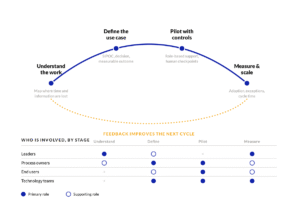
Your AI Strategy Is an Enablement Strategy
Tools will change. Teaching employees only the steps in one platform creates a narrow capability. Involving them in problem definition, process mapping, data assessment, controls, and measurement gives the organization a way to improve its systems as technology evolves.

By-Right Permitting: The Missing Lever for Scaling Modular Multifamily
Modular has already proven it can outperform traditional building methods on speed and cost per unit. The next frontier is outside the factory in the front end of the process, where projects either clear a path to construction or get stuck in review.

Remote Inspections and The Future of Factory Oversight
Remote inspection is becoming a practical part of modular construction oversight. Its value is greatest when it is used selectively, governed by clear procedures, and supported by complete traceability.
Reimagining Dry-In: How a Temporary-to-Permanent Roofing Strategy Mitigates Risk Between Modular Installation and Final Roof Construction
As volumetric modular projects continue to increase in scale and complexity, the Temporary-to-Permanent FiberTite Roof System represents an example of how traditional trade scopes can be reimagined through Design for Manufacturing and Assembly (DfMA) principles.