
The Robotic Advantage: Addressing Labor and Quality Challenges in Construction Finishing

Vered Yanushevsky is the Head of Industrial and Off-site Construction at Okibo
The Automation Gap in Off-Site Construction
Off-site construction has already transformed one of the building industry’s basic assumptions: that buildings must be built primarily at the jobsite.
By moving work into controlled manufacturing environments, modular and prefabricated builders have introduced greater predictability, repeatability and production discipline. Yet in many factories, an important contradiction remains: the building has moved into the factory, but many finishing processes have not fundamentally changed.
Drywall finishing, sanding, spraying and painting still rely heavily on manual labor. Employees may spend hours working overhead or repeating the same physical task across similar walls and ceilings, while manufacturers are under pressure to increase production, manage labor shortages and maintain consistent quality.
This is where construction robotics can make a meaningful difference.
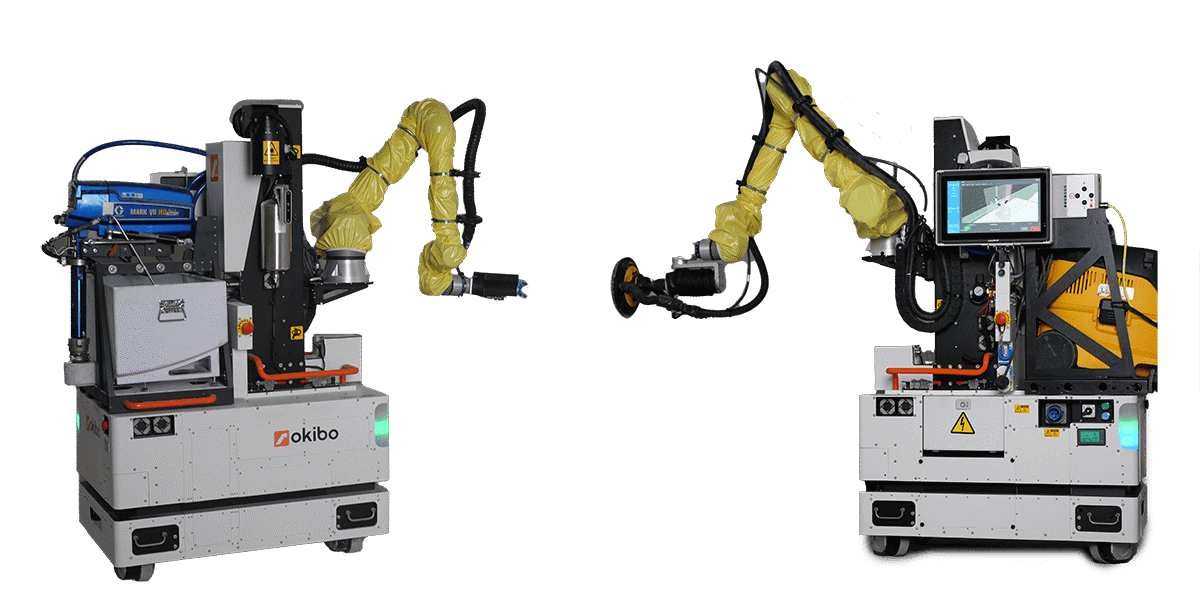
At Okibo, we focus on mobile robotic solutions for construction finishing. Our robots work directly on full-scale construction elements and perform tasks such as sanding, mudding, spraying and painting. For off-site manufacturers, the opportunity is to turn labor-intensive finishing activities into repeatable manufacturing processes.
Construction Finishing Requires a Different Kind of Robot
Traditional industrial robotics works well when the environment is designed around the robot. Components arrive in a precise location, and a fixed robotic arm performs a programmed operation within an engineered cell.
Construction is different. Walls and ceilings are large, openings and dimensions vary, and a robot may need to work at different locations, heights and surfaces. Rebuilding an entire production line around fixed automation is often impractical.
Okibo approaches the problem differently: bring the robot to the building rather than requiring the building to come to the robot.
Instead of depending on a pre-programmed fixed path, the robot reads its working environment and the surfaces around it. Manufacturers do not need to program each wall, ceiling or module as they typically would with conventional industrial robotics.
The platform is also mobile. It is not tied to fixed tracks, robotic cells or permanent cabling infrastructure. It can move to where the work is happening, operate on walls and ceilings, and support different finishing applications on the same platform.
For off-site manufacturers, that means automation can be introduced into the existing production environment rather than requiring the factory to be redesigned around the robot.

Labor: Robotics Your Existing Workforce Can Operate
Labor is usually one of the first reasons manufacturers explore automation. But another concern often follows: Who is going to operate the robot?
There can be an assumption that robotics requires engineers, programmers or an entirely different workforce. For construction robotics to succeed, that cannot be the model.
Okibo’s system is designed to be accessible to the people already working in the factory . The robot can be operated using a familiar Xbox controller, and because it reads and adapts to its environment, operators do not need to create complex programmed paths for each new surface.
The objective is not to turn construction workers into robotics engineers. It is to give them another tool.
A worker who understands drywall, painting or surface finishing already brings the most important knowledge: understanding the process and recognizing what a quality result looks like. The robot performs the repetitive physical application in a controlled and consistent manner.
Instead of spending an entire shift sanding, spraying or working overhead, employees can supervise robotic applications, prepare materials, inspect finished surfaces and focus on work that requires human judgment.
For manufacturers struggling to recruit and retain labor, the advantage is not simply doing the same work with fewer people. It is expanding what the existing workforce is capable of producing.
Quality: Making a Good Process Repeatable
Experienced craftspeople can produce excellent results. The manufacturing challenge is reproducing those results consistently across employees, shifts and production days.
Manual finishing naturally introduces variation. Application speed, spray distance, sanding pressure and coverage can differ from person to person, and fatigue can affect performance over the course of a shift.
Robotic finishing creates an opportunity to control many of those variables. With Okibo, parameters such as movement, application path, working distance and speed become part of a defined process. Once the correct parameters are established, the robot can reproduce the same movement consistently across subsequent surfaces.
The goal is not to claim that a robot has better judgment than an experienced tradesperson. Human inspection and process knowledge remain essential. The advantage is that once an experienced person determines how the job should be done, the robotic system can help repeat that process again and again.
That is closely aligned with the philosophy of off-site construction: moving from individual execution toward controlled production.


One Platform, Multiple Finishing Processes
A robot dedicated to one narrow application may be difficult to justify if that task represents only a small portion of the production day. Flexibility and utilization therefore matter.
Okibo has developed robotic applications for drywall sanding, mudding, spraying and painting. The significance is not simply that a robot can perform multiple tasks. It is that the same mobile robotic platform can move with the production process and address different finishing needs within a facility.
Rather than asking, “Can we automate this one task?” manufacturers can ask a more useful question: How many repetitive finishing processes in our factory could be handled by the same robotic platform?
That broader view is important because successful automation should fit the existing production environment, be simple enough for the manufacturer’s own employees to operate, and solve a real operational problem.
The goal is not to put a robot in a factory because robotics is innovative. It is to address labor availability, physically demanding work, consistency, throughput and the ability to scale.
The Next Stage of the Off-Site Factory
The future off-site factory will not necessarily be one in which robots replace people. It is more likely to be one in which the division of work changes.
People will continue to do what humans do exceptionally well: make decisions, solve unexpected problems, inspect quality and apply experience and judgment. Robots can increasingly take responsibility for tasks that benefit from repetition, controlled movement and endurance.
But the opportunity goes beyond the applications available today.
At Okibo, we see the robot not as a machine designed for one specific task, but as a smart robotic platform. Sanding, mudding, spraying and painting are applications on that platform today. As the technology evolves, additional capabilities can be introduced through new tools, software and applications, allowing the same platform to take on a broader role within the production environment.
For off-site manufacturers, that creates a different approach to automation: not a collection of single-purpose machines, but a flexible platform that can adapt alongside the factory, its products and its production needs.
The off-site industry has already moved construction from an unpredictable jobsite into a controlled manufacturing environment. The next evolution is to make that environment increasingly intelligent, adaptable and automated.
At Okibo, we believe construction robotics can help make that transition practical by giving manufacturers and their teams better tools to build more consistently, efficiently and at greater scale.
Today’s applications solve today’s challenges. The platform is designed to evolve for what comes next.
More from Modular Advantage
From Model to Machine: Why Modular Scale Is Becoming a Software Problem, not a Material One
For modular manufacturers that have already secured demand and repeatable volume, the next major constraint may no longer be forming capacity itself. Increasingly, it is the continuity of the information feeding that capacity.

Who Will Define Modular Products for AI?
Artificial intelligence is making building configurators easier and less expensive to create. This makes urgent manufacturers’ need portable product definitions, stable identities, and shared interfaces regardless of how others’ software is produced.
From BIM to Robotic Production: A Digital Workflow for Customized Components in Volumetric Modular Construction
For volumetric modular manufacturers, the value of this workflow is not simply the use of robotics. Its real value is continuity.
Helping Build a Common Framework for Modular Construction in Canada
Canada’s modular construction sector continues to gain momentum, but scaling it successfully will depend on shared expectations across design, manufacturing, approvals, and project delivery. CSA Z251 helps provide that common foundation.
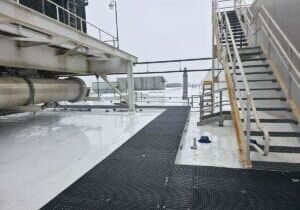
Edges, Exits & Equipment: A Modular Builder’s Guide to Rooftop Access
Rooftop access belongs in the factory design. Before the modules ship, the project team should identify each route’s users, confirm applicable requirements, coordinate with the roof system and structure, and assign responsibility.
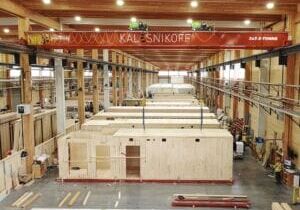
When Timber Production and Modular Construction Share One System
As demand for multifamily and workforce housing continues to outpace what conventional construction timelines can deliver, models that reduce the number of handoffs between structural fabrication and modular assembly are likely to draw more attention.
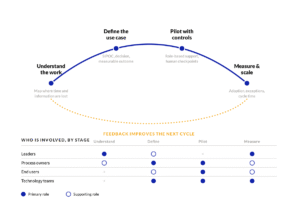
Your AI Strategy Is an Enablement Strategy
Tools will change. Teaching employees only the steps in one platform creates a narrow capability. Involving them in problem definition, process mapping, data assessment, controls, and measurement gives the organization a way to improve its systems as technology evolves.

By-Right Permitting: The Missing Lever for Scaling Modular Multifamily
Modular has already proven it can outperform traditional building methods on speed and cost per unit. The next frontier is outside the factory in the front end of the process, where projects either clear a path to construction or get stuck in review.
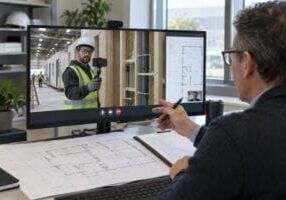
Remote Inspections and The Future of Factory Oversight
Remote inspection is becoming a practical part of modular construction oversight. Its value is greatest when it is used selectively, governed by clear procedures, and supported by complete traceability.
Reimagining Dry-In: How a Temporary-to-Permanent Roofing Strategy Mitigates Risk Between Modular Installation and Final Roof Construction
As volumetric modular projects continue to increase in scale and complexity, the Temporary-to-Permanent FiberTite Roof System represents an example of how traditional trade scopes can be reimagined through Design for Manufacturing and Assembly (DfMA) principles.