
Teeing Up the Next Generation of Modular
How a golf simulator, a scoreboard, and a real charity donation are putting modular construction in front of an audience this industry has never reached.

Chris Wilmot is the marketing director at Wilmot Modular Structures, Inc.
Ask anyone in this industry what’s holding modular back and you’ll get some version of the same answer: perception. The other barriers are real — code and regulatory inconsistency from one jurisdiction to the next is a genuine drag on this business, and anyone who has fought a plan review knows it. But perception is the one that stops a project before anybody opens a code book. People still picture a trailer in a gravel lot.
We’ve fought that for decades with the same tools: case studies, spec sheets, trade show booths, LinkedIn posts nobody finishes reading. The information is out there, and a great deal of it is excellent. It just doesn’t travel, because nobody outside our industry has a reason to sit down and take it in.
That’s a distribution problem more than a content problem. So instead of writing another white paper, we built a golf show.

The Turn — the segment where the competition stops and the business conversation starts.
The Format
Modular Impact is a golf simulator competition series. Team Wilmot takes on one guest company per episode across four challenges — long drive, closest to the pin, a wedge challenge, and a putting duel on a two-hole putting green, the only challenge played outside the simulator. Sixteen points are on the table. Each team gets one Mulligan and one “Ice,” a CO₂ jet blast fired at an opponent right before a pressure shot. Yes, really.
Halfway through, everything stops for a segment we call The Turn — the guest’s company story, and the charity they’re playing for. Every episode generates a real donation, and every one of the four challenges gives the guest a chance to grow it. The better they play, the more their charity walks away with.
A season runs ten episodes. Nine are regular matches; the tenth is a championship, where the best-performing guest company of the season returns for a rematch with higher stakes and a larger donation on the line.

The on-screen package: studio cam, game cam, live scoreboard, power plays, and the episode’s running donation.
So the competition isn’t decoration on top of the business content. The competition is the stakes. When someone stands over a six-foot putt knowing it’s worth real money to a cause they care about, you get a genuine reaction. You can’t script that, and you can’t fake it in a testimonial video.
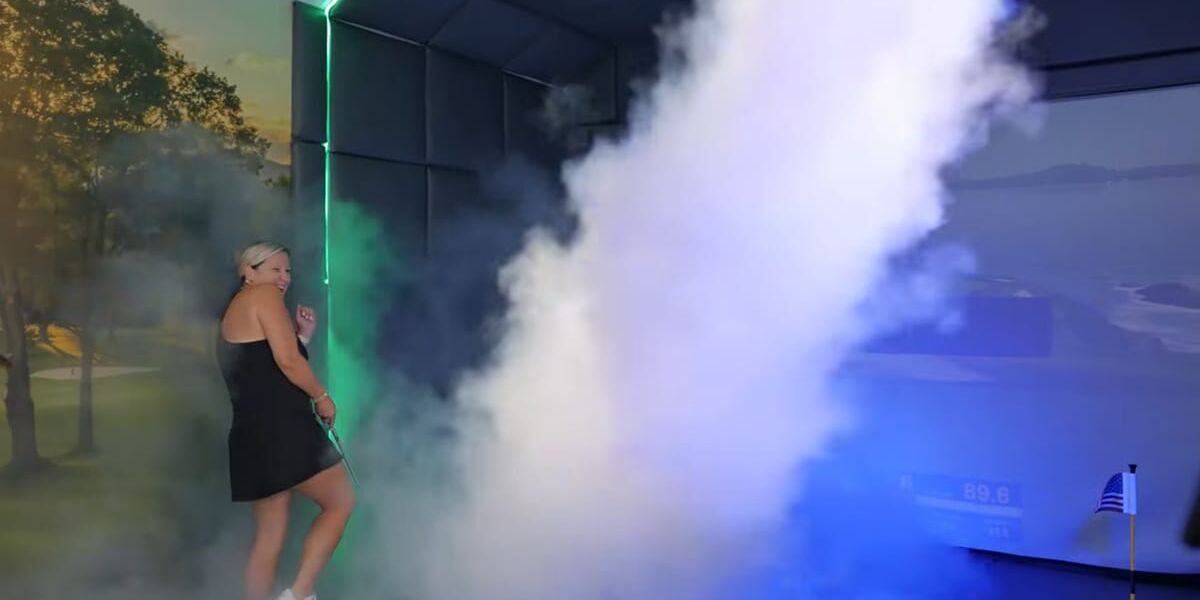
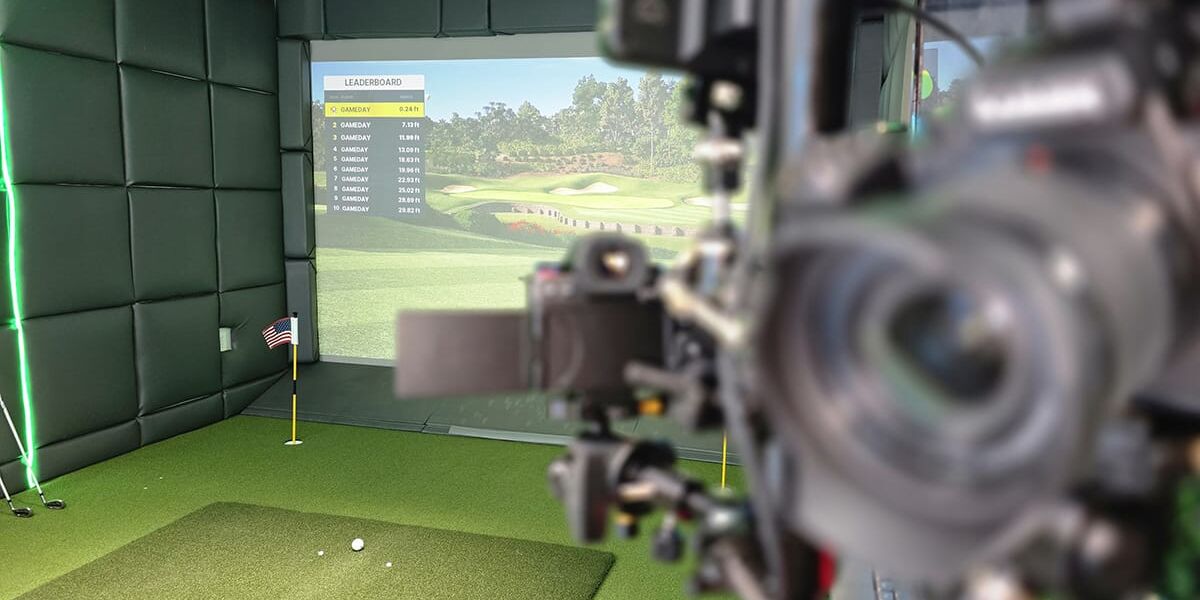
One CO₂ blast per team, deployed right before a shot that matters — and the bay where three of the four challenges are played.
The Set is the Argument
There’s one detail we don’t oversell on camera, because we’d rather people notice it themselves: the studio sits inside a two-story modular building. So does the rest of our headquarters. The stone wall behind the guest chairs, the simulator bay, the offices the whole company works out of — all of it modular.
Every guest walks through the building before they hit a single shot. Nobody has to be told what modular can look like, because they’re standing in it. That’s a better answer to the trailer-in-a-gravel-lot image than any spec sheet we could hand them.
Win — Win — Win
Our guest list is deliberately wide: customers, vendors, suppliers, general contractors, architects, association leadership. Every corner of this industry sees modular from a different angle, and the viewer should get all of them.
That breadth works because the incentives line up three ways. We reach an audience we’d never reach with a brochure. The guest gets a platform to share what they’re building and what they’ve learned along the way. And a charity walks away with money based on how well that guest plays.
We didn’t set out to make a podcast. There are a lot of good ones in this industry and we listen to plenty of them — we just didn’t think we’d add much by making another. We wanted a scoreboard, real stakes, and a reason for someone with no prior interest in construction to keep watching. Golf. Business. Purpose. The tagline isn’t a slogan we retrofitted; it’s a description of what the show produces.
Who We’re Really Trying to Reach
Here’s the part that matters most to us. Most of what we make isn’t aimed at the people already reading this magazine — you know this industry better than we could explain it. We’re after the people who don’t know it exists yet.
We have a workforce problem, and it won’t solve itself with a booth at a career fair. There’s a generation deciding right now what to do with their lives, and most of them have never heard the word modular. They don’t know these trades exist. They don’t know what they pay. They have no idea you can build a serious career without a four-year degree and the debt attached to it.
Modular is a genuinely attractive alternative to the path previous generations were pushed toward. Much of the work happens in a controlled environment instead of a muddy site in February. Schedules are more predictable. The technology is real. There’s a clear ladder from the shop floor to project management to ownership, and it can move faster than most white-collar tracks. That’s a good pitch. We’ve simply never made it anywhere young people are actually looking.
So we built a show a sixteen-year-old will watch on a phone. The competition, the CO₂ blasts, the good-natured trash talk — that’s what earns the click. The business conversation is what they get while they’re there. If one of them finishes an episode thinking wait, that’s a job you can have? — that’s worth more to this industry than any impression count.

The Unexpected Payoff
We built this as a marketing project. It became the best networking tool we’ve ever had. An invitation to compete for your charity gets a yes from people who would never sit for a marketing video. Two hours on set with a customer or a supplier builds more relationship than a year of conference handshakes, and the guest’s own network sees it, because they’re not sharing an ad — they’re sharing a win for a cause they chose.
What We’d Tell Anyone Trying This
Get a skilled editor early. Production is where a series dies. A good editor working from a shared folder with a defined workflow is the difference between a show and an abandoned channel.
Plan the release before you shoot. We map every episode’s rollout in advance — full episode in week one, clips from it in week two, teasers for the next episode in weeks three and four — then schedule it all at once. Planning the calendar upfront is what makes automating it possible.
Consistency beats everything. This one can’t be overstated. One brilliant episode followed by silence is worth less than a steady cadence of good ones. And don’t fragment the show across platforms — we consolidate watch time on YouTube and use everything else to drive there.
What We’re Actually After
None of this works without people willing to say yes. Every guest who has come through has given us their time, their story, and a fair amount of composure while standing over a putt with a camera in their face. We don’t take that lightly, and we’re grateful to MBI and to the organizations that made room for a first-season show with no track record. This industry has been generous with us, and the show is one way of giving some of that back.
We want a show a 16-year-old, a 25-year-old estimator, and a 65-year-old owner will all watch. We want viewpoints from every corner of this industry, not only the ones that agree with us. We want to have fun doing it. And most of all, we want to move real money to the causes that matter to the people in our community.
Most of what gets called innovation in modular is upstream: automation, BIM, panelization, new materials. All of it matters. But none of it reaches its potential if the owner making the decision doesn’t understand what we’re capable of, and none of it gets built if nobody shows up to build it. The work this industry produces is worth talking about. It deserves a better container than the one we’ve been shipping it in.
We’re about a quarter of the way through Season 1, and always looking for guests. You don’t need to be a golfer; half of ours aren’t. You need about two hours, a cause that matters to you, and a willingness to be a good sport when the CO₂ cannon goes off mid-backswing.
If that sounds like your company, reach out to me directly at Chris@WilmotModular.com — there’s a good chance we can get you into an episode in 2027.
Chris Wilmot is a minority owner at Wilmot Modular Structures, Inc. (est. 1989) and hosts Modular Impact alongside a rotating co-host drawn from the Wilmot ownership and team. Watch Season 1 at youtube.com/@wilmotmodularstructures. #WeHelpBuildVisions
More from Modular Advantage
From Model to Machine: Why Modular Scale Is Becoming a Software Problem, not a Material One
For modular manufacturers that have already secured demand and repeatable volume, the next major constraint may no longer be forming capacity itself. Increasingly, it is the continuity of the information feeding that capacity.

Who Will Define Modular Products for AI?
Artificial intelligence is making building configurators easier and less expensive to create. This makes urgent manufacturers’ need portable product definitions, stable identities, and shared interfaces regardless of how others’ software is produced.
From BIM to Robotic Production: A Digital Workflow for Customized Components in Volumetric Modular Construction
For volumetric modular manufacturers, the value of this workflow is not simply the use of robotics. Its real value is continuity.
Helping Build a Common Framework for Modular Construction in Canada
Canada’s modular construction sector continues to gain momentum, but scaling it successfully will depend on shared expectations across design, manufacturing, approvals, and project delivery. CSA Z251 helps provide that common foundation.
Edges, Exits & Equipment: A Modular Builder’s Guide to Rooftop Access
Rooftop access belongs in the factory design. Before the modules ship, the project team should identify each route’s users, confirm applicable requirements, coordinate with the roof system and structure, and assign responsibility.
When Timber Production and Modular Construction Share One System
As demand for multifamily and workforce housing continues to outpace what conventional construction timelines can deliver, models that reduce the number of handoffs between structural fabrication and modular assembly are likely to draw more attention.
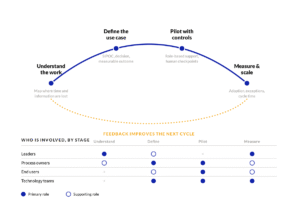
Your AI Strategy Is an Enablement Strategy
Tools will change. Teaching employees only the steps in one platform creates a narrow capability. Involving them in problem definition, process mapping, data assessment, controls, and measurement gives the organization a way to improve its systems as technology evolves.
By-Right Permitting: The Missing Lever for Scaling Modular Multifamily
Modular has already proven it can outperform traditional building methods on speed and cost per unit. The next frontier is outside the factory in the front end of the process, where projects either clear a path to construction or get stuck in review.
Remote Inspections and The Future of Factory Oversight
Remote inspection is becoming a practical part of modular construction oversight. Its value is greatest when it is used selectively, governed by clear procedures, and supported by complete traceability.
Reimagining Dry-In: How a Temporary-to-Permanent Roofing Strategy Mitigates Risk Between Modular Installation and Final Roof Construction
As volumetric modular projects continue to increase in scale and complexity, the Temporary-to-Permanent FiberTite Roof System represents an example of how traditional trade scopes can be reimagined through Design for Manufacturing and Assembly (DfMA) principles.