
Printing the Future of Modular Construction
How 3D Concrete Printing (3DCP) Is Reshaping Industrialized Construction and Building the Workforce Behind It

Vida Babajaniniashirvani is a PhD Candidate at Myers-Lawson school of construction at Virginia Tech.
Picture a near-future construction site where a single crew manages two types of printed concrete simultaneously, one team in a warehouse outside the city, running a 3D printer that prints wall panels to be shipped and assembled on site, another on the foundation itself, printing custom geometries that no factory module could replicate. Neither approach exists in isolation. They are two expressions of the same idea: that concrete construction, one of the industry's most labor-intensive and waste-generating processes, can be automated, digitized, and made radically more efficient. That idea is 3D concrete printing (3DCP): a computer-controlled additive manufacturing process that extrudes concrete layer by layer, eliminating formwork, reducing labor dependency, and enabling levels of design flexibility that conventional methods cannot match, and for the modular and offsite construction community, it represents not a competing technology but the next chapter in the industrialization of how we build.
For the modular and offsite construction industry, 3D concrete printing should not be viewed as a competing construction method. It should be understood as a potential expansion of the industrialized construction toolkit. This connection matters because many of the challenges facing 3DCP are familiar to modular builders: how to standardize production without eliminating design flexibility, how to coordinate digital models with physical assembly, how to control quality across repeatable units, how to train a workforce for manufacturing-based construction, and how to integrate new components into existing building systems. In this sense, 3DCP is not separate from modular construction; it is one possible next layer of offsite production.
This research, has focused on a question that sits at the intersection of technology and people: what does the AEC workforce actually need to know to make 3DCP work, and what does the industry currently understand about that gap? Through a combination of literature review, 3DCP expert focus groups, and a national survey of U.S. construction professionals, the answers are both encouraging and sobering.
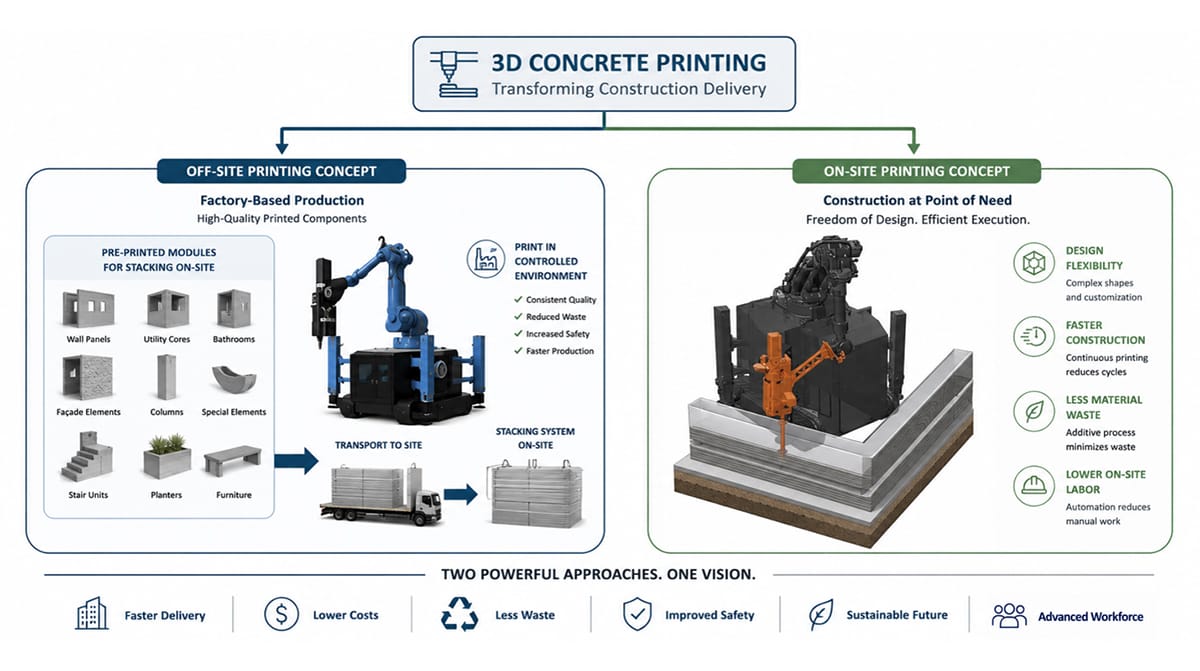
Figure 1. Two 3DCP delivery models; onsite and offsite
Understanding the Workforce Challenge
Both delivery models share one fundamental requirement: people who know what they are doing. Whether 3D concrete printing takes place directly on the jobsite or in a controlled offsite manufacturing environment, successful implementation depends on a workforce capable of operating the equipment, managing digital workflows, and integrating the technology into construction practice. Yet many discussions surrounding 3D concrete printing focus primarily on the technology itself, with less attention given to a critical question: who will operate these systems, manage these workflows, and implement these technologies at scale?
This is also a familiar issue for modular construction. Offsite construction is not simply traditional construction moved indoors; it requires a different workforce logic built around production planning, digital coordination, tolerance management, quality control, sequencing, logistics, and cross-trade integration. 3DCP raises a similar workforce challenge. The technology may be automated, but its success depends on people who understand how material behavior, machine operation, digital modeling, inspection, and assembly decisions interact.
A review of the current training landscape reveals a troubling fragmentation. There is no standardized curriculum, no unified competency framework, and no formal pathway for construction professionals to certify their readiness to work with this emerging technology (Afsari et al., 2024). To better understand the competencies required for effective adoption of 3D concrete printing, this research employed a mixed-methods approach consisting of an extensive review of the existing 3DCP literature, a focus group of 3DCP industry experts, and a national survey of U.S. AEC professionals representing 16 states. The objective was to identify and evaluate the relative importance of the competencies required for successful implementation of 3D concrete printing technology. As shown in Figure 2, the findings resulted in the identification of 16 essential competencies through the focus group process and captured industry professionals' perceptions of the importance of each competency though the survey (Babajaniniashirvani et al., 2025).
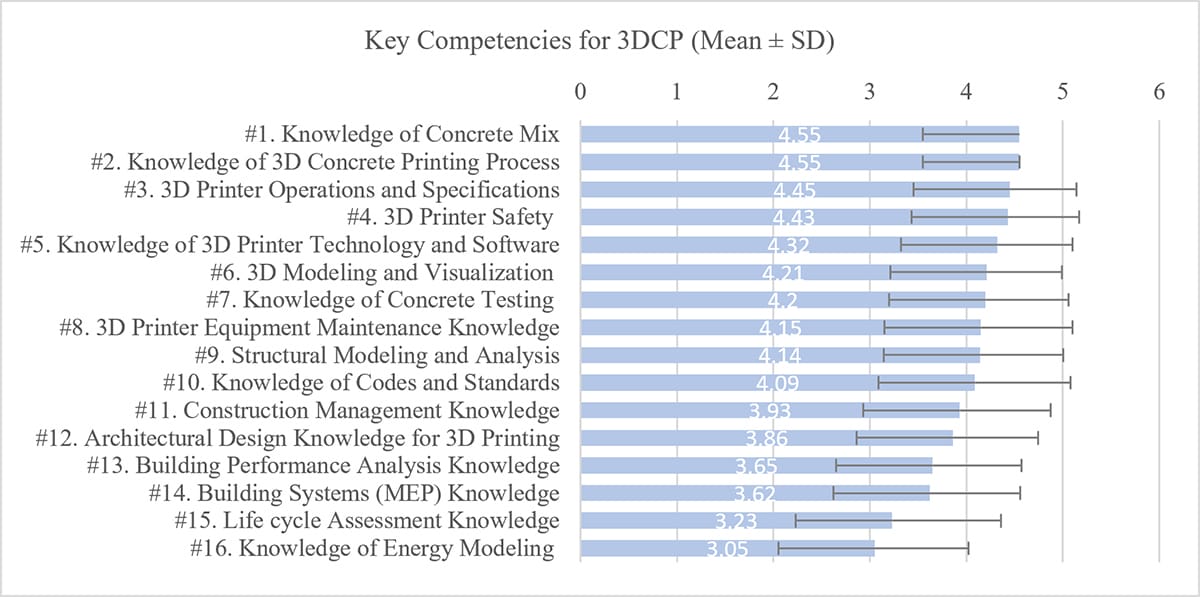
Figure 2. Perceived importance of key 3DCP competencies among AEC professionals
The results revealed several important insights. Knowledge of concrete mix and the 3DCP process emerged as the highest-ranked competencies, followed by printer operations and specifications, printer safety, and printer technology/software. While 3DCP is often associated with robotics and automation, the high ranking of concrete materials knowledge shows that successful implementation begins with understanding material behavior, printability, and process control. This finding has a clear parallel with modular construction: both depend on predictable inputs, repeatable production, safety, quality control, and coordination between design information and physical assembly. Competencies such as construction management, codes and standards, and structural modeling also received strong ratings, suggesting that the future 3DCP workforce will need more than technical machine skills. It will need the same kind of integrated thinking already required in modular and offsite construction: connecting materials, digital workflows, production sequencing, inspection, and final assembly into one coordinated delivery process.
From Key Competencies to Curriculum
Knowing what the workforce needs is only half the challenge. The next step is turning those critical competencies into a structured training program that can prepare the next generation of construction professionals.
The next step in our research was to developing a 10-module 3DCP curriculum in two tracks: Module A covers fundamentals (digital fabrication context, 3D modeling and toolpath simulation in Rhinoceros and Grasshopper, concrete mix design, codes and safety), while Module B addresses advanced application in affordable housing (case study of a real printed Virginia home, building systems, structural design and reinforcement, architectural detailing, hands-on printer operations, and concrete extrusion and testing)(Afsari et al., 2025). The curriculum translates research findings into practical workforce development, providing learners with the knowledge and skills needed to move from understanding the technology to successfully implementing it in practice.
This type of curriculum could also be paired with modular workforce education. The early modules on digital fabrication, modeling, concrete mix, codes, and safety could support broad awareness across offsite construction teams, while advanced modules on building systems, structural design, printer operations, and concrete extrusion could support specialized roles inside a modular or prefabrication facility. Rather than training a separate “3DCP workforce,” the more scalable approach may be to upskill the existing modular workforce so that printed concrete becomes one more coordinated production process within industrialized construction.
Looking Ahead
The future of construction will not be defined by a single innovation. Instead, it will be shaped by how effectively the industry combines manufacturing, automation, digital technologies, advanced materials, and workforce development into integrated delivery systems.
Industrialized construction has already transformed where buildings are manufactured. 3D concrete printing may help transform how they are manufactured. The most important question is not whether 3D concrete printing will replace modular construction, but how the industry can leverage the strengths of both approaches to deliver a more productive, affordable, and scalable built environment.
Getting there requires deliberate investment in the competencies that connect 3DCP to industrialized construction: concrete materials expertise, digital modeling and toolpath skills, production planning, equipment safety, quality control, building-system integration, and training infrastructure. These are not isolated 3DCP issues. They are the same types of workforce and process challenges that modular construction has been addressing for years as it moves building production into more controlled and repeatable environments.
For modular builders, educators, manufacturers, and policymakers, the opportunity is clear. 3DCP does not need to replace modular construction to be valuable. Its near-term value may be as a complementary production method that expands what offsite factories can make, supports hybrid building systems, and creates new pathways for workforce development. The technologies are advancing rapidly. The next challenge is preparing the modular and offsite workforce capable of turning that potential into scalable practice.
Bibliography
- Education in the Construction Industry. In T. Leathem, W. Collins, & A. Perrenoud (Eds.), Proceedings of 60th Annual Associated Schools of Construction International Conference (Vol. 5, pp. 39–47). EasyChair. https://doi.org/10.29007/dgwz
- Afsari, K., McCoy, A., Agee, P., Brand, A., King, N., Pond, N., & Babajaniniashirvani, V. (2025). 3D Concrete Printing (3DCP) Curriculum: Training for Architecture, Engineering, and Construction (AEC) Professionals | HUD USER. HUD. https://www.huduser.gov/portal/publications/3D-Concrete-Printing-3DCP-Curriculum.html
- Babajaniniashirvani, V., Afsari, K., & McCoy, A. (2025). Investigating Key Competencies for 3D Concrete Printing in Affordable Housing. 19–28. https://doi.org/10.1061/9780784486139.003
More from Modular Advantage

Mind the Gap: The Interface Between Onsite and Offsite Construction
Every design for manufacture and assembly (DfMA) project — modular, mass timber, or panelized — is really two projects joined at a seam. One is built in a controlled factory to millimeter tolerances; the other in the field, in weather, to the looser tolerances of poured concrete and human hands. Between them sits an interface: where the factory’s precision meets the site’s reality.
Rules, Rails & Repeatability: Applying DfMA to Modular Healthcare
DfMA offers several advantages for healthcare projects, with faster delivery among the most valuable. Schedule matters when building new facilities, expanding campuses, renovating existing space or bringing care closer to communities that need it.
Precision and Possibility: Demands of DfMA and What Modular Mass Timber Makes Possible
Mass timber does not automatically create an efficient modular building. Its precision makes early coordination more important: fabricated components will accurately reproduce both the team’s solutions and its mistakes. The material’s advantages are realized only when supported by an equally precise design and delivery process.
Catch It in the Factory, Not in the Field: Smarter Testing for Modular Builds
Integrating watertightness and airtightness testing into factory workflows transforms quality assurance from a reactive process into a proactive commissioning strategy. It ensures that every module shipped is field ready and resilient for transportation while also supporting the ability of the modular construction industry to make buildings better.
Modular Construction Contracts: Key Considerations for Successful Canadian Projects
Starting a modular project with a well-developed contract protects both the owner and the contractor. It will help keep the project on track and on budget, and it will improve quality from the factory floor to final installation on-site.
Modular by Design: Turning Architecture into a Manufacturing System
Modular construction is often presented as a faster way to build. Speed, however, is only one part of its value. The larger opportunity is to create a coordinated design and production system that improves quality, reduces uncertainty, and allows a building to move efficiently from concept design through manufacturing, transportation, installation, and completion.

Repeatability Begins with Trust: What Alora at Dry Creek Reveals About Scaling Modular Housing
Alora at Dry Creek, a 329-unit, multifamily community comprising five four-story buildings in Centennial, Colorado, demonstrates how repeatable design, standardized manufacturing and early collaboration can work together to create a model that is not only faster to deliver, but easier to replicate across future projects.
T.R. Arnold: The Art of Third-Party Inspections
T.R. Arnold (TRA), a third-party inspection company in Elkhart, Indiana, contracts with modular manufacturers across the US. Manufacturers register with each state to which they intend to send their modules and may be required to hire a third-party inspection company.
Creating an ‘Ecosystem for Innovation:’ 50+ Years of Modular Construction Oversight in Virginia
Virginia’s modular building program began in 1973, with the implementation of the Virginia Industrialized Building Unit and Mobile Home Safety Regulations. Now it’s leading the country in modular code adoption.
Understanding Thermal Barriers Compliance Methods & Emerging NFPA-275 Foam Plastic Technologies
New fire barrier technologies are improving total costs and margins in major areas of construction, such as commercial, government, union and prevailing wage projects. These benefits translate into other large fringe areas, such as agriculture, commercial cold storage facilities, grow houses, outbuildings, military and aviation hangars.