
The Missing Link in Modular: Developer Relevance & Messaging

RJ Mahadev is the CEO/Co-Founder at RaaP Builders.
1. Developer Frustration
Many affordable housing developers have looked at modular. Maybe even tried it. And it’s complicated.
Design revisions. Pricing black holes. Fabricators who couldn’t deliver what was promised. Everyone said modular would save time and money. Instead, it felt like a gamble developers couldn’t control.
And here’s the truth: It not anybody’s fault.
The problem isn’t the fabricator, architect or GC. It’s everything that happens between them. From design through pricing, permitting, and fabrication, developers are left to connect the dots between systems that don’t work together.
That’s where modular breaks down. And that’s where a Rooms as a Product approach changes the game.

2. The Missing Piece
The modular industry has been solving a supply-side problem: how to build better in a factory. How to design a superior wall panel system that can be manufactured more effectively. But what no one’s addressed is the developer-side problem: how to plan, price, design, deliver AND communicate a modular project that offers speed and certainty to developers. Not boxes, A believable process that enables modular for developers.
That means:
- Getting developers to a confident “yes” or “no” on modular in days, not months.
- Aligning modular design, pricing, and delivery before anyone goes into drawings.
- De-risking the choice of fabricators and ensuring accountability.
- Enabling modular-ready permitting and documentation from day one.
Think of it like this: Modular without and end-end process is like a factory on an isolated island. Lots of potential but disconnected from everything that matters.
This is the operating system modular has been missing!
3. The RaaP Productized Approach
What developers need is a full-stack modular delivery platform designed for them. Four core modules that plug directly into their process:
A. ModularFeasibility (No cost go/no go): “Is modular construction my best option?”
A rapid turn-around (hours/days not weeks/months) to evaluate modular fit, site constraints, and potential project scope prior to underwriting. This should take the parcel map and planning goals and return:
- Massing and unit yield based on real modular dimensions.
- Estimated pricing band from recent modular benchmarks.
- Factory fit assessment.
- Potential zoning, logistics and other issues unique to modular.
- Go/No Go for modular with quantified metrics.
B. SmartStart (Predevelopment Package): “Design + budget for the modular project”. For a low fixed fee, the foundation for developers to plan their modular project:
- Modular-optimized schematic design and stacking plans.
- Detailed budget breakdown (soft + hard costs).
- Coordinated fabricator strategy.
- Documents to speed up entitlement and lower costs.
C. FabAssure (Fabricator Evaluation + Execution) “Selecting & managing the fabricator”. Vet and negotiate with the top fabricators for the project type, geography, and budget.
- Shortlist with pros/cons and scorecard.
- Pricing and capacity confirmation.
- Negotiation support and scope alignment.
- Delivery management & reports.
D. EasyDesign (CD + Permitting) “Design collaboration across the architect, fabricator & sub-contractors”. Modular-first construction drawings to ease local and state permit and support factory production.
- Modular design coordination (MEP, structural, finishes).
- State permit set submission documents.
- Local AHJ permit set coordination.
- Connect factory shop drawings to permit sets.

Several NYC pilot projects have demonstrated modular construction’s potential while also revealing key implementation challenges:
4. The Proof

Case Snapshot: Hosteling International Santa Monica
- 46-unit modular hostel project.
- Constrained site conditions, tight budget & delivery requirements. Ensure high quality & reduce delivery risks.
- RaaP delivered a ModularFeasibility study in 6 days.
- SmartStart wrapped in 5 weeks with fully priced, modular coordinated design.
- Held GMP to fit within budget.
- “RaaP brought structure and clarity to the complex modular process, which makes a big difference.”

Case Snapshot: EAH Housing, Greenfield Commons
- 200 income qualified apartments utilizing volumetric modular construction.
- Developer needed a design optimized for modular fabrication and deep collaboration between the Architect, the fabricator & the GC.
- Leverage Design + Technology + Fabrication to help manage RFIs & submittals.
- Design productization to drive continued design and process improvements.
- “Modular works when the process works”.
Case Snapshot: Nationwide Extended Stay program for a major hospitality brand
- Speed up the construction of new extended stay projects (Studios + 1 bedroom). Improve developer profitability.
- Benchmark hard construction costs for projects nationwide. Compare modular construction costs and time to site built. Develop modular-optimized designs and mitigate project risks.
- Price Predictability: Hard construction estimates with 95%+ accuracy based on standardized assemblies.
- Design Optimization: Standardized designs that optimize factory throughput & savings.
- Modular Ecosystem: Curated ecosystem of Modular companies (GCs, fabs, setting, transport, consultants, etc.) that can complete the project.
- “RaaP is a must-have tool for any developer interested in saving time & money with modular projects”.
5. Why This Matters Now
Everyone wants to solve the housing crisis. But few are solving this in a scalable way for developers. RaaP makes modular plug-and-play. Instead of hunting for modular experts, coordinating between siloed teams, or crossing their fingers at pricing time, developers get one clear, integrated path from site to set.
We don’t need another white paper. We need a productized path to faster, more reliable delivery — one that fits into the way construction works. And here’s the kicker: It doesn’t require developers to go all-in on modular! RaaP lets developers explore, evaluate, and execute with confidence. No guesswork, no sunk cost, no dead ends.
6. Call To Action: Take The First Step
If you’ve ever said:
- “Modular could work for this, but I can’t price it early.”
- “My team doesn’t know how to design for modular.”
- “I don’t know who to trust on the factory side.”
RaaP is built for you.
Send us your site. We’ll run a free ModularFeasibility study and show you what’s possible.
Because modular isn’t the future of housing. It’s a tool we need right now — and with the right approach, it finally works.

More from Modular Advantage
From Model to Machine: Why Modular Scale Is Becoming a Software Problem, not a Material One
For modular manufacturers that have already secured demand and repeatable volume, the next major constraint may no longer be forming capacity itself. Increasingly, it is the continuity of the information feeding that capacity.
Who Will Define Modular Products for AI?
Artificial intelligence is making building configurators easier and less expensive to create. This makes urgent manufacturers’ need portable product definitions, stable identities, and shared interfaces regardless of how others’ software is produced.
From BIM to Robotic Production: A Digital Workflow for Customized Components in Volumetric Modular Construction
For volumetric modular manufacturers, the value of this workflow is not simply the use of robotics. Its real value is continuity.
Helping Build a Common Framework for Modular Construction in Canada
Canada’s modular construction sector continues to gain momentum, but scaling it successfully will depend on shared expectations across design, manufacturing, approvals, and project delivery. CSA Z251 helps provide that common foundation.
Edges, Exits & Equipment: A Modular Builder’s Guide to Rooftop Access
Rooftop access belongs in the factory design. Before the modules ship, the project team should identify each route’s users, confirm applicable requirements, coordinate with the roof system and structure, and assign responsibility.
When Timber Production and Modular Construction Share One System
As demand for multifamily and workforce housing continues to outpace what conventional construction timelines can deliver, models that reduce the number of handoffs between structural fabrication and modular assembly are likely to draw more attention.
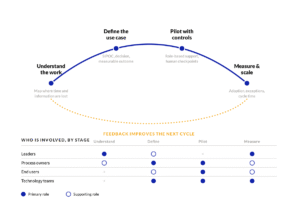
Your AI Strategy Is an Enablement Strategy
Tools will change. Teaching employees only the steps in one platform creates a narrow capability. Involving them in problem definition, process mapping, data assessment, controls, and measurement gives the organization a way to improve its systems as technology evolves.
By-Right Permitting: The Missing Lever for Scaling Modular Multifamily
Modular has already proven it can outperform traditional building methods on speed and cost per unit. The next frontier is outside the factory in the front end of the process, where projects either clear a path to construction or get stuck in review.
Remote Inspections and The Future of Factory Oversight
Remote inspection is becoming a practical part of modular construction oversight. Its value is greatest when it is used selectively, governed by clear procedures, and supported by complete traceability.
Reimagining Dry-In: How a Temporary-to-Permanent Roofing Strategy Mitigates Risk Between Modular Installation and Final Roof Construction
As volumetric modular projects continue to increase in scale and complexity, the Temporary-to-Permanent FiberTite Roof System represents an example of how traditional trade scopes can be reimagined through Design for Manufacturing and Assembly (DfMA) principles.