
From Volume to Velocity: Scaling Multi-Family Projects Without Losing Control
How modular builders can meet rising demand without sacrificing flow, quality, or profitability.

Daniel Small is the Founder & CEO at Da Vinci Consulting
Introduction: The Scaling Trap
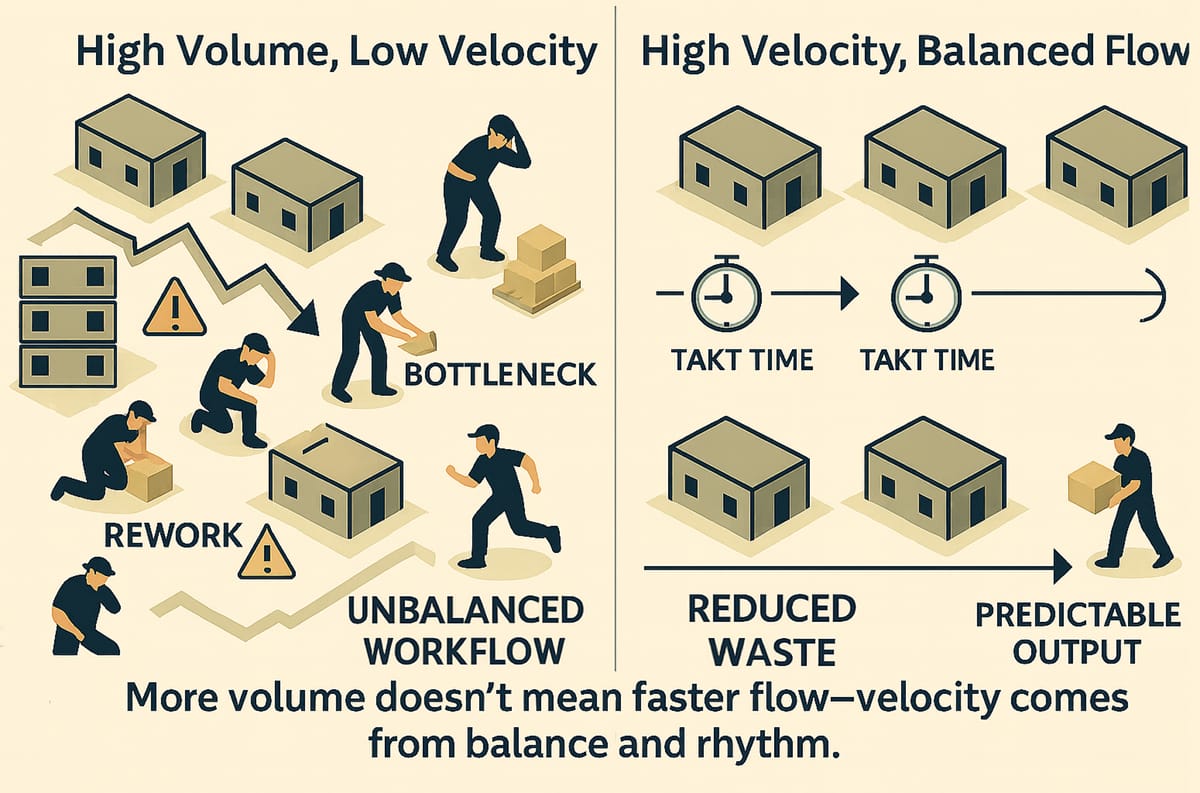
All around the world, the need for modular multi-family housing is growing fast. Cities, developers, and nonprofits are turning to modular to solve housing shortages. But as factories try to build more units quickly, they often learn a hard lesson: more volume doesn’t always mean more profit.
When projects grow too fast without the right systems, factories run into problems. They miss deadlines, crews burn out, and quality drops. Instead of steady progress, chaos takes over. Things slow down, even with more units going through. That’s because building more isn’t enough—you also need to build smarter. That means shifting focus from volume to velocity.
The Volume–Velocity Disconnect
Volume means how many modules you build. Velocity means how fast and smoothly they move through the factory and into the field—on time, on budget, and with good quality. Many teams think that more volume equals more output. But if your flow is broken, more volume just creates more problems.
Imagine a factory that doubles its weekly goal from 10 to 20 modules. If the stations aren’t balanced and the process isn’t stable, the result will be delays, overtime, rework, and piles of inventory. The factory doesn’t get faster—it just gets messier.
Velocity is what makes growth sustainable. It tells you whether your process can keep up with demand without breaking. It’s not just about how much you build—it’s how well you build it, every time.
Lean Flow as the Foundation for Scaling
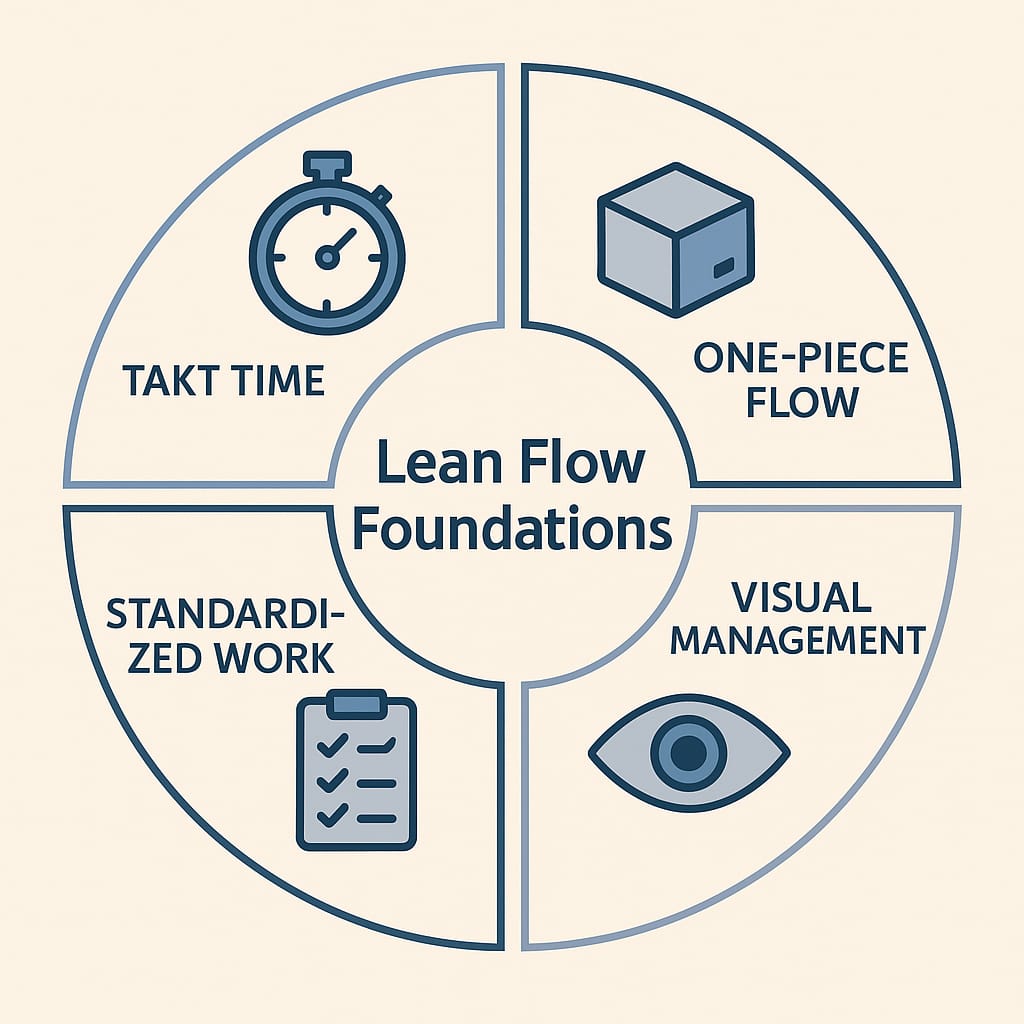
To grow without chaos, you have to build the right system first. That starts with Lean principles:
- Takt time: Set a steady rhythm that matches demand.
- One-piece or small-batch flow: Keep work moving without piles of unfinished parts.
- Standardized work: Make sure each task is done the same way, every time.
- Visual management: Use simple tools to spot problems quickly.
Lean thinking creates flow. It helps you grow in a way that’s stable and repeatable. If you try to scale without flow, you’ll be fighting fires every day. If you build flow first, scaling becomes much easier.
Systems to Stabilize Multi-Family Production
Multi-family modules are more complex than single-family units. They have more electrical, plumbing, and layout challenges. That means your process has to be even more reliable.
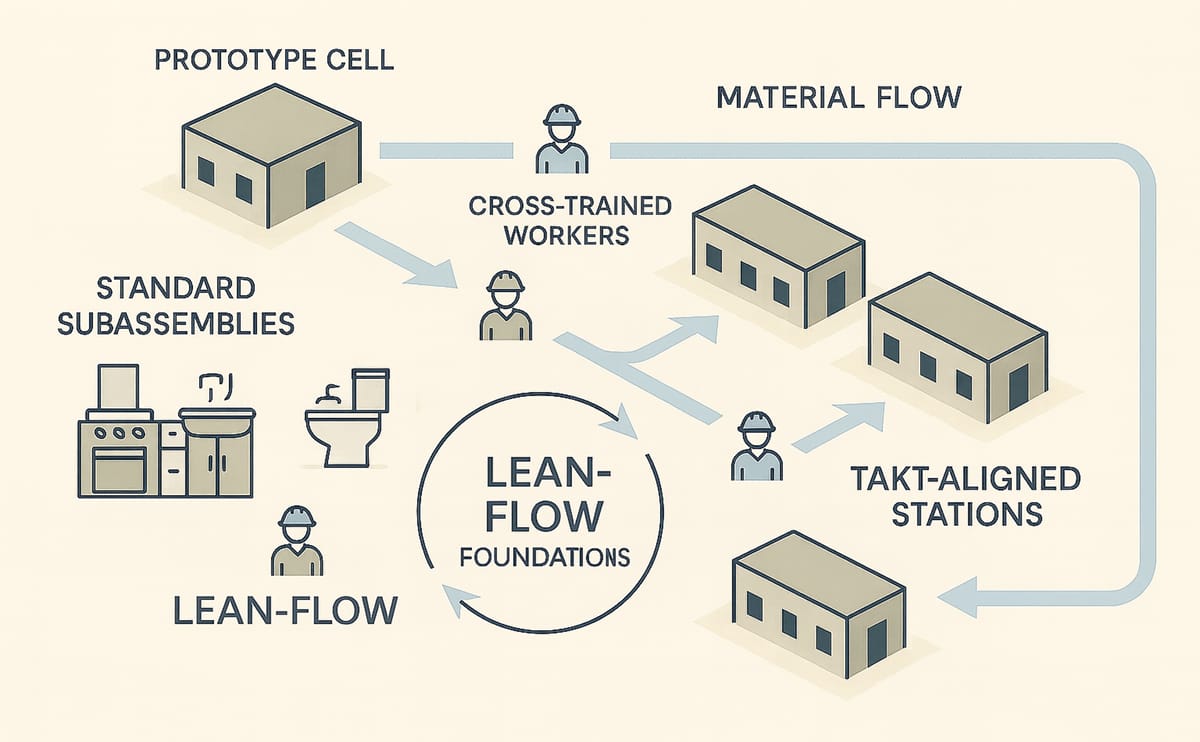
Here are smart ways to make your system ready for growth:
- Takt-based planning: Break work into chunks that match your production rhythm.
- Separate prototypes: Don’t test new designs on the main line—use a side cell.
- Standardize subassemblies: Build repeatable kitchens, bathrooms, and wall sections.
- Repeat core templates: Even in custom buildings, reuse the same module structures.
- Cross-train crews: Let team members work across stations to keep flow moving.
Also watch your labor and equipment balance. As you grow, new bottlenecks will appear. Track them daily and adjust before they slow you down. When production is steady and balanced, you can grow without stress.
Data-Driven Control During Scale-Up
You can’t manage what you can’t see. As your projects grow, you need data to stay on track.
Watch these key signals:
- Takt time tracking: Are tasks finishing on schedule?
- Inventory buildup: Are unfinished modules piling up?
- First-time quality: Are mistakes getting fixed early—or passed downstream?
- Throughput variation: Are you hitting your daily targets?
Dashboards, boards, and real-time tools help your team see what’s working—and what’s not. When workers can spot and fix problems right away, they become owners of the process, not just task-doers.
Scaling Without Losing the Client
If your factory is in chaos, your clients will feel it. Missed deadlines and sloppy communication hurt trust. As you grow, your coordination with clients and field teams must improve too.
To keep clients happy:
- Lock in designs early.
- Align deliveries with field and crane readiness.
- Set clear checkpoints for design, buying, and production.
- Communicate fast when delays come up.
One factory kept a 300-unit project on track by using a pull schedule. They only released modules when the site was ready. That simple move kept everyone aligned and avoided a huge backlog.
Your factory and field should run as one team. Without that link, even the best factory process can’t fix site problems.
Conclusion: Start Small, Scale Smart
In modular construction, success isn’t just how many modules you build. It’s how consistently you deliver—on time, on budget, and with pride in the product.
Before you ramp up, ask: Are we flowing well right now? If not, don’t scale yet. Fix the flow first. Because scaling a broken process just makes a bigger mess.
The secret to modular growth isn’t speed—it’s stability. If you build steady flow now, you’ll be ready to grow fast later. That’s how you scale smart, keep your teams strong, and earn your clients’ trust.
Real growth isn’t just bigger. It’s better, faster, and smoother. And it all starts with flow.
More from Modular Advantage

Mind the Gap: The Interface Between Onsite and Offsite Construction
Every design for manufacture and assembly (DfMA) project — modular, mass timber, or panelized — is really two projects joined at a seam. One is built in a controlled factory to millimeter tolerances; the other in the field, in weather, to the looser tolerances of poured concrete and human hands. Between them sits an interface: where the factory’s precision meets the site’s reality.
Rules, Rails & Repeatability: Applying DfMA to Modular Healthcare
DfMA offers several advantages for healthcare projects, with faster delivery among the most valuable. Schedule matters when building new facilities, expanding campuses, renovating existing space or bringing care closer to communities that need it.
Precision and Possibility: Demands of DfMA and What Modular Mass Timber Makes Possible
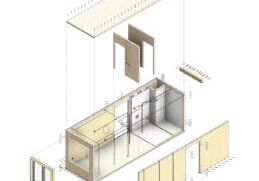
Mass timber does not automatically create an efficient modular building. Its precision makes early coordination more important: fabricated components will accurately reproduce both the team’s solutions and its mistakes. The material’s advantages are realized only when supported by an equally precise design and delivery process.
Catch It in the Factory, Not in the Field: Smarter Testing for Modular Builds
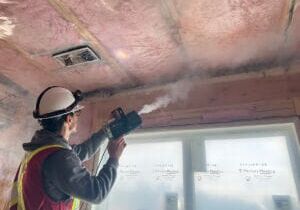
Integrating watertightness and airtightness testing into factory workflows transforms quality assurance from a reactive process into a proactive commissioning strategy. It ensures that every module shipped is field ready and resilient for transportation while also supporting the ability of the modular construction industry to make buildings better.
Modular Construction Contracts: Key Considerations for Successful Canadian Projects
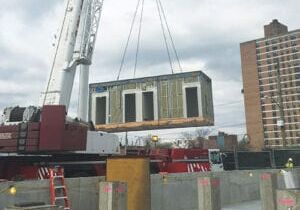
Starting a modular project with a well-developed contract protects both the owner and the contractor. It will help keep the project on track and on budget, and it will improve quality from the factory floor to final installation on-site.
Modular by Design: Turning Architecture into a Manufacturing System
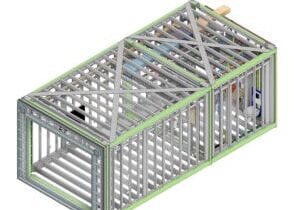
Modular construction is often presented as a faster way to build. Speed, however, is only one part of its value. The larger opportunity is to create a coordinated design and production system that improves quality, reduces uncertainty, and allows a building to move efficiently from concept design through manufacturing, transportation, installation, and completion.

Repeatability Begins with Trust: What Alora at Dry Creek Reveals About Scaling Modular Housing
Alora at Dry Creek, a 329-unit, multifamily community comprising five four-story buildings in Centennial, Colorado, demonstrates how repeatable design, standardized manufacturing and early collaboration can work together to create a model that is not only faster to deliver, but easier to replicate across future projects.

T.R. Arnold: The Art of Third-Party Inspections
T.R. Arnold (TRA), a third-party inspection company in Elkhart, Indiana, contracts with modular manufacturers across the US. Manufacturers register with each state to which they intend to send their modules and may be required to hire a third-party inspection company.

Creating an ‘Ecosystem for Innovation:’ 50+ Years of Modular Construction Oversight in Virginia
Virginia’s modular building program began in 1973, with the implementation of the Virginia Industrialized Building Unit and Mobile Home Safety Regulations. Now it’s leading the country in modular code adoption.
Understanding Thermal Barriers Compliance Methods & Emerging NFPA-275 Foam Plastic Technologies
New fire barrier technologies are improving total costs and margins in major areas of construction, such as commercial, government, union and prevailing wage projects. These benefits translate into other large fringe areas, such as agriculture, commercial cold storage facilities, grow houses, outbuildings, military and aviation hangars.