The Digitalization of Offsite Construction: Trends & Best Practices to be Featured at World of Modular Europe
Digitalization and ever-advancing project modelling software have been aiding traditional manufacturers, builders, and designers for years. More recently, tech-savvy modular and offsite construction stakeholders have also embraced these tools, adding their own knowledge and data to create newer, faster, more efficient ways of building. Together with quickly-evolving AI-powered tools, these builders are now pushing the boundaries of what’s possible with offsite construction. In an effort to expand that knowledge across the industry, the Modular Building Institute (MBI), the world’s largest international trade association for the commercial modular construction industry, is bringing its premier event to Brussels, Belgium, in October, 2024.
World of Modular Europe, an international conference hosted by MBI on 1-2 October, will feature speakers, exhibitors, and attendees from across Europe and around the globe. In addition to manufacturers and designers, World of Modular Europe will feature some of the leading voices in the use of BIM, digital twins, and AI in offsite construction. The two-day conference will offer key insights, best practices, and the opportunity to meet leaders and stakeholders from every corner of European industry.
How is Digitalization Changing Offsite Construction?
“Digitalization hasn't fully changed the offsite construction sector yet,” says Charlotte Garret, Head of Industry Strategy at KOPE and speaker at World of Modular Europe. “While designers and project managers have made progress using advanced BIM models and project management tools, these improvements often stay within individual projects or with specific designers or supplier who have invested in the technology. This means a large part of the supply chain, especially manufacturers and suppliers, misses out on these digital advancements.”
“There needs to be industry-wide standards and platforms to make digitalization and integration of products and processes seamless,” continues Garret. “Offsite construction methods are already standardized and rule-based, making them ideal for digitalization.”
“Digitization and BIM are the keys to success for offsite construction,” adds Kris Droszcz, Founder of Poland-based Rebel Concept and fellow World of Modular Europe presenter. “By having all your project data in a detailed BIM model we can easily collect information about a project’s materials, cost, or count. In fact, we have created our own Revit addons and developed scripts to automate those processes. And by using AI-based tools, we have increased our efficiency significantly.”
The Value of Data
With the growing importance of digital building tools, there’s another element of construction projects that’s becoming arguably more valuable than the project itself: big data.
“Having correct data available any time you need it saves time and money but also ensures the safety of the structure,” says Droszcz. “It gives insight into the full life cycle of the building. And from a design standpoint, it allows you to control standards and the quality of the project. For example, if you are working in different countries and you have to trace all material certificates and codes for local markets, it is easy to switch between the standards and metrics of different regions instead of redesigning your project from scratch.”
“To unlock its full potential,” adds Garrett, “data must be standardized, complete, structured, and readily accessible. This will provide us in the industry with valuable insights that will help us improve versatility and interoperability, enabling seamless integration across teams and applications and facilitating quick comparisons and informed decisions.
“With reliable data at their fingertips, designers can identify and tailor solutions quickly and easily to meet client requirements, supported by reliable insights.”
Educating the Industry in Brussels
World of Modular Europe will offer attendees the chance to learn and converse directly with Garrett, Droszcz, and dozens of other modular and offsite construction industry leaders.
“I have been attending MBI’s World of Modular in the United States for years,” says Droszcz, “and I am happy that it’s finally beginning to grow here in Europe. Europe has great manufacturers, engineers and architects that can share knowledge during these events, and I believe that collaboration and learning from each other is the best thing we can do to grow offsite modular industry together.”
Droszcz believes his presentation will be of particular interest to fellow design professionals. “I will show the real value of design tools and DfMA using automation scripts in BIM software that improves the efficiency of a project from start to finish.”
Garrett is equally excited for her presentation.

As Head of Industry Strategy at KOPE, Charlotte Garrett works closely with partner organizations and clients in the offsite construction sector, understanding their specific needs and challenges, and demonstrating how KOPE’s platform can streamline their design and project delivery processes. By aligning its software capabilities with its clients’ operational requirements, KOPE ensures that it effectively supports its clients’ goals of efficiency, quality, and scalability.

As an architect, founder and CEO of Rebel Concept, and founder and partner at iQ module / Bud-Invest Group, Krzysztof Droszcz has experience in architectural design, business development, modular and offsite technology, engineering, and construction. His companies collaborate with clients to design, manufacture, and QC modular buildings from the ground up using a variety of innovative AR-, VR-, and AI-powered tools.
“I will explore the ecosystem of demand, development, and deployment,” says Garrett, “highlighting the crucial role of standardization within this framework. By standardizing technical systems, repeatable processes, and stable relationships, we can streamline operations, enhance predictability, and foster continuous innovation.
“One of the key points of the presentation,” adds Garrett, “will be addressing the hurdles we face in delivering scalable solutions, including issues of visibility, variation, and verification. I will talk through some UK initiatives that have successfully navigated these challenges and where I think they should go next, offering valuable lessons for construction.”
“Digitization is a necessity and there is no other way to follow today’s trends and speed without it,” concludes Droszcz. “AI is a powerful tool, too, capable of analyzing big data in moments that would take a human much, much longer. AI is not a substitute, though; we should only be using it to assist us. At World of Modular Europe, attendees will learn how.”

World of Modular Europe, presented by the Modular Building Institute, comes to Brussels on 1-2 October.
Join the Industry in Brussels, 1-2 October, 2024
"I'm so excited about the opportunity to connect with forward-thinking professionals from across the construction industry," says Garrett. "It’s inspiring to share ideas and collaborate on innovative solutions that can drive our industry forward.”
See all speakers and presentations from the 2024 World of Modular Europe.
About the Author: John McMullen, PCM, is the marketing director for the Modular Building Institute. You can reach him directly at mcmullen@modular.org or on LinkedIn.
More From Modular Advantage

Mind the Gap: The Interface Between Onsite and Offsite Construction
Every design for manufacture and assembly (DfMA) project — modular, mass timber, or panelized — is really two projects joined at a seam. One is built in a controlled factory to millimeter tolerances; the other in the field, in weather, to the looser tolerances of poured concrete and human hands. Between them sits an interface: where the factory’s precision meets the site’s reality.
Rules, Rails & Repeatability: Applying DfMA to Modular Healthcare
DfMA offers several advantages for healthcare projects, with faster delivery among the most valuable. Schedule matters when building new facilities, expanding campuses, renovating existing space or bringing care closer to communities that need it.
Precision and Possibility: Demands of DfMA and What Modular Mass Timber Makes Possible
Mass timber does not automatically create an efficient modular building. Its precision makes early coordination more important: fabricated components will accurately reproduce both the team’s solutions and its mistakes. The material’s advantages are realized only when supported by an equally precise design and delivery process.
Catch It in the Factory, Not in the Field: Smarter Testing for Modular Builds
Integrating watertightness and airtightness testing into factory workflows transforms quality assurance from a reactive process into a proactive commissioning strategy. It ensures that every module shipped is field ready and resilient for transportation while also supporting the ability of the modular construction industry to make buildings better.
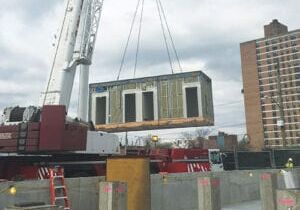
Modular Construction Contracts: Key Considerations for Successful Canadian Projects
Starting a modular project with a well-developed contract protects both the owner and the contractor. It will help keep the project on track and on budget, and it will improve quality from the factory floor to final installation on-site.
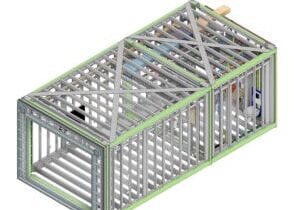
Modular by Design: Turning Architecture into a Manufacturing System
Modular construction is often presented as a faster way to build. Speed, however, is only one part of its value. The larger opportunity is to create a coordinated design and production system that improves quality, reduces uncertainty, and allows a building to move efficiently from concept design through manufacturing, transportation, installation, and completion.

Repeatability Begins with Trust: What Alora at Dry Creek Reveals About Scaling Modular Housing
Alora at Dry Creek, a 329-unit, multifamily community comprising five four-story buildings in Centennial, Colorado, demonstrates how repeatable design, standardized manufacturing and early collaboration can work together to create a model that is not only faster to deliver, but easier to replicate across future projects.

T.R. Arnold: The Art of Third-Party Inspections
T.R. Arnold (TRA), a third-party inspection company in Elkhart, Indiana, contracts with modular manufacturers across the US. Manufacturers register with each state to which they intend to send their modules and may be required to hire a third-party inspection company.

Creating an ‘Ecosystem for Innovation:’ 50+ Years of Modular Construction Oversight in Virginia
Virginia’s modular building program began in 1973, with the implementation of the Virginia Industrialized Building Unit and Mobile Home Safety Regulations. Now it’s leading the country in modular code adoption.
Understanding Thermal Barriers Compliance Methods & Emerging NFPA-275 Foam Plastic Technologies
New fire barrier technologies are improving total costs and margins in major areas of construction, such as commercial, government, union and prevailing wage projects. These benefits translate into other large fringe areas, such as agriculture, commercial cold storage facilities, grow houses, outbuildings, military and aviation hangars.