
Understanding Thermal Barriers Compliance Methods & Emerging NFPA-275 Foam Plastic Technologies

Richard Barrone is the EVP of Marketing Operations at Firestable Insulation Company
Over the past several decades, plastic has been increasingly used in the construction industry, and with more plastics in buildings, the International Building Code® (IBC) has had to update its requirements to address the flammability of these plastics.
It was at the point of the proliferation of plastics and composites that the thermal barrier section of the IBC (and chapter 26, specifically) came into useable existence. However, as “thermal barrier” is a term used specifically for the fire rating of a building element, It can easily be confused with terms such as “thermal insulation” or “thermal bridging.” Both All relate to the transference of heat or cold through building materials. However, a thermal barrier, as defined by the IBC, is very specific to heat and fire as it relates to safety.
Underwriters Laboratories (UL) describes thermal barriers as “a material or product that prevents or delays the ignition of a flammable surface, such as foam plastic insulation or metal composite material, in the event of a fire.”
Now entering the marketplace is a new fire barrier, foamed-in-place insulation that overcomes major fire barrier challenges, including thermal barrier code compliance while providing less risk and saving builders time and money on materials, labor and fewer installation steps. Let’s dig in.
The World of IBC Chapter 26 and Thermal Barrier Options
According to the Code, all plastics installed in the building envelope require an additional step for a thermal barrier. IBC Section 2603.4 defines thermal barrier and various deviations, derivatives or direct compliance approaches to allow the safe application of plastics.
Figure one illustrates three of the four methods:
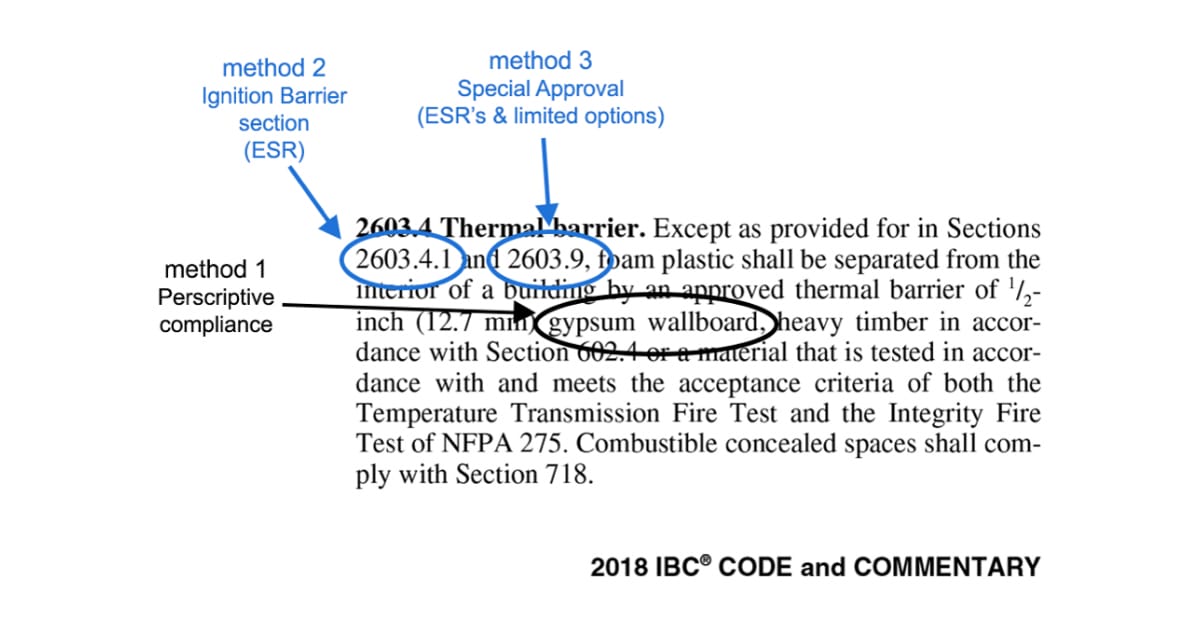
Figure 1
There’s also a fourth ‘equivalent’ compliance method that identifies a multi-test test protocol (National Fire Protection Association – NFPA 275) for achieving an equivalent rating to gypsum (Figure 2). Any product that strives to be equivalent to ½” gypsum must meet this protocol.
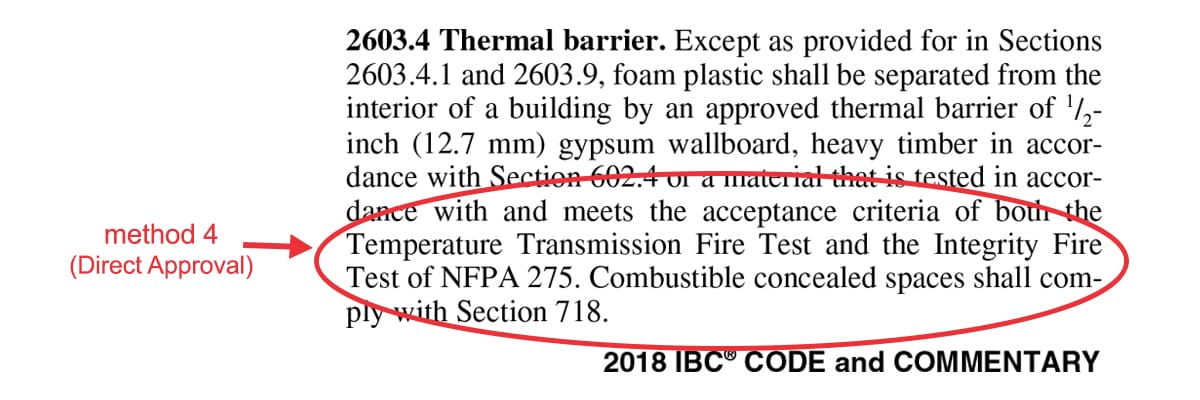
Figure 2
If an insulation material that meets NFPA-275 standards can also serve as a thermal barrier, then post-added thermal barriers (for specific use and requiring multiple steps) can be eliminated.
Past Solutions – “Add-on” Thermal Barrier Products Over Plastics
Historically, spray polyurethane foam (SPF) met code by being applied behind gypsum (method one) or covered with approved, add-on thermal barriers, i.e., cellulosic and cementitious materials. SPF could also comply with the code through “exception” methods using lower-level ignition barrier approval (method two) or special approval testing (method three).
When choosing one of these methods, the questions are:
- Which test(s) should be used?
- Which combination of coatings, cellulose or cementitious materials should be used?
- Over which foams?
- At which thickness?
- In which densities?
Addressing all combinations of SPF/coating/cellulose/cementitious solutions and the appropriate paperwork required by building officials is a separate topic in and of itself and beyond the scope of this article.
Simplifying this confusion and expediting safety, emerging in the market are spray foam insulation products that have the NFPA 275 thermal barrier already built in. Let’s learn the benefits.
Monolithic Fire Performance
Current post-applied “exception-based” thermal barrier solutions become daunting when trying to ensure correct, safe application; they need to be properly applied, require third-party inspection, and are utilized only in “conditioned spaces.” Also, as soon as the thermal barrier is breached, the fire protection of the flammable substrate is lost.
NFPA-275 SPF products achieve fire performance monolithically. The foam fire barrier is built into the composite and is protective throughout the complete volume of the insulation ─ against fires from the outside in, and inside out.
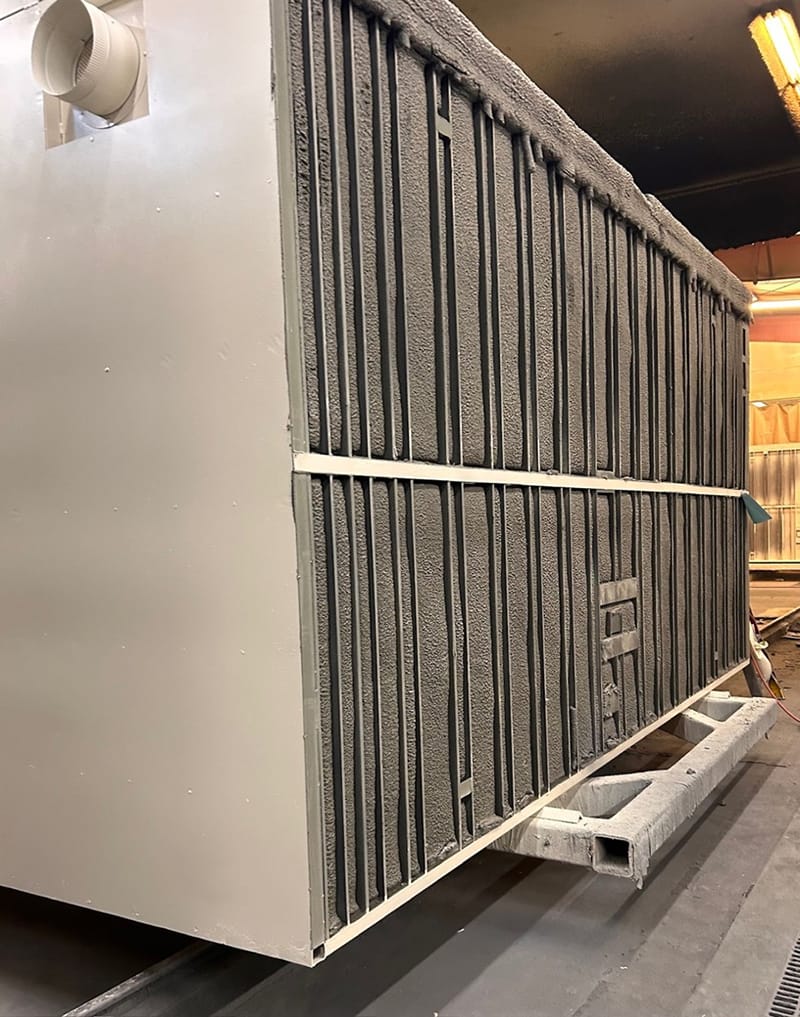
A modular partition wall between rooms, insulated with Fire rated closed cell foam. Provides 1 step High R value, moisture, vapor and fire compliance, eliminated materials, steps and possible code problems.
With thermal barrier technologies in NFPA 275 foam, the benefits of continuous insulation, air and moisture barrier, mold defense, structural rigidity and high-insulation value are still maintained. Monolithic fire protection means safer solutions, fewer added steps and materials, less cost and risk, versus a post-applied thermal barrier coating, cellulose, etc.
Reducing Risk Window
NFPA-275 foam becomes an effective fire barrier as soon as the chemical reaction finishes. Fire safety is “built-in” as soon as the foam reaction is complete, providing a “zero risk window” and is very different from traditional methods where flammable plastic insulation materials, both panels and continuous, require an additional thermal barrier post installation. That gap in time waiting for the post-applied thermal barrier poses a life-safety risk and liability.
Embracing the Benefits
What does this mean for contractors and builders? At the end of the day, they care about better value. NFPA-275 thermal barrier high-R insulation liquids cost slightly more initially. However, the total costs, including speed of installation, overall quality and end-user impact generate significant value across the complete construction hierarchy, resulting in significant cost savings, with costs decreasing as market penetration increases.
These new technologies are improving total costs and margins in major areas of construction, such as commercial, government, union and prevailing wage projects. These benefits translate into other large fringe areas, such as agriculture, commercial cold storage facilities, grow houses, outbuildings, military and aviation hangars.
The elimination of steps translates into lower costs, more efficient installations, and most importantly, a safer building and lower risk for the loss of life and property…a true trifecta of value.
More from Modular Advantage

Mind the Gap: The Interface Between Onsite and Offsite Construction
Every design for manufacture and assembly (DfMA) project — modular, mass timber, or panelized — is really two projects joined at a seam. One is built in a controlled factory to millimeter tolerances; the other in the field, in weather, to the looser tolerances of poured concrete and human hands. Between them sits an interface: where the factory’s precision meets the site’s reality.
Rules, Rails & Repeatability: Applying DfMA to Modular Healthcare
DfMA offers several advantages for healthcare projects, with faster delivery among the most valuable. Schedule matters when building new facilities, expanding campuses, renovating existing space or bringing care closer to communities that need it.
Precision and Possibility: Demands of DfMA and What Modular Mass Timber Makes Possible
Mass timber does not automatically create an efficient modular building. Its precision makes early coordination more important: fabricated components will accurately reproduce both the team’s solutions and its mistakes. The material’s advantages are realized only when supported by an equally precise design and delivery process.
Catch It in the Factory, Not in the Field: Smarter Testing for Modular Builds
Integrating watertightness and airtightness testing into factory workflows transforms quality assurance from a reactive process into a proactive commissioning strategy. It ensures that every module shipped is field ready and resilient for transportation while also supporting the ability of the modular construction industry to make buildings better.
Modular Construction Contracts: Key Considerations for Successful Canadian Projects
Starting a modular project with a well-developed contract protects both the owner and the contractor. It will help keep the project on track and on budget, and it will improve quality from the factory floor to final installation on-site.
Modular by Design: Turning Architecture into a Manufacturing System
Modular construction is often presented as a faster way to build. Speed, however, is only one part of its value. The larger opportunity is to create a coordinated design and production system that improves quality, reduces uncertainty, and allows a building to move efficiently from concept design through manufacturing, transportation, installation, and completion.

Repeatability Begins with Trust: What Alora at Dry Creek Reveals About Scaling Modular Housing
Alora at Dry Creek, a 329-unit, multifamily community comprising five four-story buildings in Centennial, Colorado, demonstrates how repeatable design, standardized manufacturing and early collaboration can work together to create a model that is not only faster to deliver, but easier to replicate across future projects.

T.R. Arnold: The Art of Third-Party Inspections
T.R. Arnold (TRA), a third-party inspection company in Elkhart, Indiana, contracts with modular manufacturers across the US. Manufacturers register with each state to which they intend to send their modules and may be required to hire a third-party inspection company.

Creating an ‘Ecosystem for Innovation:’ 50+ Years of Modular Construction Oversight in Virginia
Virginia’s modular building program began in 1973, with the implementation of the Virginia Industrialized Building Unit and Mobile Home Safety Regulations. Now it’s leading the country in modular code adoption.
Financing the Future of Modular Construction: How Better Capital Strategies Can Help the Industry Scale
The future of construction will not be solved by one product, one lender, or one financing model. It will be solved by matching the right project with the right capital strategy.