
Building a Stronger Voice for Modular Construction in the Benelux
Modular Building Institute (MBI) members have helped strengthen MBI’s presence in Europe with the creation of “MBI Benelux,” an informal regional group comprised of MBI-member companies in Belgium, the Netherlands, and Luxembourg.
The group grew out of a gathering of modular construction companies in Eindhoven in January 2026. It was formally established on April 16 at CORAM in Zaltbommel, the Netherlands. Its mission is to unite industry partners, increase awareness of MBI, and give the sector a stronger voice with developers, policymakers, and other decision-makers.
The MBI Benelux group is led by three chairs whose companies represent different parts of the modular construction supply chain.
Rob Ranshuysen is affiliated with CORAM, a manufacturer of bathroom and shower products that can be integrated into factory-built bathroom pods and other standardized modular applications. Lawrence De Bruycker works with ARDEX, a construction materials company with a dedicated prefab, modular, and offsite division. Pieter Schoofs represents Skilpod, a Belgian modular housing company that manufactures complete timber-frame homes as three-dimensional modules before installing them on site.
MBI spoke with the three chairs about the group’s formation, the outlook for modular construction in the region, and the upcoming World of Modular Europe conference in Amsterdam.

ARDEX's Lawrence De Bruycker, Skilpod's Pieter Schoofs, and CORAM's Rob Ranshuysen formed the MBI Benelux group to further expand the partnerships and opportunities for MBI members—and the modular construction industry at-large—in the Benelux region.
MBI: What prompted these gatherings of MBI members in the Benelux region, and what has the group discussed during its recent meetings?
MBI Benelux: The group was created to strengthen collaboration among modular construction companies throughout the Benelux region and establish a stronger regional voice within MBI.
Demand for industrialized construction is increasing, while governments are paying greater attention to housing shortages, sustainability, and construction labor shortages. Members recognized that companies across Belgium, the Netherlands, and Luxembourg could benefit from sharing their experiences and identifying common priorities.
Our discussions have covered market developments, differences in national regulations and building codes, standardization, cross-border business opportunities, workforce challenges, sustainability, and preparations for World of Modular Europe.
We have also discussed how to improve understanding of modular construction among developers, policymakers, financial institutions, housing organizations, and public-sector clients. Many decision-makers still lack experience with modular delivery, so education will be a major part of the group’s work.
MBI: Where do you see the greatest opportunities for modular construction in the Benelux region?
Stick-built construction struggles to be reliably by-right for a simple reason, every project is custom. Even two buildings from the same architect vary once site conditions, subcontractors, and value engineering enter the picture, so a jurisdiction can't fully trust a one-time compliance check because no two projects are actually the same. That's a large part of why discretionary review became the default in the first place.
Modular inverts that logic. A manufactured product is, by definition, uniform — the same unit, built the same way, batch after batch. A manufacturer can engineer a product once against a fixed set of by-right conditions — setbacks, height, density, materials — and every unit that comes off the line afterward already satisfies them. It is important to understand that even within modular construction, manufacturers are still able to customize the unit to customer-specifics to some degree.
One-off stick-built design has to evaluate each specific project on its own terms. A planning department reviewing a modular product that's already been engineered to a known, repeatable by-right specification is merely confirming. The review essentially boils down to "does this match the spec we already approved?" That's a dramatically lighter lift for city staff, and faster to process, harder to contest, and easier to scale across many projects without adding headcount. Uniformity is what makes by-right scalable, for the jurisdiction as much as for the builder.
MBI: What challenges are modular companies encountering in the region?
MBI Benelux: Many of the challenges are similar to those found elsewhere in Europe. Companies face rising material costs, shortages of skilled workers, financing uncertainty, and lengthy permitting processes.
However, the Benelux market has some distinct characteristics. Land is limited, which makes logistics, transportation, staging, and project planning especially important. Building regulations also differ among neighboring countries, complicating efforts to scale products and projects across borders.
Terminology and public perception remain obstacles as well. People frequently use terms such as prefab, modular, and volumetric interchangeably. Some clients still assume modular buildings are temporary or lower quality. Consistent language and stronger examples of completed projects can help correct those misconceptions.
Project procurement also needs to change. Clients often select modular manufacturers too late in the process. When manufacturers and suppliers are not involved early in design, project teams lose many of the advantages associated with Design for Manufacturing and Assembly.
Cash flow presents another serious concern. Modular manufacturers frequently carry high overhead costs and must purchase materials and begin production before receiving full payment. Irregular order pipelines, permitting delays, and project postponements can place severe financial pressure on small and mid-sized factories.
MBI: How can MBI Benelux help address these issues?
MBI Benelux: Our first responsibility is to bring companies together. The industry will have greater influence when manufacturers, suppliers, designers, developers, and other partners communicate through a unified organization.
We also want to improve education. Presentations, factory visits, project tours, and meetings can help government officials, housing associations, lenders, developers, and architects better understand how modular construction works.
Advocacy will be important as well. MBI’s presence in Brussels gives members a connection to European institutions and policy discussions. The group can help members follow regulatory developments, understand their potential effects, and communicate the industry’s needs to policymakers.
MBI Benelux is now developing a roadmap, expanding recruitment, and building stronger connections with municipalities, architects, developers, and other industry stakeholders.
Capitalizing on World of Modular Europe
Hosting World of Modular Europe 2026 in Amsterdam gave the Benelux region an opportunity to showcase its innovation, engineering expertise, and manufacturing capabilities.
The conference allowed attendees to exchange knowledge with industry leaders, examine successful projects, build partnerships, and discuss standardization and new technologies.
It also helped demonstrate how modular construction can contribute to affordable housing, sustainability, productivity, and economic growth. The conference brought policymakers, architects, developers, contractors, manufacturers, and suppliers together and underscored the need for partnerships to move the industry forward.
Most importantly, the conference showed that modular construction in Europe is no longer a niche concept. The industry has matured, the need is clear, and the Benelux region is prepared to play a leading role.
More from Modular Advantage
From Amsterdam to Brussels: How MBI Is Strengthening Europe’s Modular Construction Voice
By the end of 2026 MBI’s Government Affairs team will have traveled over 6,000 air miles to bring Town Hall events to five different cities in two countries.
From Model to Machine: Why Modular Scale Is Becoming a Software Problem, not a Material One
For modular manufacturers that have already secured demand and repeatable volume, the next major constraint may no longer be forming capacity itself. Increasingly, it is the continuity of the information feeding that capacity.
Who Will Define Modular Products for AI?
Artificial intelligence is making building configurators easier and less expensive to create. This makes urgent manufacturers’ need portable product definitions, stable identities, and shared interfaces regardless of how others’ software is produced.
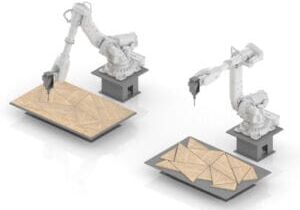
From BIM to Robotic Production: A Digital Workflow for Customized Components in Volumetric Modular Construction
For volumetric modular manufacturers, the value of this workflow is not simply the use of robotics. Its real value is continuity.
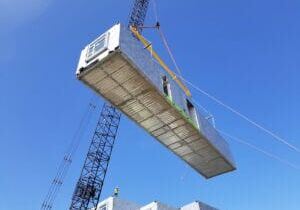
Helping Build a Common Framework for Modular Construction in Canada
Canada’s modular construction sector continues to gain momentum, but scaling it successfully will depend on shared expectations across design, manufacturing, approvals, and project delivery. CSA Z251 helps provide that common foundation.
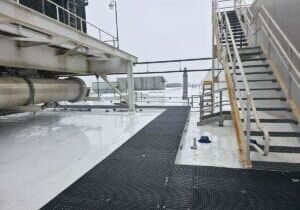
Edges, Exits & Equipment: A Modular Builder’s Guide to Rooftop Access
Rooftop access belongs in the factory design. Before the modules ship, the project team should identify each route’s users, confirm applicable requirements, coordinate with the roof system and structure, and assign responsibility.
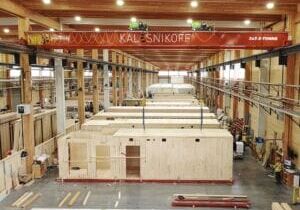
When Timber Production and Modular Construction Share One System
As demand for multifamily and workforce housing continues to outpace what conventional construction timelines can deliver, models that reduce the number of handoffs between structural fabrication and modular assembly are likely to draw more attention.
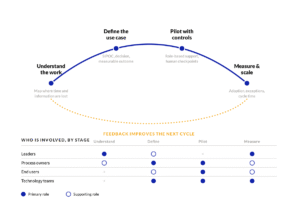
Your AI Strategy Is an Enablement Strategy
Tools will change. Teaching employees only the steps in one platform creates a narrow capability. Involving them in problem definition, process mapping, data assessment, controls, and measurement gives the organization a way to improve its systems as technology evolves.
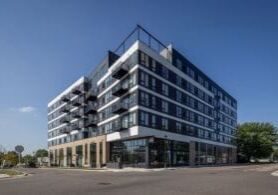
By-Right Permitting: The Missing Lever for Scaling Modular Multifamily
Modular has already proven it can outperform traditional building methods on speed and cost per unit. The next frontier is outside the factory in the front end of the process, where projects either clear a path to construction or get stuck in review.
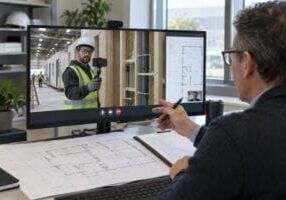
Remote Inspections and The Future of Factory Oversight
Remote inspection is becoming a practical part of modular construction oversight. Its value is greatest when it is used selectively, governed by clear procedures, and supported by complete traceability.